
Proposed Mechanism of Bacterial Hydroxyapatite Biosynthesis and Comparative Molecular Docking Analysis of Hydroxyapatite and Osteogenic Factors with Alkaline Phosphatase
Keywords:
Hydroxyapatite, osteogenic factors, dockingAbstract
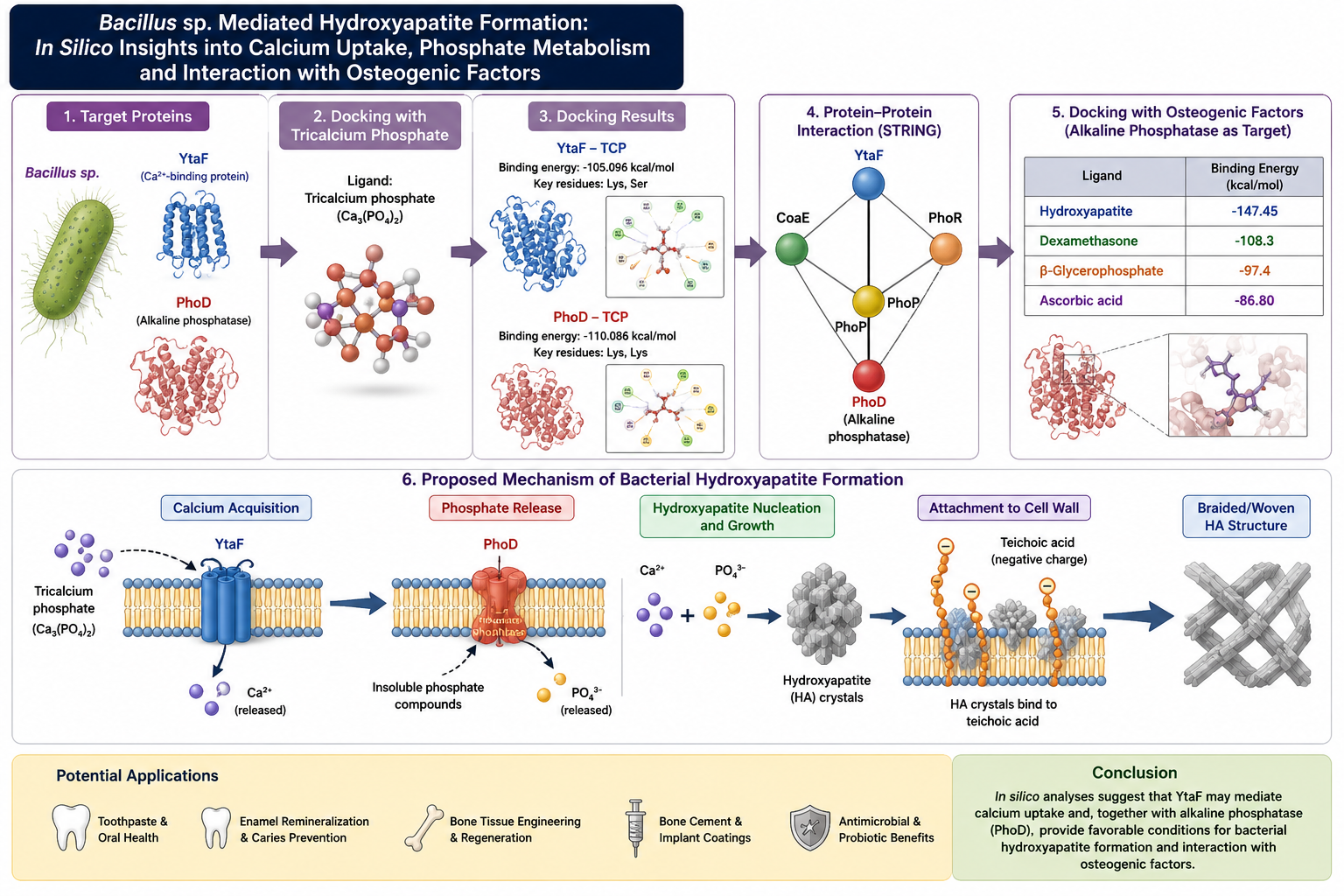
Hydroxyapatite is a biocompatible calcium phosphate mineral with extensive applications in bone tissue engineering and regenerative medicine. This study investigated the probable molecular mechanism of bacterial hydroxyapatite biosynthesis and evaluated the predicted interaction of hydroxyapatite with an osteogenic marker protein using in silico approaches. Molecular docking was performed using Molegro Virtual Docker, and protein–protein interactions were analyzed using the STRING database. Tricalcium phosphate showed favorable interactions with the Bacillus membrane proteins YtaF and alkaline phosphatase (PhoD), with binding energies of −105.096 and −110.086 kcal/mol, respectively. STRING analysis suggested a functional association between YtaF and proteins involved in alkaline phosphatase regulation, supporting a putative biomineralization pathway. Docking analysis of osteogenic compounds revealed that hydroxyapatite exhibited the strongest predicted interaction with alkaline phosphatase (−147.45 kcal/mol), followed by dexamethasone, β-glycerophosphate, and ascorbic acid. These findings provide a hypothetical framework for bacterial hydroxyapatite formation and suggest potential molecular interactions between hydroxyapatite and osteogenic pathways. Experimental validation is required to confirm these predictions.
Downloads
References
1. Hoveidaei, A.H., M. Sadat-Shojai, S. Mosalamiaghili, S.R. Salarikia, H. Roghani-Shahraki, R. Ghaderpanah, M.H. Ersi and J.D. Conway, Nano-hydroxyapatite structures for bone regenerative medicine: Cell-material interaction. Bone, 2024. 179: p. 116956. https://doi.org/10.1016/j.bone.2023.116956
2. Nouri, S., R. Roghanian and G. Emtizi, Review on Biological Synthesis of Nano-Hydroxyapatite and Its Application in Nano-Medicine. Iranian Journal of Medical Microbiology, 2021. 15(4): p. 369. https://doi.org/10.30699/ijmm.15.4.369
3. Fendi, F., B. Abdullah, S. Suryani, A.N. Usman and D. Tahir, Development and application of hydrox-yapatite-based scaffolds for bone tissue regeneration: A systematic literature review. Bone, 2024. 183: p. 117075. https://doi.org/10.1016/j.bone.2024.117075
4. Nouri, S., R. Roghanian, G. Emtiazi and R. Shafiei, Biosynthesis of nano-calcite and nano-hydroxyapatite by the probiotic bacteria of Bacillus subtilis and Bacillus coagulans. Applied Food Biotechnology, 2022. 9(4): p. 275-286. https://doi.org/10.22037/afb.v9i4.38768
5. Wang, X., S. Huang and Q. Peng, Metal ion-doped hydroxyapatite-based materials for bone defect restoration. Bioengineering, 2023. 10(12): p. 1367. https://doi.org/10.3390/bioengineering10121367
6. Emtiazi, G., F.A. Shapoorabadi and M. Mirbagheri, Chemical and Biological Synthesis of HydroxyApatite: Advantage and Application. Int J Microbiol Curr Res, 2019. 1(1): p. 20-2. https://doi.org/10.18689/ijmr-1000103
7. Paramasivan, M., T.S. Kumar, H. Kanniyappan, V. Muthuvijayan and T. Chandra, Microbial biomineralization of hydroxyapatite nanocrystals using Bacillus tequilensis. Ceramics International, 2023. 49(4): p. 5621-5629. https://doi.org/10.1016/j.ceramint.2022.10.138
8. Nouri, S., R. Roghanian, G. Emtiazi, O. Gunduz and R. Shafiei, Osteoblastic differentiation of stem cells from human exfoliated deciduous teeth by probiotic hydroxyapatite. Cell Journal (Yakhteh), 2023. 25(11): p. 753. https://doi.org/10.22074/cellj.2023.1999743.1276
9. Nouri, S., R. Roghanian, G. Emtiazi, O. Gunduz and R. Shafiei, The efficacy of probiotic mediated hydroxyapatite in mammalian cell culture: promotion of MG–63 and L–929, anti–MCF7 breast cancer cells activities, and cytokine production of PBMC. Emergent Materials, 2025. 8(3): p. 1715-1725. https://doi.org/10.1007/s42247-024-00828-5
10. Zhu, S., W. Chen, A. Masson and Y.-P. Li, Cell signaling and transcriptional regulation of osteoblast lineage commitment, differentiation, bone formation, and homeostasis. Cell discovery, 2024. 10(1): p. 71. https://doi.org/10.1038/s41421-024-00689-6
11. Lwin, H.Y., W. Tiskratok, M. Kyawsoewin, J. Manokawinchoke, C. Termkwanchareon, N. Limjeerajarus, C.N. Limjeerajarus, H. Egusa, T. Osathanon and P. Limraksasin, Shear Stress Regulates Osteogenic Differentiation of Human Dental Pulp Stem Cells via the p38 Pathway. International Journal of Molecular Sciences, 2025. 26(12): p. 5667. https://doi.org/10.3390/ijms26125667
12. Dorcheh, K.A., S. Hashemi-Najafabadi, E. Vasheghani-Farahani and A. Zarei-Dastgerdi, Cell Therapy using Multilayered Core-shell Microcapsules with Liquid or Semi-liquid Core for Bone Regeneration. BiotechIntellect, 2025. 2(1): p. e9 (1-14). https://doi.org/10.61882/BiotechIntellect.2.1.13
13. Chegini, M. and H. Zare, Advances in Microbial Biosurfactants: Sustainable Production, Diverse Microorganisms, and Eco-Friendly Substrates. BiotechIntellect, 2025. 2(1): p. e15 (1-19). https://doi.org/10.66224/BiotechIntellect.2.1.27
14. Abecasis, A.B., M. Serrano, R. Alves, L. Quintais, J.B. Pereira-Leal and A.O. Henriques, A genomic signature and the identification of new sporulation genes. Journal of bacteriology, 2013. 195(9): p. 2101-2115. https://doi.org/10.1128/jb.02110-12
15. Seidel, M., J. Bauer, C. Geiß and S. Gebhard, Decoding the functional role of the calcium ATPase YloB in microbially induced calcite precipitation and sporulation in Solibacillus silvestris. Microbiology, 2026. 172(3): p. 001687. https://doi.org/10.1099/mic.0.001687
16. Emami-Karvani, Z., A. Jenab and K. Jenab, Microbial Minds and Machine Models: Harnessing Artificial Intelligence to Revolutionize Microbiological Research. BiotechIntellect, 2025. 2(1): p. e10: 1-18. https://doi.org/10.61882/BiotechIntellect.2.1.7
17. Yu, X., J. Jiang, J. Liu and W. Li, Review on potential uses, cementing process, mechanism and syntheses of phosphate cementitious materials by the microbial mineralization method. Construction and Building Materials, 2021. 273: p. 121113. https://doi.org/10.1016/j.conbuildmat.2020.121113
18. Ojha, A., T.K. Bandyopadhyay and D. Das, A comprehensive review on microbial urease: features and industrial applications. Critical Reviews in Biotechnology, 2026. 46(1): p. 1-24. https://doi.org/10.1080/07388551.2025.2529589
19. Amaechi, B.T., A.I. Tan, A.A.K. Noureldin, K. Kanthaiah, E. Holladay, A.C. Obiefuna and M. Vijayaraghavan, In vitro evaluation of the ability of nanohydroxyapatite toothpastes to enhance remineralization of enamel caries lesion. Journal of Dentistry, 2025: p. 106006. https://doi.org/10.1016/j.jdent.2025.106006
20. Akbeyaz Şivet, E. and B. Kargül, Remineralization of artificial caries lesions using casein phosphopeptide–amorphous calcium phosphate containing probiotic lozenge: an in vitro study. BMC Oral Health, 2025. 25(1): p. 1086. https://doi.org/10.1186/s12903-025-06352-0
21. Komori, T., Molecular mechanism of Runx2-dependent bone development. Molecules and cells, 2020. 43(2): p. 168-175. https://doi.org/10.14348/molcells.2019.0244
22. Komori, T., Regulation of osteoblast differentiation by transcription factors. Journal of cellular biochemistry, 2006. 99(5): p. 1233-1239. https://doi.org/10.1002/jcb.20958
23. Stein, G.S., J.B. Lian, A.J. Van Wijnen, J.L. Stein, M. Montecino, A. Javed, S.K. Zaidi, D.W. Young, J.-Y. Choi and S.M. Pockwinse, Runx2 control of organization, assembly and activity of the regulatory machinery for skeletal gene expression. Oncogene, 2004. 23(24): p. 4315-4329. https://doi.org/10.1038/sj.onc.1207676
24. Nori, R. and P. Shariati, In Silico Molecular Docking of Plant-Derived Compounds Targeting PBP2a to Combat MRSA Antibiotic Resistance. BiotechIntellect, 2025. 2(1): p. e16 (1-7). https://doi.org/10.66224/BiotechIntellect.2.1.5
25. Yokoi, T., S. Tomita, J. Nakamura, A. Sugawara-Narutaki, Y. Matsukawa, M. Kawashita and C. Ohtsuki, Apatite Formation on α-Tricalcium Phosphate Modified with Bioresponsive Ceramics in Simulated Body Fluid Containing Alkaline Phosphatase. Biomimetics, 2024. 9(8): p. 502. https://doi.org/10.3390/biomimetics9080502
26. Nouri, S., G. Emtiazi, S. Ulag, O. Gunduz, A.C.C. Koyuncu, R. Roghanian, A. Moradi, R. Shafiei, A. Tukay and H.T. Sasmazel, Advanced 3D printed bone scaffolds with sodium alginate/Tri-calcium phosphate-probiotic bacterial hydroxyapatite: Enhanced mechanical and biocompatible properties for bone tissue engineering. Polymer, 2024. 311: p. 127523. https://doi.org/10.1016/j.polymer.2024.127523

Downloads
Published
Submitted
Revised
Accepted
Issue
Section
License
Copyright (c) 2026 Sabereh Nouri; Giti Emtiazi, Oguzhan Gunduz, Songul Ulag (Author)

This work is licensed under a Creative Commons Attribution-NonCommercial 4.0 International License.