
In Silico Molecular Docking of Plant-Derived Compounds Targeting PBP2a to Combat MRSA Antibiotic Resistance
Keywords:
Antibiotic resistance, Methicillin-Resistant Staphylococcus aureus (MRSA), Plant-based compounds, Curcumin, Quercetin, Molecular docking, In silico, Drug discoveryAbstract
Background: The escalating threat of antibiotic resistance, particularly in Methicillin-Resistant Staphylococcus aureus (MRSA), underscores the urgent need for novel therapeutic strategies. The PBP2a protein, encoded by the mecA gene, is a primary driver of MRSA resistance to beta-lactam antibiotics. This in silico study aims to identify plant-derived compounds with potential to inhibit PBP2a, offering alternatives to conventional antibiotics.
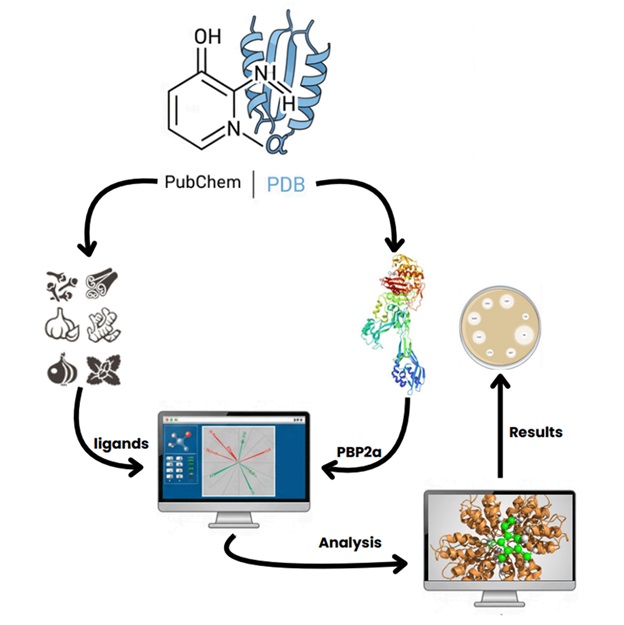
Materials and Methods: Using a descriptive-analytical approach, molecular docking was performed with Molegro Virtual Docker 6.0 and Molegro Molecular Viewer 2.5. The 3D structure of PBP2a was retrieved from the Protein Data Bank (PDB), and seven phytochemical ligands—Allicin, Carvacrol, Thymol, Curcumin, Eugenol, Quercetin, and Terpinen-4-ol—were sourced from PubChem. Docking simulations evaluated ligand binding affinity to PBP2a’s active site.
Results and Conclusion: Curcumin (PubChem ID: 969516) exhibited the highest binding affinity with a MolDock score of -281.131 kJ/mol, indicating strong interaction with PBP2a’s active site. Quercetin (PubChem ID: 5280343) followed closely with a score of -279.218 kJ/mol, positioning both as promising candidates. Conclusion: Curcumin and Quercetin demonstrate significant potential as PBP2a inhibitors, warranting further in vitro and in vivo studies to validate their efficacy against MRSA infections. These findings highlight the value of phytochemicals in addressing antibiotic resistance.
Downloads
References
1.Milani M, Curia R, Shevlyagina NV, Tatti F. Staphy-lococcus aureus. Bacterial Degradation of Organic and Inorganic Materials: Staphylococcus aureus Meets the Nanoworld: Springer; 2023. p. 3–20. (https://doi.org/ 10.1007/978-3-031-26949-3_1)
2.Fayisa WO, Tuli NF. Review on Staphylococcus aureus. Int J Nurs Care Res. 2023;1:1–8.
3.Cheung GY, Bae JS, Otto M. Pathogenicity and virulence of Staphylococcus aureus. Virulence. 2021;12(1):547–69. (https://www.tandfonline.com/doi/abs/10.1080/21505594.2021.1878688%4010.1080/tfocoll.2024.0.issue-Virulence-Signature-Series)
4.Salam MA, Al-Amin MY, Salam MT, Pawar JS, Akhter N, Rabaan AA, et al., editors. Antimicrobial resistance: a growing serious threat for global public health. Healthcare; 2023: https://doi.org/10.3390/healthcare11131946
5.Tarin-Pello A, Suay-Garcia B, Perez-Gracia M-T. Antibiotic resistant bacteria: current situation and treatment options to accelerate the development of a new antimicrobial arsenal. Expert review of anti-infective therapy. 2022;20(8):1095–108. (https://doi.org/10.1080/ 14787210.2022.2078308)
6.Baker RE, Mahmud AS, Miller IF, Rajeev M, Rasambainarivo F, Rice BL, et al. Infectious disease in an era of global change. Nature reviews microbiology. 2022;20(4):193–205.(https://doi.org/10.1038/s41579-021-00639-z)
7.Abebe AA, Birhanu AG. Methicillin resistant Staphylococcus aureus: molecular mechanisms underlying drug resistance development and novel strategies to combat. Infection and drug resistance. 2023:7641–62.( https://doi.org/10.2147/IDR.S428103)
8.Belay WY, Getachew M, Tegegne BA, Teffera ZH, Dagne A, Zeleke TK, et al. Mechanism of antibacterial resistance, strategies and next-generation antimicrobials to contain antimicrobial resistance: a review. Frontiers in Pharmacology. 2024;15:1444781. (https://doi.org/10.3389 /fphar.2024.1444781)
9.Darby EM, Trampari E, Siasat P, Gaya MS, Alav I, Webber MA, et al. Molecular mechanisms of antibiotic resistance revisited. Nature Reviews Microbiology. 2023;21(5):280–95. (https://doi.org/10.1038/s41579-022-00820-y)
10. Huang L, Wu C, Gao H, Xu C, Dai M, Huang L, et al. Bacterial multidrug efflux pumps at the frontline of antimicrobial resistance: an overview. Antibiotics. 2022;
11(4):520.(https://doi.org/10.3390/antibiotics11040520)
11. González-Vázquez R, Córdova-Espinoza MG, Escamilla-Gutiérrez A, Herrera-Cuevas MdR, González-Vázquez R, Esquivel-Campos AL, et al. Detection of mecA genes in hospital-acquired MRSA and Sosa strains associated with biofilm formation. Pathogens. 2024;13(3):212. (https://doi.org/10.3390/pathogens 13030212)
12. Aita SE, Ristori MV, Cristiano A, Marfoli T, De Cesaris M, La Vaccara V, et al. Proteomic Insights into Bacterial Responses to Antibiotics: A Narrative Review. International Journal of Molecular Sciences. 2025;26(15):7255.(https://doi.org/10.3390/ijms26157255)
13. Dabhi M, Patel R, Shah V, Soni R, Saraf M, Rawal R, et al. Penicillin-binding proteins: the master builders and breakers of bacterial cell walls and its interaction with β-lactam antibiotics. Journal of Proteins and Proteomics. 2024;15(2):215–32. (https://doi.org/10.1007/s42485-024-00135-x)
14. Paggi JM, Pandit A, Dror RO. The art and science of molecular docking. Annual review of biochemistry. 2024;93(1):389–410. (https://doi.org/10.1146/annurev-biochem-030222-120000)
15. Nguyen TLA, Bhattacharya D. Antimicrobial activity of quercetin: an approach to its mechanistic principle. Molecules.2022;27(8):2494. (https://doi.org/10.3390/molecules27082494)
16. Zhu M, Li Y, Long X, Wang C, Ouyang G, Wang Z. Antibacterial activity of allicin-inspired disulfide derivatives against Xanthomonas axonopodis pv. Citri. International Journal of Molecular Sciences. 2022;23 (19):11947.(https://doi.org/10.3390/ijms231911947)
17. Hajibonabi A, Yekani M, Sharifi S, Nahad JS, Dizaj SM, Memar MY. Antimicrobial activity of nanoformulations of carvacrol and thymol: New trend and applications. OpenNano. 2023;13:100170. (https://doi.org/10.1016/j.onano.2023.100170)
18.Hettiarachchi SS, Perera Y, Dunuweera SP, Dunuweera AN, Rajapakse S, Rajapakse RMG. Comparison of antibacterial activity of nanocurcumin with bulk curcumin. ACS omega. 2022;7(50):46494–500. (https://doi.org/10.1021/acsomega.2c05293)
19.Kowalewska A, Majewska-Smolarek K. Eugenol-based polymeric materials—antibacterial activity and applications. Antibiotics. 2023;12(11): 1570. (https://doi.org/10.3390/antibiotics12111570)
20.Kamiya H, Haraguchi A, Mitarai H, Yuda A, Wada H, Shuxin W, et al. In vitro evaluation of the antimicrobial properties of terpinen-4-ol on apical periodontitis-associated bacteria. Journal of Infection and Chemotherapy. 2024;30(4):306–14. ( https://doi.org/10.1016/j.jiac.2023.10.021)

Downloads
Published
Submitted
Revised
Accepted
Issue
Section
License
Copyright (c) 2025 Dr. Parvin Shariati; Mr. Reza Nori (Author)

This work is licensed under a Creative Commons Attribution-NonCommercial 4.0 International License.