
The production of Poly (3-Hydroxybutyrate) in the Extremely Halophilic Archaea Halarchaeum acidiphilum
Keywords:
biodegradable plastics, crotonic acid, halophiles, polyhydroxybutyrateAbstract
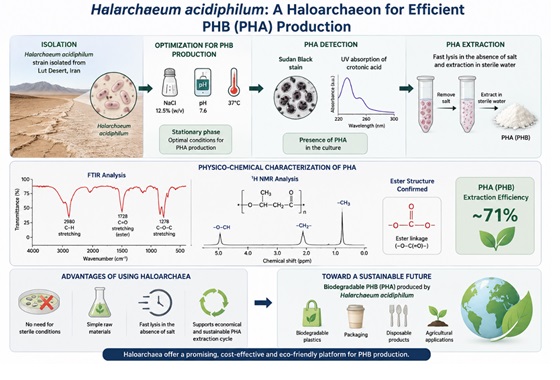
Biodegradable Polyhydroxyalkanoates (PHAs), produced by bacteria, are a solid alternative to native plastic. However, in the archaea domain, some members of the haloarchaea genera have been identified as PHAs producers. In the present study, we selected Halarchaeum acidiphilum strain and optimized it for PHB production.
We isolated the Halarchaeum acidiphilum strain from the Lut desert of Iran and performed Sudan black stain and UV absorption of crotonic acid. The results showed that the strain produced PHA in the medium containing 12.5% sodium chloride and pH equal to 7.6 at 37°C at the stationary phase. The PHA was extracted in sterile water, and the Physico-chemical analysis of PHA was detected by FTIR and 1HNMR test, which approved the ester structure and the efficiency was almost 71%.
The use of haloarchaea in the production of PHA has advantages such as no need for sterile conditions, simple raw materials, and fast lysis of bacteria in the absence of salt, which help the processes of the economic cycle of PHAs extraction.
Downloads
References
[1] Beltrán-Sanahuja, A., et al., Monitoring polymer degradation under different conditions in the marine environment. Environ. Pollut. 2020; 259:113836. https://doi.org/10.1016/j.envpol.2019.113836
[2] Suriyamongkol P, Weselake R, Narine S, Moloney M, Shah S. Biotechnological approaches for the production of polyhydroxyalkanoates in microorganisms and plants—a review. Biotechnol. Adv. 2007;25:148-75. https://doi.org/10.1038/s41428-020-00396-5
[3] Jâms IB, Windsor FM, Poudevigne-Durance T, Ormerod SJ, Durance I. Estimating the size distribution of plastics ingested by animals. Nat. Commun. 2020;11:1-7. https://doi.org/10.1038/s41467-020-15406-6.
[4] Koelmans AA, Bakir A, Burton GA, Janssen CR. Microplastic as a vector for chemicals in the aquatic environment: critical review and model-supported reinterpretation of empirical studies. Environ. Sci. Technol. 2016;50:3315-26. https://doi.org/10.1021/acs.est.5b06069
[5] Kumar M, Rathour R, Singh R, Sun Y, Pandey A, Gnansounou E, et al. Bacterial polyhydroxyalkanoates: Opportunities, challenges, and prospects. J. Clean. Prod. 2020;263:121500. https://doi.org/10.1016/j.jclepro.2020.121500
[6] Castilho LR, Mitchell DA, Freire DM. Production of polyhydroxyalkanoates (PHAs) from waste materials and by-products by submerged and solid-state fermentation. J. Clean. Prod. 2009;100:5996-6009. https://doi.org/10.1016/j.biortech.2009.03.088
[7] Keshavarz T, Roy I. Polyhydroxyalkanoates: bioplastics with a green agenda. Curr. Opin. Microbiol. 2010;13:321-6. https://doi.org/10.1016/j.mib.2010.02.006
[8] Tekin E, Ateş M, Kahraman Ö. Poly-3-hydroxybutyrate-producing extreme halophilic archaeon: Haloferax sp. MA10 isolated from Çamaltı Saltern, İzmir. Turk. J. Biol. 2012;36:303-12.
https://journals.tubitak.gov.tr/biology/vol36/iss3. 8. https://org.doi/10.3906/biy-1102-16
[9] Giani M, Garbayo I, Vílchez C, Martínez-Espinosa RM. Haloarchaeal carotenoids: healthy novel compounds from extreme environments. Mar. Drugs. 2019; 17: 524. https://doi.org/10.3390/md17090524
[10] Simó-Cabrera L, García-Chumillas S, Hagagy N, Saddiq A, Tag H, Selim S, et al. Haloarchaea as cell factories to produce bioplastics. Marine Drugs 2021;19:159. https://doi.org/10.3390/md19030159
[11] Abbasi S, Emtiazi G. MALDI‐TOF analysis of a novel extremophile peptide purified from Halarchaeum acidiphilum ASDL78 with antiarchaeal and antibacterial activities. J. Basic Microbiol. 2020;60:920-30. https://doi.org/10.1002/jobm.202000392
[12] Murray R. Determinative and cytological light microscopy. Methods mol. biol. 1994:7-20. https://doi.org/10.1002/cncy.22195
[13] Legat A, Gruber C, Zangger K, Wanner G, Stan-Lotter H. Identification of polyhydroxyalkanoates in Halococcus and other haloarchaeal species. Appl. Microbiol. Biotechnol. 2010;87:1119-27. https://doi.org/10.1007/s00253-010-2611-6
[14] Lillo JG, Rodriguez-Valera F. Effects of culture conditions on poly (β-hydroxybutyric acid) production by Haloferax mediterranei. Appl. Environ. Microbiol. 1990;56:2517-21. https://doi.org/10.1128/aem.56.8.2517-2521.1990
[15] Torregrosa‐Crespo J, González‐Torres P, Bautista V, Esclapez JM, Pire C, Camacho M, et al. Analysis of multiple haloarchaeal genomes suggests that the quinone‐dependent respiratory nitric oxide reductase is an important source of nitrous oxide in hypersaline environments. Environ. Microbiol. Rep. 2017;9:788-96. https://doi.org/10.1111/1758-2229.12596
[16] Obruca S, Benesova P, Kucera D, Petrik S, Marova I. Biotechnological conversion of spent coffee grounds into polyhydroxyalkanoates and carotenoids. N Biotechnol. 2015;32:569-74. https://doi.org/10.1016/j.nbt.2015.02.008
[17] Salgaonkar B, Mani K, Braganca J. Characterization of polyhydroxyalkanoates accumulated by a moderately halophilic salt pan isolate B acillus megaterium strain H 16. J. Appl. Microbiol. 2013;114:1347-56. https://doi.org/10.1111/jam.12135
[18] Pašić L, Velikonja BH, Ulrih NP. Optimization of the culture conditions for the production of a bacteriocin from halophilic archaeon Sech7a. Prep. Biochem. Biotechnol. 2008;38:229-45. https://doi.org/10.1080/10826060802164637
[19] Oren A. Industrial and environmental applications of halophilic microorganisms. Environ. Technol. 2010;31:825-34. https://doi.org/10.1080/09593330903370026
[20] Rodríguez-Contreras A, Koller M, Braunegg G, Marqués-Calvo MS. Poly [(R)-3-hydroxybutyrate] production under different salinity conditions by a novel Bacillus megaterium strain. N Biotechnol. 2016;33:73-7. https://doi.org/10.1016/j.nbt.2015.08.006
[21] Sun Y, An Z. Late Pliocene‐Pleistocene changes in mass accumulation rates of eolian deposits on the central Chinese Loess Plateau. J. Geophys. Res. Atmos. 2005;110. https://doi.org/10.1029/2005JD006064
[22] Bajpai B, Chaudhary M, Saxena J. Production and characterization of α-amylase from an extremely halophilic archaeon, Haloferax sp. HA10. Food Technol. Biotechnol.. 2015;53:11. https://doi.org/10.17113/ftb.53.01.15.3824
[23] Chaudhary M, Bajpai B, Suthar K, Saxena J. Characterization of a halotolerant archaeon Haloferax larsenii HA8 isolated from solar saltern for halocin production. J Sci. 2018;45:2244-55. https://doi.org/10.1111/lam.13377
[24] Karthikeyan P, Bhat SG, Chandrasekaran. Halocin SH10 production by an extreme haloarchaeon Natrinema sp. BTSH10 isolated from salt pans of South India. Saudi J. Biol. Sci. 2013;20:205-12. https://doi.org/10.1016/j.sjbs.2013.02.002
[25] Hay JXW, Wu TY, Teh CY, Jahim JM. Optimized growth of Rhodobacter sphaeroides OU 001 using response surface methodology (RSM). 2012. http://hdl.handle.net/123456789/13493
[26] Tănase EE, Popa ME, Râpă M, Popa O. PHB/Cellulose fibers based materials: physical, mechanical and barrier properties. Agric Agric Sci Proc. 2015;6:608-15. https://doi.org/10.1016/j.aaspro.2015.08.099
[27] Rech CR, Martelli SM, Brabes KCdS. Antimicrobial analysis and characterization of P (3HB) films containing essential oils. Orbital: Electron. J. Chem. 2018;10:9-13. http://dx.doi.org/10.17807/orbital.v10i1.1007
[28] Mukhopadhyay M, Patra A, Paul A. Production of poly (3-hydroxybutyrate) and poly (3-hydroxybutyrate-co-3-hydroxyvalerate) by Rhodopseudomonas palustris SP5212. World J. Microbiol. Biotechnol. 2005;21:765-9. https://doi.org/10.1016/j.biortech.2017.05.029

Downloads
Published
Submitted
Revised
Accepted
Issue
Section
License
Copyright (c) 2026 Sheivan Chahianchy (Author); Soheila Abbasi; Giti Emtiazi, Maryam Jalili Tabaii, Martin Koller (Author)

This work is licensed under a Creative Commons Attribution-NonCommercial 4.0 International License.