
Antifungal Properties and Purification of Chitinase from Haloferax mediterranei Isolated from Lake Urmia in Iran
Keywords:
chitinase, haloarchaea, Haloferax mediterranei , antifungalAbstract
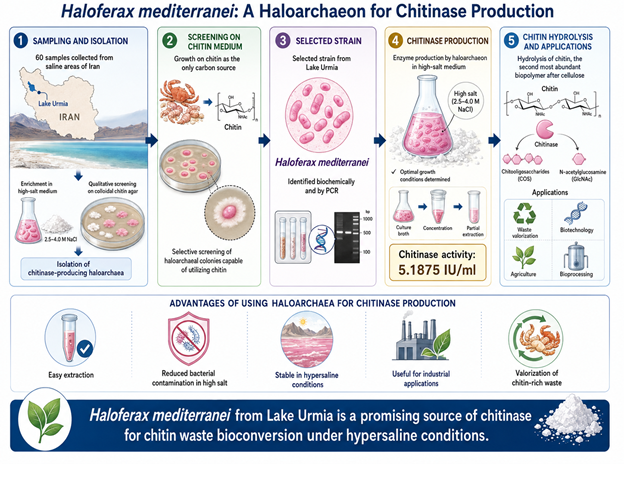
Background and Objective: Chitin and its hydrolyzing enzyme, chitinase, are produced by a variety of organisms and microorganisms. Production chitinase with Archaea are more concern today, for easy to extraction and contamination control. Therefor in this research the production of this enzyme is reported by Archaea.
Materials and Methods: 60 samples were collected from different saline areas of Iran and then enrichment and qualitative screening were performed to isolate chitinase-producing archaea. The selected strain was identified biochemically and molecularly and its optimal growth conditions were determined.
Results: Halophilic Archaea strains were isolated on chitin as the only sources of carbon for chitinase-producing archaeal strains. The result showed, a pink colony strain from Lake Urmia with chitinase activities of 5.1875 IU/ml was selected for maximum enzyme production and identified as Haloferax mediterranei by PCR reaction test. The enzyme was concentrated and partial extracted.
Conclusion: Enzyme production from archaea can be useful for industries. The hydrolysis of chitin, the second biopolymer after cellulose, which also leaves a lot of waste every year, is of great importance, therefore, with high chitinase activity from haloarchaea, it can be used in industry without bacterial contamination science this microorganism is stable only in high salt solution.
Downloads
References
[1]. Yavari-Bafghi, M., H. Babavalian, and M.A. Amoozegar, Isolation, screening and identification of haloarchaea with chitinolytic activity from hypersaline lakes of Iran. Archives of Biological Sciences, 2019. 71(1): p. 71-81.
https://doi.org/10.2298/abs180525049y
[2]. Dayakar, B., et al., Application of extreme halophilic archaea as biocatalyst for chitin isolation from shrimp shell waste. Carbohydrate Polymer Technologies and Applications, 2021. 2: p. 100093.
https://doi.org/10.1016/j.carpta.2021.100093
[3]. Poria, V., et al., Current perspectives on chitinolytic enzymes and their agro-industrial applications. Biology, 2021. 10(12): p. 1319.
https://doi.org/10.3390/biology10121319
[4]. Cabrera, M.Á. and J.M. Blamey, Biotechnological applications of archaeal enzymes from extreme environments. Biological research, 2018. 51.
https://doi.org/10.1186/s40659-018-0186-3
[5]. Singh, R.V., et al., Chitinases production: A robust enzyme and its industrial applications. Biocatalysis and Biotransformation, 2021. 39(3): p. 161-189.
https://doi.org/10.1080/10242422.2021.1883004
[6]. Gomaa, E.Z., Microbial chitinases: properties, enhancement and potential applications. Protoplasma, 2021. 258(4): p. 695-710.
https://doi.org/10.1007/s00709-021-01612-6
[7]. Bonete, M.J. and R.M. Martínez-Espinosa, Enzymes from halophilic archaea: open questions, in Halophiles and Hypersaline Environments: Current Research and Future Trends. 2011, Springer. p. 359-371.
https://doi.org/10.1007/978-3-642-20198-1_19
[8]. Tanaka, T., et al., A unique chitinase with dual active sites and triple substrate binding sites from the hyperthermophilic archaeon Pyrococcus kodakaraensis KOD1. Applied and environmental microbiology, 1999. 65(12): p. 5338-5344.
https://doi.org/10.1128/aem.65.12.5338-5344.1999
[9]. Littlechild, J.A., Archaeal enzymes and applications in industrial biocatalysts. Archaea, 2015. 2015(1): p. 147671.
https://doi.org/10.1155/2015/147671
[10]. Aparici-Carratalá, D., et al., Archaea: current and potential biotechnological applications. Research in Microbiology, 2023. 174(7): p. 104080.
https://doi.org/10.1016/j.resmic.2023.104080
[11]. Brugère, J.-F., et al., Archaea: microbial candidates in next-generation probiotics development. Journal of Clinical Gastroenterology, 2018. 52: p. S71-S73.
https://doi.org/10.1097/mcg.0000000000001043
[12]. Moopantakath, J., et al., Bioactive molecules from haloarchaea: Scope and prospects for industrial and therapeutic applications. Frontiers in Microbiology, 2023. 14: p. 1113540.
https://doi.org/10.3389/fmicb.2023.1113540
[13]. Dussault, H., An improved technique for staining red halophilic bacteria. Journal of bacteriology, 1955. 70(4): p. 484-485.
https://doi.org/10.1128/jb.70.4.484-485.1955
[14]. Najjari A, Elshahed MS, Cherif A, Youssef NH. Patterns and determinants of halophilic archaea (class halobacteria) diversity in tunisian endorheic salt lakes and sebkhet systems. Appl Environ Microbiol. 2015 Jul;81(13):4432-41.

Downloads
Published
Submitted
Revised
Accepted
Issue
Section
License
Copyright (c) 2026 Farhanaz Sadat Mirlohi (Author); Soheila Abbasi; Maryam Jalili Tabaii, Giti Emtiazi (Author)

This work is licensed under a Creative Commons Attribution-NonCommercial 4.0 International License.