
PCR Identification of Subtilosin and Coagulin synthetase gene in Bacillus coagulans, Cultured in an Artificial Medium
Identification of subtilosin and coagulin synthetase gene in B. coagulans
Keywords:
Bacillus coagulans, Coagulin, Subtilosin, PCR identificationAbstract
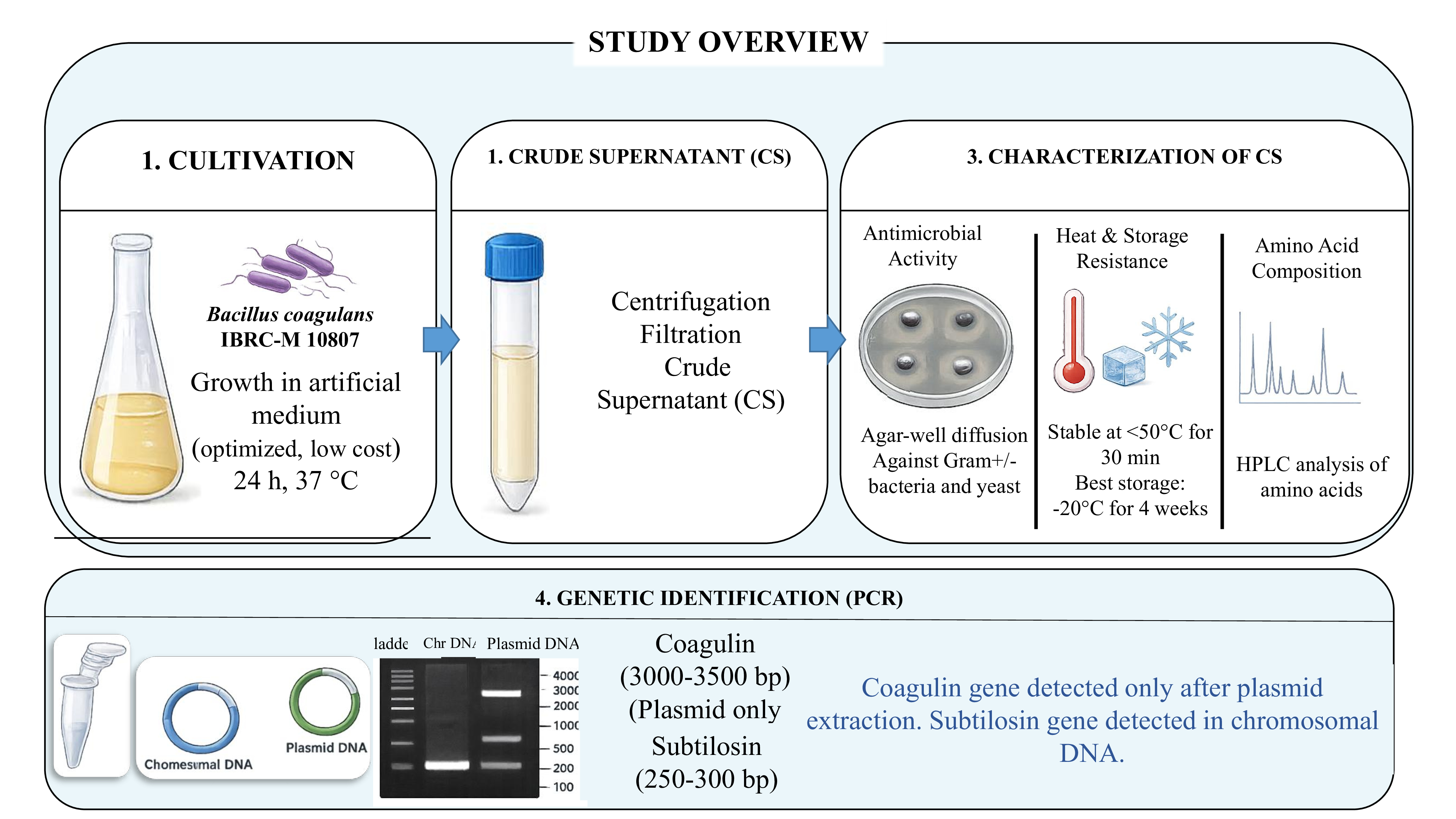
Purpose and aim: Bacillus spp. is particularly important among probiotic microorganisms due to its resistance to extreme conditions. Bacillus coagulans, producing coagulin is a probiotic bacteria used in food products. This study aimed to genetically identify bacteriocins in B. coagulans IBRC-M 10807.
Method: The agar-well diffusion method was used to examine the antimicrobial property of the 24-hour crude supernatant. The heat and storage resistance of the crude supernatant was studied, and the HPLC technique was utilized to analyze its percentage of amino acids. Finally, the PCR method detected the presence of coagulin, subtilin, and subtilosin genes.
Results and conclusion: The results showed the antimicrobial properties of the CS against gram-positive/gram-negative bacteria. The best storage condition for the CS was -20 °C for 4 weeks, and it was resistant to <50 °C for 30 minutes. Furthermore, the artificial medium in this study with similar efficiency and a lower price, was valuable compared to the other two commercial media. PCR results showed the presence of a 3000-3500 bp band related to coagulin (observed only after plasmid extraction) and a 250-300 bp band related to subtilosin after sequencing. The sequence of the subtilosin band had 100% identity with the B. subtilis strain L4 subtilosin (albA) gene. These broad-spectrum antimicrobial properties, and their relative resistance to temperature and storage, make this strain a valuable candidate for use in probiotic products.
Downloads
References
1. Cao J., Yu Z., Liu W., Zhao J., Zhang H., Zhai Q., and Chen W., Probiotic characteristics of Bacillus coagulans and associated implications for human health and diseases, Journal of Functional Foods, 2020; 64, 103643.
https://doi.org/10.1016/j.jff.2019.103643
2. Abdhul K., Ganesh M., Shanmughapriya S., Vanithamani S., Kanagavel M., Anbarasu K., and Natarajaseenivasan K., Bacteriocinogenic potential of a probiotic strain Bacillus coagulans [BDU3] from Ngari, International journal of biological macromolecules, 2015; 79, 800-6.
3. Wang L., Wang J., Du L., Fang X., and Liao Z., Application of Weizmannia coagulans in the medical and livestock industry, Annals of Microbiology, 2022; 72(1), 1-9. https://doi.org/10.1186/s13213-022-01687-3
4. Ghoreishi F.S., Roghanian R., and Emtiazi G. Simultaneous Production of Antibacterial Protein and Lipopeptides in Bacillus tequilensis, Detected by MALDI-TOF and GC Mass Analyses, Probiotics and antimicrobial proteins, 2022; 2022 1-12
5. Marrec L., (1998) Coagulin, a bacteriocin‐like inhibitory substance produced by Bacillus coagulans I4, Journal of applied microbiology, 1998; 85(1), 42-50
6. Nicolas GM. Secondary Metabolites from Bacillus spp. probiotics as potential treatments for multidrug-resistant pathogens: A comprehensive review. Curr Res Microb Sci. 2025 Apr 16;8:100392. https://org.doi/10.1016/j.crmicr.2025.100392. PMID: 40337641; PMCID: PMC12056956
7. Meskhi B, Todorov SD, Rudoy D, Olshevskaya A, Shevchenko V, Maltseva T, Mirzoyan A, Kozyrev D, Odabashyan M, Teplyakova S, Mazanko M. Bacteriocins, a New Generation of Sustainable Alternatives to Antibacterial Agents in Primary Food Production Systems. Molecules. 2026 Jan 19;31(2):356. https://org.doi/10.3390/molecules31020356. PMCID: PMC12844023
8. Geda AM, Tumebo AW, Abey SL, Kasse GE, Temesgen AB, Wassie ZG. Bacteriocins as a Promising Antimicrobial Strategy Against Multidrug-Resistant Pathogens: Mechanisms of Action, Applications in Human and Animal Health, and the Food Industry. Biomed Res Int. 2026;2026(1):e1527677. https://org.doi/10.1155/bmri/1527677. PMCID: PMC13148635
9. Riazi S., Wirawan R., Badmaev V., and Chikindas M., Characterization of lactosporin, a novel antimicrobial protein produced by Bacillus coagulans ATCC 7050, Journal of applied microbiology, 2009; 106(4), 1370-7
10. Halami P.M., Sublichenin, a new subtilin-like lantibiotics of probiotic bacterium Bacillus licheniformis MCC 2512T with antibacterial activity, Microbial Pathogenesis, 2019; 128, 139-46
11. Manikandan P., Moopantakath J., Imchen M., Kumavath R., and SenthilKumar P., Identification of multi-potent protein subtilosin A from halophilic bacterium Bacillus firmus VE2, Microbial Pathogenesis, 2021; 157, 105007. https://doi.org/10.1016/j.micpath.2021.105007
12. Park S., Classen A., Gohou H.M., Maldonado R., Kretschmann E., Duvernay C., Kim G.J., and Ronholm J., A new, reliable, and high-throughput strategy to screen bacteria for antagonistic activity against Staphylococcus aureus, BMC. Microbiology, 2021; 21(1), 1-10. https://doi.org/10.1186/s12866-021-02265-4
13. Tumbarski Y., Deseva I., Mihaylova D., Stoyanova M., Krastev L., Nikolova R., Yanakieva V., and Ivanov I., Isolation, characterization and amino acid composition of a bacteriocin produced by Bacillus methylotrophicus strain BM47, Food Technology and Biotechnology, 2018; 56(4), 546-552. https://doi.org/10.17113/ftb.56.04.18.5905
14. Abada E.A.E.M., Isolation and characterization of an antimicrobial compound from Bacillus coagulans, Animal cells and systems, 2008; 12(1), 41-6
15. Kim Y.S., Lee J., Heo S., Lee J.H., and Jeong D.W. Technology and safety evaluation of Bacillus coagulans exhibiting antimicrobial activity for starter deveopment. LWT, 2021; 137, 110464

Downloads
Published
Submitted
Revised
Accepted
Issue
Section
License
Copyright (c) 2026 Elham Mousavi , Maryam Jalili Tabaii , Fatemeh Sadat Ghoreishi , Morteza Abkar , Giti Emtiazi (Author)

This work is licensed under a Creative Commons Attribution-NonCommercial 4.0 International License.