
Dipeptide and Cyclic-peptide Secondary Metabolites Derived from Streptomyces: Molecular Structure and Therapeutic Applications
Di & Cyclic-peptide secondary metabolites of Streptomyces
Keywords:
antibacterial , antimicrobial peptides, dipeptides , StreptomycesAbstract
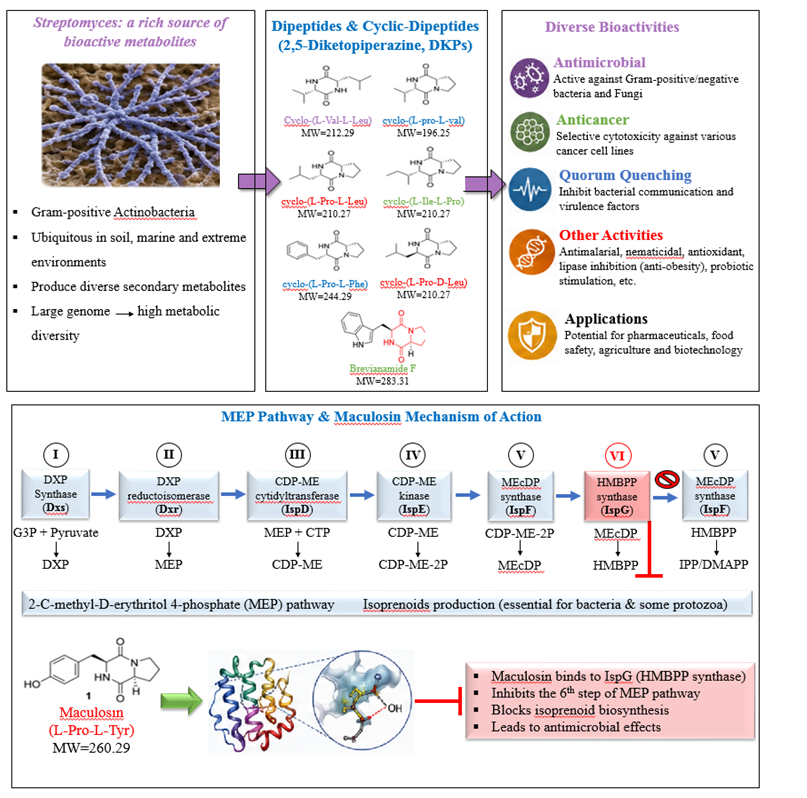
Purpose: In this review, we focus specifically on dipeptides and cyclic dipeptides derived from Streptomyces, exploring their structural diversity, biosynthesis pathways, and potential therapeutic applications.
Methods: This review is prepared with collection of many literatures about antimicrobial peptides from Streptomyces.
Results: Streptomyces are prolific producers of secondary metabolites and antibiotics, contributing significantly to pharmacology and industry fields. They are widely distributed in various environments. These gram-positive strains are generally non-pathogenic. While many antibiotics originate from Streptomyces, ongoing research continues to unveil novel metabolites with diverse biological activities, including anticancer, antibacterial properties, and others whose functions remain undiscovered. Some of these peptides like albonoursin and alahopsin are self-assembled dipeptides.
Conclusion: Application, design and engineering of dipeptides and cyclic dipeptides from Streptomyces could be a novel method in development of therapeutic purposes, especially for reduction of human toxicity.
Downloads
References
1. Abbasi S, Emtiazi G. Antimicrobial peptides of haloarchaea: Properties and applications of halocin. Journal of Microbial World 2022;15(2):88-108. https://org.doi/10.30495/jmw.2022.1956712.2018
2. Ghoreishi FS, Roghanian R, Emtiazi G. Simultaneous production of antibacterial protein and lipopeptides in Bacillus tequilensis, detected by MALDI-TOF and GC mass analyses. Probiotics Antimicrob Proteins 2023;15(3):749-60. https://org.doi/10.1007/s12602-021-09883-4
3. Higashide E, Horii S, Ono H, Mizokami N, Yamazaki T, Shibata M, et al. Alahopcin, a new dipeptide antibiotic produced by Streptomyces albulus subsp. ochragerus subsp. nov. J Antibiot 1985;38(3):285-95.
4. Etemadzadeh SS, Emtiazi G. In vitro identification of antimicrobial hemolytic lipopeptide from halotolerant Bacillus by Zymogram, FTIR, and GC mass analysis. Iran J Basic Med Sci 2021;24(5):666. https://org.doi/10.22038/IJBMS.2021.53419.12022
5. Fanaei M, Jurcic K, Emtiazi G. Detection of simultaneous production of kurstakin, fengycin and surfactin lipopeptides in Bacillus mojavensis using a novel gel-based method and MALDI-TOF spectrometry. World J Microbiol Biotechnol 2021;37:1-11. https://org.doi/10.1007/s11274-021-03064-9
6. Quinn GA, Banat AM, Abdelhameed AM, Banat IM. Streptomyces from traditional medicine: sources of new innovations in antibiotic discovery. J Med Microbiol 2020;69(8):1040-8.
https://org.doi/10.1099/jmm.0.001232
7. Joseph J, Abirami B, Manigundan K, Gopikrishnan V, Radhakrishnan M. Antimicrobial peptides from Actinobacteria: Current status and future prospects. Microbial and natural macromolecules 2021:205-31. https://org.doi/10.1016/B978-0-12-820084-1.00009-0
8. Zou P, Chen W-T, Sun T, Gao Y, Li L-L, Wang H. Recent advances: peptides and self-assembled peptide-nanosystems for antimicrobial therapy and diagnosis. Biomater Sci 2020;8(18):4975-96. https://org.doi/10.1039/D0BM00789G
9. Li L, Xie L, Zheng R, Sun R. Self-assembly dipeptide hydrogel: The structures and properties. Front Chem 2021;9:739791.
https://org.doi/10.3389/fchem.2021.739791
10. Chauhan JV, Gohel SD. Molecular diversity and pharmaceutical applications of free-living and rhizospheric marine actinobacteria. Marine Niche: Applications in Pharmaceutical Sciences: Translational Research 2020:111-31.
https://org.doi/10.1007/978-981-15-5017-1_6
11. Holt JG, Krieg NR, Sneath PH, Staley JT, Williams ST. Bergey's Manual of determinate bacteriology. 1994.
12. Jensen PR, Mincer TJ, Williams PG, Fenical W. Marine actinomycete diversity and natural product discovery. Antonie Van Leeuwenhoek 2005;87:43-8. https://org.doi/10.1007/s10482-004-6540-1
13. Wang P, Xi L, Liu P, Wang Y, Wang W, Huang Y, et al. Diketopiperazine derivatives from the marine-derived actinomycete Streptomyces sp. FXJ7. 328. Mar Drugs 2013;11(4):1035-49.
https://org.doi/10.3390/md11041035
14. Shaala LA, Youssef DT, Badr JM, Harakeh SM. Bioactive 2 (1 H)-pyrazinones and diketopiperazine alkaloids from a tunicate-derived actinomycete Streptomyces sp. Molecules 2016;21(9):1116. https://org.doi/10.3390/molecules21091116
15. Ye X, Chai W, Lian X-Y, Zhang Z. Novel propanamide analogue and antiproliferative diketopiperazines from mangrove Streptomyces sp. Q24. Nat Prod Res 2017;31(12):1390-6. https://org.doi/10.1080/14786419.2016.1253079
16. Lin C-K, Wang Y-T, Hung E-M, Yang Y-L, Lee J-C, Sheu J-h, et al. Butyrolactones and diketopiperazines from marine microbes: Inhibition effects on dengue virus Type 2 replication. Planta Med 2017;83(01/02):158-63.
https://org.doi/10.1055/s-0042-112998
17. Kim MC, Cullum R, Machado H, Smith AJ, Yang I, Rodvold JJ, et al. Photopiperazines A–D, photosensitive interconverting Diketopiperazines with significant and selective activity against U87 glioblastoma cells, from a rare, marine-derived actinomycete of the family Streptomycetaceae. J Nat Prod 2019;82(8):2262-7.
https://org.doi/10.1021/acs.jnatprod.9b00429
18. Raju R, Piggott AM, Conte M, Aalbersberg WG, Feussner K, Capon RJ. Naseseazines A and B: a new dimeric diketopiperazine framework from a marine-derived actinomycete, Streptomyces sp. Org Lett 2009;11(17):3862-5. https://org.doi/10.1021/ol901466r
19. Buedenbender L, Grkovic T, Duffy S, Kurtböke DI, Avery VM, Carroll AR. Naseseazine C, a new anti-plasmodial dimeric diketopiperazine from a marine sediment derived Streptomyces sp. Tetrahedron Lett 2016;57(52):5893-5. https://org.doi/10.1016/j.tetlet.2016.11.071
20. Chen S, Zhang D, Chen M, Zhang Z, Lian X-Y. A rare diketopiperazine glycoside from marine-sourced Streptomyces sp. ZZ446. Nat Prod Res 2020;34(7):1046-50. https://org.doi/10.1080/14786419.2018.1544978
21. Ou Y-x, Huang J-f, Li X-m, Kang Q-j, Pan Y-t. Three new 2, 5-diketopiperazines from the fish intestinal Streptomyces sp. MNU FJ-36. Nat Prod Res 2016;30(15):1771-5.
https://org.doi/10.1080/14786419.2015.1137570
22. Shaala LA, Youssef DT, Badr JM, Harakeh SM, Genta-Jouve G. Bioactive diketopiperazines and nucleoside derivatives from a sponge-derived Streptomyces species. Mar Drugs 2019;17(10):584. https://org.doi/10.3390/md17100584
23. Yi W, Qin L, Lian X-Y, Zhang Z. New antifungal metabolites from the Mariana Trench sediment-associated actinomycete Streptomyces sp. SY1965. Mar Drugs 2020;18(8):385.
https://org.doi/10.3390/md18080385
24. Song M-M, Xie Y-H, Chen W-H, Hu Y-W, Zhao K, Liu Y-H, et al. Diketopiperazine and enterotoxin analogues from the mangrove derived-soil Streptomyces sp. SCSIO 41400 and their biological evaluation. Nat Prod Res 2022;36(5):1197-204. https://org.doi/10.1080/14786419.2020.1864632
25. Lee H-S, Shin HJ, Jang KH, Kim TS, Oh K-B, Shin J. Cyclic peptides of the nocardamine class from a marine-derived bacterium of the genus Streptomyces. J Nat Prod (Gorakhpur) 2005;68(4):623-5. https://org.doi/10.1021/np040220g
26. Kalinovskaya NI, Romanenko LA, Irisawa T, Ermakova SP, Kalinovsky AI. Marine isolate Citricoccus sp. KMM 3890 as a source of a cyclic siderophore nocardamine with antitumor activity. Microbiol Res 2011;166(8):654-61.
https://org.doi/10.1016/j.micres.2011.01.004
27. Hahn D. Induction of cryptic natural product fungicides from actinomycetes. Pest Management with Natural Products 2013:217-36. https://org.doi/10.1021/bk-2013-1141.ch015
28. Molloy B, Lively D, Gale R, Gorman M, Boeck L, Higgens G, et al. A new dipeptide antibiotic from Streptomyces collinus, Lindenbein. J Antibiot (Tokyo) 1972;25(2):137-40.
https://org.doi/10.7164/antibiotics.25.137
29. Horii S, Fukase H, Higashide E, Yoneda M, Nishida H, Sakai H, et al. Structure of alahopcin (nourseimycin), a new dipeptide antibiotic. J Antibiot (Tokyo) 1985;38(3):302-11.
https://org.doi/10.7164/antibiotics.38.302
30. Lin W-X, Xie C-L, Zhou M, Xia M-L, Zhou T-T, Chen H-F, et al. Chemical constituents from the deep sea-derived Streptomyces xiamenensis MCCC 1A01570 and their effects on RXRα transcriptional regulation. Nat Prod Res 2020;34(10):1461-4. https://org.doi/10.1080/14786419.2018.1508148
31. Bojarska J, Mieczkowski A, Ziora ZM, Skwarczynski M, Toth I, Shalash AO, et al. Cyclic dipeptides: The biological and structural landscape with special focus on the anti-cancer proline-based scaffold. Biomolecules 2021;11(10):1515. https://org.doi/10.3390/biom11101515
32. Kumar SN, Mohandas C, Nambisan B. Purification of an antifungal compound, cyclo (l-Pro-d-Leu) for cereals produced by Bacillus cereus subsp. thuringiensis associated with entomopathogenic nematode. Microbiol Res 2013;168(5):278-88. https://org.doi/10.1016/j.micres.2012.12.003
33. Saadouli I, Zendah El Euch I, Trabelsi E, Mosbah A, Redissi A, Ferjani R, et al. Isolation, characterization and chemical synthesis of large spectrum antimicrobial cyclic dipeptide (L-leu-L-pro) from Streptomyces misionensis V16R3Y1 bacteria extracts. A novel 1H NMR metabolomic approach. Antibiotics 2020;9(5):270.
https://org.doi/10.3390/antibiotics9050270
34. Basha S, Raghavendra G, Kumar M, Singh Y, Patil J, Tanemura Y, et al. Isolation and characterization of antimicrobial cyclic dipeptides from Pseudomonas fluorescens and their efficacy on sorghum grain mold fungi. Chem Biodivers 2014;11(1):92-100. https://org.doi/10.1002/cbdv.201300045
35. Kumar N, Mohandas C, Nambisan B, Kumar DS, Lankalapalli RS. Isolation of proline-based cyclic dipeptides from Bacillus sp. N strain associated with rhabitid entomopathogenic nematode and its antimicrobial properties. World J Microbiol Biotechnol 2013;29:355-64. https://org.doi/10.1007/s11274-012-1189-9
36. Che Q, Li J, Li D, Gu Q, Zhu T. Structure and absolute configuration of drimentine I, an alkaloid from Streptomyces sp. CHQ-64. J Antibiot (Tokyo) 2016;69(6):467-9. https://org.doi/10.1038/ja.2015.133
37. Kamiya T, Maeno S, Hashimoto M, Mine Y. Bicyclomycin, a new antibiotic II. Structural elucidation and acyl derivatives. J Antibiot (Tokyo) 1972;25(10):576-81. https://org.doi/10.7164/antibiotics.25.576
38. Williams RM, Durham CA. Bicyclomycin: synthetic, mechanistic, and biological studies. Chem Rev 1988;88(3):511-40.
https://org.doi/10.1021/cr00085a004
39. Wang Y, Wang P, Ma H, Zhu W. Developments around the bioactive diketopiperazines: A patent review. Expert Opin Ther Pat 2013;23(11):1415-33. https://org.doi/10.1517/13543776.2013.828036
40. Ben Ameur Mehdi R, Shaaban KA, Rebai IK, Smaoui S, Bejar S, Mellouli L. Five naturally bioactive molecules including two rhamnopyranoside derivatives isolated from the Streptomyces sp. strain TN58. Nat Prod Res 2009;23(12):1095-107. https://org.doi/10.1080/14786410802362352
41. Abraham W-R. Fumitremorgins and relatives-from tremorgenic compounds to valuable anti-cancer drugs. Curr Med Chem 2018;25(2):123-40. https://org.doi/10.2174/0929867324666170724103410
42. Anusree T, Suseela Bhai R, Ahammed Shabeer T, Oulkar D. Streptomyces spp from black pepper rhizosphere: a boundless reservoir of antimicrobial and growth promoting metabolites. Journal of Biologically Active Products from Nature 2019;9(1):1-23. https://org.doi/10.1080/22311866.2018.1561327
43. Zin NM, Baba MS, Zainal-Abidin AH, Latip J, Mazlan NW, Edrada-Ebel R. Gancidin W, a potential low-toxicity antimalarial agent isolated from an endophytic Streptomyces SUK10. Drug Des Devel Ther 2017:351-63.
https://org.doi/10.2147/DDDT.S121283
44. Aiso K, Arai T, Suzuki M, Takamizawa Y. Gancidin, An Antitumor Substance Derived from Streptomyces Sp. I. The Journal of Antibiotics, Series A 1956;9(3):97-101.
https://org.doi/10.11554/antibioticsa.9.3_97
45. Kannabiran K. Bioactivity-guided extraction and identification of antibacterial compound from marine actinomycetes strains isolated from costal soil samples of Rameswaram and Dhanushkodi, Tamil Nadu, India. Asian J Pharm (AJP) 2016;10(04). https://org.doi/10.22377/ajp.v10i04.885
46. Khan MS, Gao J, Munir I, Zhang M, Liu Y, Moe TS, et al. Characterization of Endophytic Fungi, Acremonium sp., from Lilium davidii and Analysis of Its Antifungal and Plant Growth‐Promoting Effects. Biomed Res Int 2021;2021(1):9930210. https://org.doi/10.1155/2021/9930210
47. Guo ZK, Wang R, Chen FX, Liu TM, Yang MQ. Bioactive aromatic metabolites from the sea urchin-derived actinomycete Streptomyces spectabilis strain HDa1. Phytochem Lett 2018;25:132-5.
https://org.doi/10.1016/j.phytol.2018.04.014
48. Xiong Z-Q, Liu Q-X, Pan Z-L, Zhao N, Feng Z-X, Wang Y. Diversity and bioprospecting of culturable actinomycetes from marine sediment of the Yellow Sea, China. Arch Microbiol 2015;197:299-309. https://org.doi/10.1007/s00203-014-1059-y
49. Cheng C, Othman EM, Stopper H, Edrada-Ebel R, Hentschel U, Abdelmohsen UR. Isolation of petrocidin A, a new cytotoxic cyclic dipeptide from the marine sponge-derived bacterium Streptomyces sp. SBT348. Mar Drugs 2017;15(12):383. https://org.doi/10.3390/md15120383
50. Chen M, Chai W, Zhu R, Song T, Zhang Z, Lian X-Y. Streptopyrazinones A− D, rare metabolites from marine-derived Streptomyces sp. ZZ446.
Tetrahedron 2018;74(16):2100-6.
https://org.doi/10.1016/j.tet.2018.03.028
51. Li B, Chen G, Bai J, Jing Y-K, Pei Y-H. A bisamide and four diketopiperazines from a marine-derived Streptomyces sp. J Asian Nat Prod Res 2011;13(12):1146-50. https://org.doi/10.1080/10286020.2011.617744
52. Rhee K-H. Isolation and characterization of Streptomyces sp. KH-614 producing anti-VRE (vancomycin-resistant enterococci) antibiotics. J Gen Appl Microbiol 2002;48(6):321-7. https://org.doi/10.2323/jgam.48.321
53. HU X-L. Secondary metabolites from endophyte fungus Fusariums sp. LC-1. Chinese Pharmaceutical Journal 2013:17-21.
54. Hatanaka M, Morita H, Aoyagi Y, Sasaki K, Sasaki D, Kondo A, et al. Effective bifidogenic growth factors cyclo-Val-Leu and cyclo-Val-Ile produced by Bacillus subtilis C-3102 in the human colonic microbiota model. Sci Rep 2020;10(1):7591.
https://org.doi/10.1038/s41598-020-64374-w
55. Jayatilake GS, Thornton MP, Leonard AC, Grimwade JE, Baker BJ. Metabolites from an Antarctic sponge-associated bacterium, Pseudomonas aeruginosa. J Nat Prod (Gorakhpur) 1996;59(3):293-6. https://org.doi/10.1021/np960095b
56. Holden MT, Ram Chhabra S, De Nys R, Stead P, Bainton NJ, Hill PJ, et al. Quorum‐sensing cross talk: isolation and chemical characterization of cyclic dipeptides from Pseudomonas aeruginosa and other gram‐negative bacteria. Mol Microbiol 1999;33(6):1254-66. https://org.doi/10.1046/j.1365-2958.1999.01577.x
57. Ghoreishi FS, Roghanian R, Emtiazi G. Inhibition of quorum sensing-controlled virulence factors with natural substances and novel protease, obtained from Halobacillus karajensis. Microb Pathog 2020;149:104555. https://org.doi/10.1016/j.micpath.2020.104555
58. Zhai Y, Shao Z, Cai M, Zheng L, Li G, Yu Z, et al. Cyclo (l-Pro–l-Leu) of Pseudomonas putida MCCC 1A00316 isolated from antarctic soil: identification and characterization of activity against Meloidogyne incognita. Molecules 2019;24(4):768. https://org.doi/10.3390/molecules24040768
59. Niu S, Zhou T-T, Xie C-L, Zhang G-Y, Yang X-W. Microindolinone A, a novel 4, 5, 6, 7-tetrahydroindole, from the deep-sea-derived actinomycete Microbacterium sp. MCCC 1A11207. Mar Drugs 2017;15(7):230.
https://org.doi/10.3390/md15070230
60. Cronan Jr JM, Davidson TR, Singleton FL, Colwell RR, Cardellina JH. Plant growth promoters isolated from a marine bacterium associated with Palythoa sp. Nat Prod Lett 1998;11(4):271-8. https://org.doi/10.1080/10575639808044959
61. Ienaga K, Nakamura K, Goto T. Bioactive compounds produced in animal tissues (I); two diketopiperadine plant growth regulators containing hydroxyproline isolated from rabbit skin tissue extract. Tetrahedron Lett 1987;28(12):1285-6. https://org.doi/10.1016/S0040-4039(00)95347-4
62. Elleuch L, Shaaban M, Smaoui S, Mellouli L, Karray-Rebai I, Fourati-Ben Fguira L, et al. Bioactive secondary metabolites from a new terrestrial Streptomyces sp. TN262. Appl Biochem Biotechnol 2010;162:579-93. https://org.doi/10.1007/s12010-009-8808-4
63. Ferreira EG, Torres MdCM, da Silva AB, Colares LL, Pires K, Lotufo TM, et al. Prospecting Anticancer Compounds in Actinomycetes Recovered from the Sediments of Saint Peter and Saint Paul's Archipelago, Brazil. Chem Biodivers 2016;13(9):1149-57. https://org.doi/10.1002/cbdv.201500514
64. Stierle AC, Cardellina JH, Strobel GA. Maculosin, a host-specific phytotoxin for spotted knapweed from Alternaria alternata. Proceedings of the National Academy of Sciences 1988;85(21):8008-11. https://org.doi/10.1073/pnas.85.21.8008
65. Driche EH, Badji B, Bijani C, Belghit S, Pont F, Mathieu F, et al. A new saharan strain of Streptomyces sp. GSB-11 produces maculosin and N-acetyltyramine active against multidrug-resistant pathogenic bacteria. Curr Microbiol 2022;79(10):298. https://org.doi/10.1007/s00284-022-02994-3
66. Nakagawa K, Takada K, Imamura N. Probable novel MEP pathway inhibitor and its binding protein, IspG. Biosci Biotechnol Biochem 2013;77(7):1449-54. https://org.doi/10.1271/bbb.130094
67. Paudel B, Maharjan R, Rajbhandari P, Aryal N, Aziz S, Bhattarai K, et al. Maculosin, a non-toxic antioxidant compound isolated from Streptomyces sp. KTM18. Pharm Biol 2021;59(1):931-4. https://org.doi/10.1080/13880209.2021.1946091
68. Allamand A, Piechowiak T, Lièvremont D, Rohmer M, Grosdemange-Billiard C. The multifaceted MEP pathway: Towards new therapeutic perspectives. Molecules 2023;28(3):1403. https://org.doi/10.3390/molecules28031403
69. Lacey HJ, Rutledge PJ. Recently discovered secondary metabolites from Streptomyces species. Molecules 2022;27(3):887.
https://org.doi/10.3390/molecules27030887
70. Cibichakravarthy B, Jose PA. Biosynthetic potential of Streptomyces rationalizes genome-based bioprospecting. Antibiotics (Basel) 2021;10(7):873. https://org.doi/10.3390/antibiotics10070873
71. Liu T, Ren Z, Chunyu W-X, Li G-D, Chen X, Zhang Z-T-L, et al. Exploration of diverse secondary metabolites from Streptomyces sp. YINM00001, using genome mining and one strain many compounds approach. Front Microbiol 2022;13:831174. https://org.doi/10.3389/fmicb.2022.831174
72. Lee N, Hwang S, Kim J, Cho S, Palsson B, Cho B-K. Mini review: Genome mining approaches for the identification of secondary metabolite biosynthetic gene clusters in Streptomyces. Comput Struct Biotechnol J 2020;18:1548-56.
https://org.doi/10.1016/j.csbj.2020.06.024
73. Unno K, Kodani S. Heterologous expression of cryptic biosynthetic gene cluster from Streptomyces prunicolor yields novel bicyclic peptide prunipeptin. Microbiol Res 2021;244:126669.
https://org.doi/10.1016/j.micres.2020.126669
74. Ji Z, Wei S, Fan L, Wu W. Three novel cyclic hexapeptides from Streptomyces alboflavus 313 and their antibacterial activity. Eur J Med Chem 2012;50:296-303. https://org.doi/10.1016/j.ejmech.2012.02.008
75. Pickens LB, Tang Y, Chooi Y-H. Metabolic engineering for the production of natural products. Annu Rev Chem Biomol Eng 2011;2(1):211-36. https://org.doi/10.1146/annurev-chembioeng-061010-114209
76. Ciulla MG, Gelain F. Structure–activity relationships of antibacterial peptides. Microb Biotechnol 2023;16(4):757-77.
https://org.doi/10.1111/1751-7915.14213
77. Jing X, Jin K. A gold mine for drug discovery: Strategies to develop cyclic peptides into therapies. Med Res Rev 2020;40(2):753-810. https://org.doi/10.1002/med.21639.
78. Kaur, M., Travin, D.Y., Berger, M.J. et al. A natural depsipeptide antibiotic binds the E-site of the bacterial ribosome. Nature (2026). https://doi.org/10.1038/s41586-026-10589-2.

Downloads
Published
Submitted
Revised
Accepted
Issue
Section
License
Copyright (c) 2025 Fatemeh Sadat Ghoreishi, Fatemeh Yousef-Saber (Author); Giti Emtiazi; Fatih Tarlak (Author)

This work is licensed under a Creative Commons Attribution-NonCommercial 4.0 International License.