
Quantum Biosensors and Engineered Microbiomes in Precision Food Systems: A Conceptual Framework for Enhancing Sustainability
Keywords:
Quantum Biotechnology, Smart Foods, Quantum Biosensors, Engineered Microbiomes, Food Security, Climate Resilience, Precision FermentationAbstract
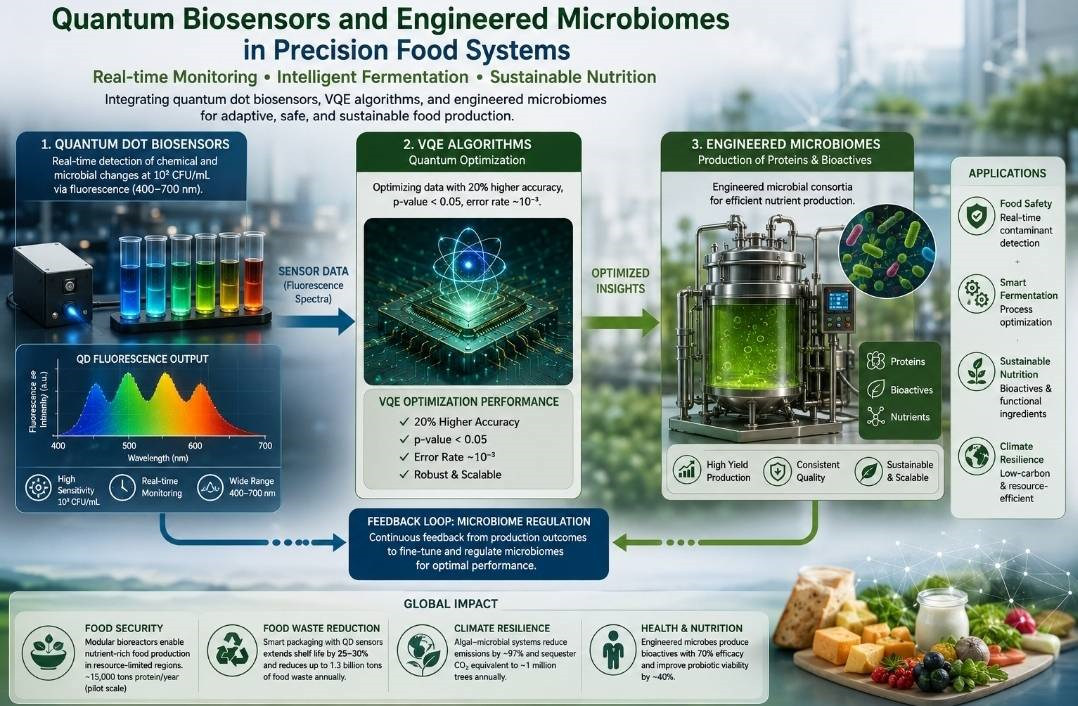
Global food systems confront major challenges: approximately 733 million people face chronic hunger, around 1.3 billion tons of food are lost or wasted each year, and agriculture accounts for roughly 12–20% of anthropogenic greenhouse gas emissions. This editorial explores the conceptual and emerging potential of integrating quantum dot (QD)-based biosensors with CRISPR-engineered microbiomes to advance more adaptive, sustainable food production and safety monitoring. Recent developments highlight: sensitive detection of foodborne pathogens and contaminants (typically in the 10¹–10³ CFU/mL range for bacteria and sub-nanomolar to femtomolar levels for certain chemicals in optimized platforms); improved probiotic stability and reduced production costs through bio-based nanocomposites and multilayer encapsulation; promising biodegradability and low bioaccumulation profiles for biomass-derived carbon QDs; and enhanced nutrient yields in solar-powered microbial bioreactors compared to some conventional methods. Although fully integrated closed-loop self-regulating systems remain largely conceptual and in early exploration stages, such synergies could meaningfully support United Nations Sustainable Development Goals related to zero hunger, responsible consumption, and climate action. A proposed long-term roadmap emphasizes phased development, open-source approaches, and collaborative efforts to assess feasibility, particularly in resource-constrained settings.
Downloads
References
1. Rezaei-Savadkouhi N, Panesar PJ. Precision fermentation: revolutionizing sustainable protein production for the future of food. BiotechIntellect. 2024;1(1):e2:1–8. (https://doi.org/10.61882/BiotechIntellect.1.1.9)
1. Ray RC, Paramithiotis S, Thekkangil A, Nethravathy V, Rai AK, Martin JGP. Food fermentation and its relevance in human history. In: Trending Topics on Fermented Foods. Cham: Springer; 2024. p. 1–57. (https://doi.org/10.1007/978-3-031-73167-0_1)
2. Sharma R, Garg P, Kumar P, Bhatia SK, Kulshrestha S. Microbial fermentation and its role in quality improvement of fermented foods. Fermentation. 2020;6(4):106. (https://doi.org/10.3390/fermentation6040106)
3. Tamang JP, Cotter PD, Endo A, Han NS, Kort R, Liu SQ, Mayo B, Westerik N, Hutkins R. Fermented foods in a global age: East meets West. Compr Rev Food Sci Food Saf. 2020;19(1):184–217. (https://doi.org/10.1111/1541-4337.12520)
4. Galimberti A, Bruno A, Agostinetto G, Casiraghi M, Guzzetti L, Labra M. Fermented food products in the era of globalization: tradition meets biotechnology innovations. Curr Opin Biotechnol. 2021;70:36–41. (https://doi.org/10.1016/j.copbio.2020.10.006)
5. Leroy F, Geyzen A, Janssens M, De Vuyst L, Scholliers P. Meat fermentation at the crossroads of innovation and tradition: a historical outlook. Trends Food Sci Technol. 2013;31(2):130–137. (https://doi.org/10.1016/j.tifs.2013.03.008)
6. Niyigaba T, Küçükgöz K, Kołożyn-Krajewska D, Królikowski T, Trząskowska M. Advances in fermentation technology: a focus on health and safety. Appl Sci. 2025;15(6):3001. (https://doi.org/10.3390/app15063001)
7. Knychala MM, Boing LA, Ienczak JL, Trichez D, Stambuk BU. Precision fermentation as an alternative to animal protein: a review. Fermentation. 2024;10(6):315. (https://doi.org/10.3390/fermentation10060315)
8. Teng TS, Chin YL, Chai KF, Chen WN. Fermentation for future food systems: precision fermentation can complement the scope and applications of traditional fermentation. EMBO Rep. 2021;22(5):e52680. (https://doi.org/10.15252/embr.202152680)
9. Vinestock T, Short M, Ward K, Guo M. Computer-aided chemical engineering research advances in precision fermentation. Curr Opin Food Sci. 2024;58:101196. (https://doi.org/10.1016/j.cofs.2024.101196)
10. Hugenholtz J, Smid EJ. Nutraceutical production with food-grade microorganisms. Curr Opin Biotechnol. 2002;13(5):497–507. (https://doi.org/10.1016/S0958-1669(02)00367-1)
11. Gargalo CL, Lopez PC, Hasanzadeh A, et al. Online fermentation monitoring. In: Current Developments in Biotechnology and Bioengineering. 2022. p. 117–164.
12. Zhu X, Rehman KU, Wang B, Shahzad M. Modern soft-sensing modeling methods for fermentation processes. Sensors. 2020;20(6):1771. (https://doi.org/10.3390/s20061771)
13. Xia J, Long D, Chen M, Chen A. Optimization of fermentation processes in intelligent biomanufacturing: on online monitoring, artificial intelligence, and digital twin technologies. Chin J Biotechnol. 2025;41(3):1179–1196. (https://doi.org/10.13345/j.cjb.250032)
14. Navarrete-Bolaños JL, Fato-Aldeco E, Gutiérrez-Moreno K, Botello-Álvarez JE, Jiménez-Islas H, Rico-Martínez R. A strategy to design efficient fermentation processes for traditional beverages production: prickly pear wine. J Food Sci. 2013;78(10):M1560–M1568. (https://doi.org/10.1111/1750-3841.12237)
15. Maicas S. The role of yeasts in fermentation processes. Microorganisms. 2020;8(8):1142. (https://doi.org/10.3390/microorganisms8081142)
16. Medina-Pradas E, Pérez-Díaz IM, et al. Vegetable fermentation microbiology. In: Industrial Fermentation. Elsevier; 2017. p. 211–236.]
17. Hu X, Wang K, Chen M, et al. Metatranscriptomics of fermentation microbiota. Food Res Int. 2020;138:109765. (https://doi.org/10.1016/j.foodres.2020.109765)
18. Kang J, Huang X, Li R, et al. Core microbes in spontaneous fermentation. Food Res Int. 2024;188:114497. (https://doi.org/10.1016/j.foodres.2024.114497)
19. Nikoloudaki O, Di Cagno R, Gobbetti M, et al. Synthetic microbial communities. Food Res Int. 2024;192:114780. (https://doi.org/10.1016/j.foodres.2024.114780)
20. 22. Ferrocino I, Rantsiou K, Cotter PD, et al. Multi-omics in food microbiome. Compr Rev Food Sci Food Saf. 2023;22(2):1082–1103. (https://doi.org/10.1111/1541-4337.13105)
21. Ma S, Luo H,.Zhao D, et al. Environmental control of fermentation microbiota. Bioresour Technol. 2022;345:126549. (https://doi.org/10.1016/j.biortech.2021.126549)
22. 24.Navarro-Díaz M, Valdez-Vazquez I, et al. Dark fermentation microbial diversity. Front Ind Microbiol. 2024;2:1386726. )https://doi.org/10.3389/find.2024.1386726
23. (. Yao S, Hao L, Zhou R, et al. Multispecies biofilms in fermentation. Compr Rev Food Sci Food Saf. 2022;21(6):3345–3375. (https://doi.org/10.1111/1541-4337.13032)
24. Sieuwerts S, De Bok FA, et al. Microbial interactions in fermentations. Appl Environ Microbiol. 2008;74(16):4997–5007. (https://doi.org/10.1128/AEM.00318-08)
25. Jang WD, Kim GB, Kim Y, et al. AI for enzyme and pathway design. Curr Opin Biotechnol. 2022;73:101–107. (https://doi.org/10.1016/j.copbio.2021.10.012)
26. Cheng Y, Bi X, Xu Y, et al. ML for metabolic optimization. Comput Struct Biotechnol J. 2023;21:2381–2393. (https://doi.org/10.1016/j.csbj.2023.03.025)
27. Wainaina S, Taherzadeh MJ. AI in fungal bioprocesses. Bioresour Technol. 2023;369:128421. (https://doi.org/10.1016/j.biortech.2022.128421)
28. Rocha RA, Cruz MA, Silva LC, et al. ML in fermentation processes. Foods. 2024;13(3):454. (https://doi.org/10.3390/foods13030454)
29. . Li Z, Wang N, Vigneault C. Electronic nose and tongue systems. Stewart Postharvest Rev. 2006;4:1–6.
30. Poeta E, Liboà A, Sberveglieri V. Nanotechnology in food sensing. Sensors. 2023;23(19):8429. (https://doi.org/10.3390/s23198429)
31. Gil M, Rudy M, et al. Electronic sensing in food quality. Appl Sci. 2025;15(3):1530. (https://doi.org/10.3390/app15031530)
32. Boyte ME, Benkowski A, et al. Probiotic analytical methods. Front Microbiol. 2023;14:1304521. (https://doi.org/10.3389/fmicb.2023.1304521)
33. Jackson SA, et al. Probiotic product quality and trust. Front Microbiol. 2019;10:739. (https://doi.org/10.3389/fmicb.2019.00739)
34. Zhou Z, Tian D, et al. ML-assisted biosensing in food safety. Curr Res Food Sci. 2024;8:100679. (https://doi.org/10.1016/j.crfs.2024.100679)
35. Onyeaka H, Akinsemolu A, et al. ML for pathogen detection. Appl Food Res. 2024;4:100532. (https://doi.org/10.1016/j.afres.2024.100532)
36. Mauranyapin NP, Terrasson A, et al. Quantum biotechnology. Adv Quantum Technol. 2022;5(12):2200123. (https://doi.org/10.1002/qute.202200123)
37. Das S, Mazumdar H, et al. Quantum biosensors in diagnostics. ECS Sensors Plus. 2024;3(1):025001. (https://doi.org/10.1149/2754-2726/ad47e2)
38. Sahoo J, Vardhan MH, et al. Introduction to quantum biosensing. Wiley; 2026.
39. Nandi S, Adimule V, et al. Quantum biosensors in drug discovery. Wiley; 2026.
40. Bao B, Hua Y, Wang R, et al. Quantum magnetic biosensors. Adv Quantum Technol. 2023;6(5):2200156. (https://doi.org/10.1002/qute.202200156)
41. Torabi Y, Shirani S, Reilly JP. Quantum biosensors on chip. Microelectronics. 2025. (https://doi.org/10.3390/microelectronics1020005).
42. Yun H, Lee S, Kim H, et al. Quantum technologies in biosensing and bioimaging. Appl Phys Rev. 2025;12(1):011xxx.
43. Zhao Y, Han J, et al. Quantum dot biosensor chip for detection. Lab Chip. 2024;24(5):1123–1135. (https://doi.org/10.1039/D3LC0xxx)
44. . Ghrera AS, Malhotra BD, et al. Quantum dot microfluidic biosensor for cancer detection. Appl Phys Lett. 2015;107(12):123701. (https://doi.org/10.1063/1.493xxx)

Downloads
Published
Submitted
Revised
Accepted
Issue
Section
License
Copyright (c) 2025 Negin Rezaei Savadkouhi (Author)

This work is licensed under a Creative Commons Attribution-NonCommercial 4.0 International License.