The Convergence of Artificial Intelligence, Machine Learning, and New Technologies in Agricultural Waste Valorization Systems
Keywords:
Waste Valorization, circular economy, artificial intelligence, thermochemical conversion, waste-to-energy, sustainable developmentAbstract
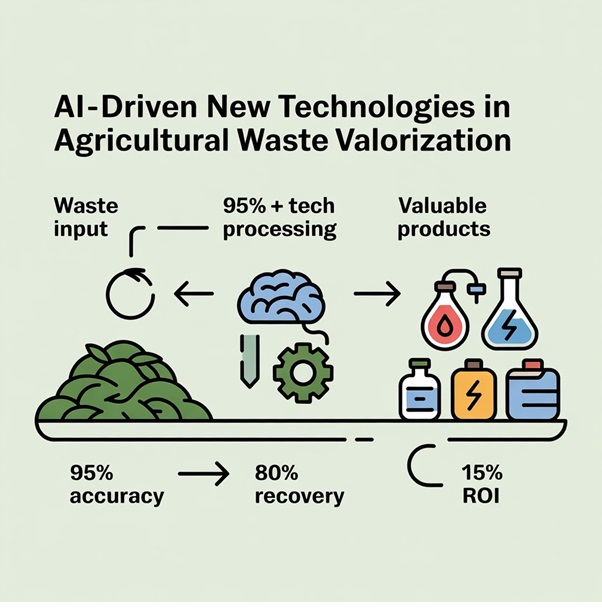
Background and Objectives: The shift towards circular economic models renders new technologies for waste valorization highly competitive as waste streams are turned into resources. In this mini review, we discuss the recent advances in technologies such as artificial intelligence (AI)-based waste management, advanced thermochemical conversion processes, biotechnological approaches, and integrated waste-to-resource platforms.
Results and Conclusions: Recent results in the application of AI for sorting technologies report classification accuracies greater than 95% for different mixed waste streams; thermochemical processes such as pyrolysis and gasification report conversion efficiencies of 70-85% for plastic and organic waste streams; biotechnological approaches such as engineered microorganisms and enzyme systems show promising advancements for converting different complex waste streams into high-value chemicals and fuels. The combination of these technologies into circular economy models provides numerous opportunities for achieving the 2030 sustainable development goals by turning waste streams, which could be treated as disposal costs, into economic value.
Downloads
References
1. Kaza S, Yao L, Bhada-Tata P, van Woerden F. What a waste 2.0: a global snapshot of solid waste management to 2050: World Bank Publications; 2018.
2. Negrete-Cardoso M, Rosano-Ortega G, Álvarez-Aros EL, Tavera-Cortés ME, Vega-Lebrún CA, Sánchez-Ruíz FJ. Circular economy strategy and waste management: a bibliometric analysis in its contribution to sustainable development, toward a post-COVID-19 era. Environ Sci Pollut Res Int. 2022;29(41):61729–46. doi:10.1007/s11356-022-18703-3 Cited in: PubMed; PMID 35668274.
3. Moraga G, Huysveld S, Mathieux F, Blengini GA, Alaerts L, van Acker K, Meester S de, Dewulf J. Circular economy indicators: What do they measure? Resour Conserv Recycl. 2019;146452–61. doi:10.1016/j.resconrec.2019.03.045 Cited in: PubMed; PMID 31274959.
4. Iacovidou E, Velis CA, Purnell P, Zwirner O, Brown A, Hahladakis J, Millward-Hopkins J, Williams PT. Metrics for optimising the multi-dimensional value of resources recovered from waste in a circular economy: A critical review. Journal of Cleaner Production. 2017;166910–38. doi:10.1016/j.j clepro.2017.07.100
5. Fang B, Yu J, Chen Z, Osman AI, Farghali M, Ihara I, Hamza EH, Rooney DW, Yap P-S. Artificial intelligence for waste management in smart cities: a review. Environ Chem Lett. 2023;1–31. doi:10.1007/s10311-023-01604-3 Cited in: PubMed; PMID 37362015.
6. Sharma HB, Vanapalli KR, Samal B, Cheela VRS, Dubey BK, Bhattacharya J. Circular economy approach in solid waste management system to
achieve UN-SDGs: Solutions for post-COVID recovery. Sci Total Environ. 2021;800149605.
doi:10.1016/j.scitotenv.2021.149605 Cited in: PubMed; PMID 34426367.
7. Russell SJ, Norvig P. Artificial Intelligence: A Modern Approach, Global Edition 4e: Pearson; 2021.
8. Binns R, editor. Fairness in machine learning: Lessons from political philosophy: PMLR; 2018. 149-159.
9. He H, Gray J, Cangelosi A, Meng Q, McGinnity TM, Mehnen J, editors. The challenges and opportunities of artificial intelligence for trustworthy robots and autonomous systems: IEEE; 2020. 68-74.
10. Bibri SE, Krogstie J, Kaboli A, Alahi A. Smarter eco-cities and their leading-edge artificial intelligence of things solutions for environmental sustainability: A comprehensive systematic review. Environ Sci Ecotechnol. 2024;19100330. doi:10.1016/j.ese. 2023.100330 Cited in: PubMed; PMID 38021367.
11. Ahmed MIB, Alotaibi RB, Al-Qahtani RA, Al-Qahtani RS, Al-Hetela SS, Al-Matar KA, Al-Saqer NK, Rahman A, Saraireh L, Youldash M. Deep learning approach to recyclable products classification: Towards sustainable waste management. Sustainability. 2023;15(14):11138.
12. Shahab S, Anjum M, Umar MS. Deep learning applications in solid waste management: A deep literature review. International Journal of Advanced Computer Science and Applications. 2022;13(3).
13. Zhang M, Fan X, Jia H, Peng W, Ren G, Du D. Green and Sustainable Biochar for Coastal Wetlands Management: A Review to Achieve In Situ Remediation by Artificial Intelligence. Water. 2024;16(14):1966.
14. Wilts H, Garcia BR, Garlito RG, Gómez LS, Prieto EG. Artificial Intelligence in the Sorting of Municipal Waste as an Enabler of the Circular Economy. Resources. 2021;10(4):28. doi:10.3390/ resources10040028
15. Kumar NM, Mohammed MA, Abdulkareem KH, Damasevicius R, Mostafa SA, Maashi MS, Chopra SS. Artificial intelligence-based solution for sorting COVID related medical waste streams and supporting data-driven decisions for smart circular economy practice. Process Safety and Environmental Protection. 2021;152482–94. doi:10.1016/j.psep.2021.06.026
16. Andeobu L, Wibowo S, Grandhi S. Artificial intelligence applications for sustainable solid waste management practices in Australia: A systematic review. Sci Total Environ. 2022;834155389.
doi:10.1016/j.scitotenv.2022.155389 Cited in: PubMed; PMID 35460765.
17. Abdallah M, Abu Talib M, Feroz S, Nasir Q, Abdalla H, Mahfood B. Artificial intelligence applications in solid waste management: A systematic research review. Waste Manag. 2020;109231–46.
doi:10.1016/j.wasman.2020.04.057 Cited in: PubMed; PMID 32428727.
18. Lee SY, Sankaran R, Chew KW, Tan CH, Krishnamoorthy R, Chu D-T, Show P-L. Waste to bioenergy: a review on the recent conversion technologies. BMC Energy. 2019;1(1). doi:10.1186/ s42500-019-0004-7
19. Hinton ZR, Talley MR, Kots PA, Le AV, Zhang T, Mackay ME, Kunjapur AM, Bai P, Vlachos DG, Watson MP, Berg MC, Epps TH, Korley LT. Innovations Toward the Valorization of Plastics Waste. Annu. Rev. Mater. Res. 2022;52(1):249–80.
doi:10.1146/annurev-matsci-081320-032344
20.Beyene HD, Werkneh AA, Ambaye TG. Current updates on waste to energy (WtE) technologies: a review. Renewable Energy Focus. 2018;241–11.
21. Tsui T-H, Wong JWC. A critical review: emerging bioeconomy and waste-to-energy technologies for sustainable municipal solid waste management. Waste Dispos. Sustain. Energy. 2019;1(3):151–67.
doi:10.1007/s42768-019-00013-z
22. Dhalsamant K, Dalai AK. Optimization and characterization of biocrude produced from hydrothermal liquefaction of food waste. Sustainable Energy Fuels. 2025;9(8):2119–36.
doi:10.1039/D5SE00136F
23. He M. Tailored waste-derived biochar for energy recovery and environmental applications. 2023.
24. Lyu X, Nuhu M, Candry P, Wolfanger J, Betenbaugh M, Saldivar A, Zuniga C, Wang Y, Shrestha S. Top-down and bottom-up microbiome engineering approaches to enable biomanufacturing from waste biomass. Journal of Industrial Microbiology and Biotechnology. 2024;51kuae025.
25. Castaldi M, van Deventer J, Lavoie JM, Legrand J, Nzihou A, Pontikes Y, Py X, Vandecasteele C, Vasudevan PT, Verstraete W. Progress and Prospects in the Field of Biomass and Waste to Energy and Added-Value Materials. Waste Biomass Valor. 2017;8(6):1875–84. doi:10.1007/s12649-017-0049-0
26. Qin Z-H, Mou J-H, Chao CYH, Chopra SS, Daoud W, Leu S-Y, Ning Z, Tso CY, Chan CK, Tang S, Hathi ZJ, Haque MA, Wang X, Lin CSK. Biotechnology of Plastic Waste Degradation, Recycling, and Valor-ization: Current Advances and Future Perspec-tives. Chem Sus Chem. 2021;14(19):4103–14. doi:10.1002/cssc.202100752 Cited in: PubMed; PMID 34137191.
27. Patel AK, Singhania RR, Albarico FPJB, Pandey A, Chen C-W, Dong C-D. Organic wastes bioremediation and its changing prospects. Sci Total Environ. 2022; 824153889. doi:10.1016/j.scitotenv.2022.153889 Cited in: PubMed; PMID 35181362.
28.Peng X, Jiang Y, Chen Z, Osman AI, Farghali M, Rooney DW, Yap P-S. Recycling municipal, agricultural and industrial waste into energy, fertilizers, food and construction materials, and economic feasibility: a review. Environ Chem Lett. 2023;21(2):765–801. doi:10.1007/s10311-022-01551-5
29. Brancoli P, Bolton K, Eriksson M. Environmental impacts of waste management and valorisation pathways for surplus bread in Sweden. Waste Manag. 2020;117136–45. doi:10.1016/j. wasman.2020.07.043 Cited in: PubMed; PMID 32823078.
30.Tawo OE, Mbamalu MI. Advancing waste valorization techniques for sustainable industrial operations and improved environmental safety. Int. J. Sci. Res. Arch. 2025;14(02):127–49.
doi:10.30574/ijsra.2025.14.2.0334
31. Goutam Mukherjee A, Ramesh Wanjari U, Chakraborty R, Renu K, Vellingiri B, George A, C R SR, Valsala Gopalakrishnan A. A review on modern and smart technologies for efficient waste disposal and management. J Environ Manage. 2021;297113347. doi:10.1016/j.jenvman.2021. 113347 Cited in: PubMed; PMID 34314963.
32. Ganguly RK, Chakraborty SK. Plastic waste management during and post Covid19 pandemic: Challenges and strategies towards circular economy. Heliyon. 2024;10(4). doi:10.1016/j .heliyon.2024.e25613
33. Serpe A, Purchase D, Bisschop L, Chatterjee D, Gioannis G de, Garelick H, Kumar A, Peijnenburg W, Piro VM, Cera M. 2002–2022: 20 years of e-waste regulation in the European Union and the worldwide trends in legislation and innovation technologies for a circular economy. RSC Sustainability. 2025;3(3):1039–83. doi:10.1039/ d4su00548a
34. Wikurendra EA, Csonka A, Nagy I, Nurika G. Urbanization and Benefit of Integration Circular Economy into Waste Management in Indonesia: A Review. Circ.Econ.Sust. 2024;4(2):1219–48. doi:10.1007/s43615-024-00346-w
35. Yang J, Jiang P, Nassar R-U-D, Suhail SA, Sufian M, Deifalla AF. Experimental investigation and AI prediction modelling of ceramic waste powder concrete – An approach towards sustainable construction. Journal of Materials Research and Technology. 2023;233676–96. doi:10.1016/ j.jmrt.2023.02.024

Downloads
Published
Submitted
Revised
Accepted
Issue
Section
License
Copyright (c) 2025 DESOBGO ZANGUE Steve Carly, Bunty Ray (Author)

This work is licensed under a Creative Commons Attribution-NonCommercial 4.0 International License.