
Quantitative Comparative Analysis of Pathogenic Microorganism Inactivation Kinetics in Spontaneous versus Directed Fermentation of Raw Milk: Evidence for Differential Efficacy and Food Safety Implications
DOI:
https://doi.org/10.66224/BiotechIntellect.2.1.30Keywords:
Pathogen kinetics, directed fermentation, microbial ecosystem dynamics, biopreservation, food safetyAbstract
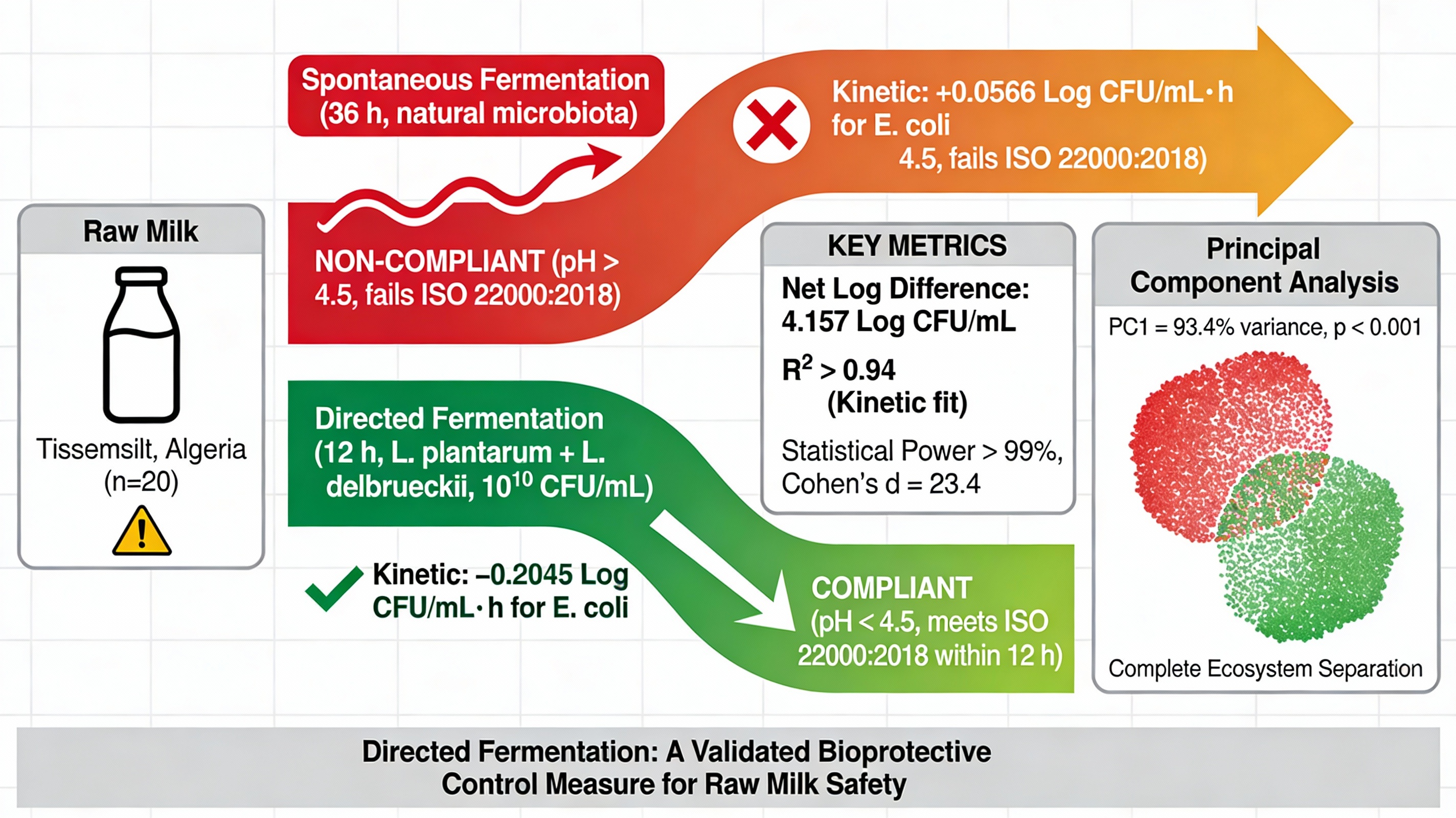
Background and Objective: Spontaneous fermentation of raw milk, ubiquitous in artisanal dairy production worldwide, frequently results in pathogen proliferation and fails to meet modern food safety standards (ISO 22000:2018). Quantitative comparative data on fermentation modalities and their kinetic behaviour remain critically limited.
Material and Methods: Raw bovine milk from Tissemsilt, Algeria (n=20 per group) underwent spontaneous fermentation (36 h) or directed fermentation (12 h) with Lactiplantibacillus plantarum and Lactobacillus delbrueckii subsp. bulgaricus (1010 CFU/mL). Escherichia coli, coliforms, Staphylococcus aureus, and total microbial flora were enumerated at predefined intervals using standard microbiological methods. Kinetic parameters were modelled via linear regression, whilst ecosystem alterations were assessed by Principal Component Analysis. Statistical power exceeded 99% with Cohen's d = 23.4.
Results and Conclusion: Natural fermentation displayed pathogen proliferation (+0.0566 Log CFU/mL.h for Escherichia coli), whilst directed fermentation achieved rapid inactivation (−0.2045 Log CFU/mL.h), creating a net 4.157 Log difference (R² > 0.94). Principal component analysis indicated complete separation between modalities (PC1 = 93.4% variance, p < 0.001). Only directed fermentation obtained pH < 4.5 and passed ISO 22000 norms within 12 h; spontaneous fermentation remained non-compliant after 36 h. Directed fermentation is categorically distinct, driving opposite kinetic trajectories and providing guaranteed pathogen control. This bioprotective approach should be implemented in dairy operations to ensure consumer safety whilst retaining traditional product value.
Downloads
References
1. Costanzo N, Ceniti C, Santoro A, Clausi MT, Casalinuovo F. Foodborne Pathogen Assessment in Raw Milk Cheeses. International Journal of Food Science. 2020;2020: 3616713. (https://doi.org/10.1155/2020/3616713).
2. Doo H, Kwak J, Keum GB, Ryu S, Choi Y, Kang J, et al. Lactic acid bacteria in Asian fermented foods and their beneficial roles in human health. Food Science and Biotechnology. 2024;33(9): 2021–2033. (https://doi.org/10.1007/s10068-024-01634-9.)
3. Barzegar H, Alizadeh Behbahani B, Falah F. Safety, probiotic properties, antimicrobial activity, and technological performance of Lactobacillus strains isolated from Iranian raw milk cheeses. Food Science & Nutrition. 2021;9(8): 4094–4107. (https://doi.org/10.1002/fsn3.2365.)
4. Mahmoudi M, Khomeiri M, Saeidi M, Davoodi H, Memarian A. Safety Assessment and Anticancer Potential of Fermented Milk Containing Enterococcus faecium KMJC93 Isolated from Traditional Sources: Fermented Milk Containing Enterococcus faecium. BiotechIntellect. 2025;2(1): e3 (1-14). https://doi.org/10.61882/BiotechIntellect.2.1.18.
5. Maktabdar M, Houmann RH, Scheel NH, Skytthe KB, Wemmenhove E, Gkogka E, et al. Evaluation and validation of extensive growth and growth boundary models for mesophilic and psychrotolerant Bacillus cereus in dairy products (Part 2). Frontiers in Microbiology. 2025;16. (https://doi.org/10.3389/fmicb.2025.1553903)
6. Johnston DJ, Theodoridou K, Gordon AW, Yan T, McRoberts WC, Ferris CP. Field bean inclusion in the diet of early-lactation dairy cows: Effects on performance and nutrient utilization. Journal of Dairy Science. 2019;102(12): 10887–10902. (https://doi.org/10.3168/jds.2019-16513.)
7. Tayeb S, Morsli A, Saadia L, Mohamed C, Khaled H, Salah-Abbes JB. Bacterial Population Kinetics and Physicochemical Profiles in Fermented Goat Milks: Roles of Streptococcus thermophiles ATCC19258 and Lactobacillus bulgaricus ATCC11842. Applied Food Biotechnology. 2025;12(1): 1-12 (e7). (https://doi.org/10.22037/afb.v12i1.47532).
8. Weinstein E, Lamba K, Bond C, Peralta V, Needham M, Beam S, et al. Outbreak of Salmonella Typhimurium Infections Linked to Commercially Distributed Raw Milk — California and Four Other States, September 2023–March 2024. 2025;74(27).
9. Coelho MC, Malcata FX, Silva CCG. Lactic Acid Bacteria in Raw-Milk Cheeses: From Starter Cultures to Probiotic Functions. Foods. 2022;11(15): 2276 . (https://doi.org/10.3390/foods11152276.)
10. Werdiningsih W, Rahayu ES, Setyaningsih W, Utami T. Addition of Lactiplantibacillus plantarum subsp. plantarum WGK4 to Pressure-cooked Komak (Lablab purpureus (L.) Sweet) to Decrease Soaking Time and Water Requirement during Acid Fermentation in Tempe Processing. Applied Food Biotechnology. 2024;11(1): e23–e23. (https://doi.org/10.22037/afb.v11i1.44970.)
11. Rouhi S, Hashemiravan M, Zand N, Adl SN. Production of Synbiotic Raspberry Jam with Inulin Content and Lactic Acid Bacteria. BiotechIntellect. 2024;1(1): e3 (1-8). (https://doi.org/10.61882/BiotechIntellect.1.1.1.)
12. CHOLOE A, cecile mangavel, cecile callon. Serial fermentation in milk generates functionally diverse community lineages with different degrees of structure stabilization. 2024. (https://journals.asm.org/doi/epub/10.1128/msystems.00445-24.)
13. J.O.R.A. J.O.R.F. In: ITBM-RBM News. 2017. p. 13–31.
14. Mkhwanazi F, Mazibuko T, Mosoma O, Rathebe M, Patel M. Comparison of PetrifilmTM AC and pour plate techniques used for the heterotrophic aerobic bacterial count in water. FEMS microbiology letters. 2024;371: fnae029. (https://doi.org/10.1093/femsle/fnae029.)
15. Sessou P, Keisam S, Gagara M, Komagbe G, Farougou S, Mahillon J, et al. Comparative analyses of the bacterial communities present in the spontaneously fermented milk products of Northeast India and West Africa. Frontiers in Microbiology. 2023; 14. (https://doi.org/10.3389/fmicb.2023.1166518)
16. Martuzzi F, Franceschi P, Formaggioni P. Fermented Mare Milk and Its Microorganisms for Human Consumption and Health. Foods. 2024;13(3): 493. (https://doi.org/10.3390/foods13030493.)
17. Tayeb S, Saadia L, Hakim T, Abdellah F, Hamden K. Effect of milking frequency on the hygiene index and nutritional quality of raw milk : Mid-northern region Algerian study. Modern Phytomorphology. 2025;18: 9. (https://doi.org/10.5281/zenodo.14619456).
18. Colautti A, Orecchia E, Comi G, Iacumin L. Lactobacilli, a Weapon to Counteract Pathogens through the Inhibition of Their Virulence Factors. Journal of Bacteriology. 2022;204(11): e00272-22. (https://doi.org/10.1128/jb.00272-22.)
19. Castro VS, Ngo S, Stanford K. Influence of temperature and pH on induction of Shiga toxin Stx1a in Escherichia coli. Frontiers in Microbiology. 2023;14: 1181027. (https://doi.org/10.3389/fmicb.2023.1181027)
20. Maktabdar M, Wemmenhove E, Gkogka E, Dalgaard P. Development of extensive growth and growth boundary models for mesophilic and psychrotolerant Bacillus cereus in dairy products (Part 1). Frontiers in Microbiology. 2025;16: 1553885. (https://doi.org/10.3389/fmicb.2025.155388)
21. González‐González F, Delgado S, Ruiz L, Margolles A, Ruas‐Madiedo P. Functional bacterial cultures for dairy applications: Towards improving safety, quality, nutritional and health benefit aspects. Journal of Applied Microbiology. 2022;133(1): 212–229. (https://doi.org/10.1111/jam.15510.)
22. Atasoy M, Álvarez Ordóñez A, Cenian A, Djukić-Vuković A, Lund PA, Ozogul F, et al. Exploitation of microbial activities at low pH to enhance planetary health. FEMS Microbiology Reviews. 2024;48(1): fuad062. (https://doi.org/10.1093/femsre/fuad062.)
23. Karssa TH, Kussaga JB, Semedo-Lemsaddek T, Mugula JK. Insights on the microbiology of Ethiopian fermented milk products: A review. Food Science & Nutrition. 2024;12(10): 6990–7003. (https://doi.org/10.1002/fsn3.4372.)
24. Guo X, Ma L, Qiao Z, Luo L, Zhang Y, Wang X, et al. The antibacterial mechanism of the novel bacteriocin LpH25 and the synergistic preservation effect of this bacteriocin and Nisin in fresh milk. LWT. 2024;194: 115766. (https://doi.org/10.1016/j.lwt.2024.115766.)
25. Lin M, Lin S, He H, Yu Y, Hu J, Zhou L. Lactiplantibacillus plantarum in fermented beverages: Properties, mechanisms, and future prospects. Journal of Functional Foods. 2025;129: 106864. (https://doi.org/10.1016/j.jff.2025.106864.)
26. Huang F, Zhao Y, Hou Y, Yang Y, Yue B, Zhang X. Unraveling the antimicrobial potential of Lactiplantibacillus plantarum strains TE0907 and TE1809 sourced from Bufo gargarizans: advancing the frontier of probiotic-based therapeutics. Frontiers in Microbiology. 2024;15. (https://doi.org/10.3389/fmicb.2024.134783)
27. Siedler S, Rau MH, Bidstrup S, Vento JM, Aunsbjerg SD, Bosma EF, et al. Competitive Exclusion Is a Major Bioprotective Mechanism of Lactobacilli against Fungal Spoilage in Fermented Milk Products. Applied and Environmental Microbiology. 2020;86(7): e02312-19. (https://doi.org/10.1128/AEM.02312-19.)
28. Zare D, Aryaee H, Mirdamadi S, Shirkhan F. A Review on Isolation Sources of Lactiplant-ibacillus Plantarum in Iran and Other Countries from Food Sources and with Food Applications. Microbiology, Metabolites and Biotechnology. 2024;7(1): 26–37. (https://doi.org/10.22104/mmb.2024.6836.1138.)
29. Erem E, Kilic-Akyilmaz M. The role of fermentation with lactic acid bacteria in quality and health effects of plant-based dairy analogues. Comprehensive Reviews in Food Science and Food Safety. 2024;23(4): e13402. (https://doi.org/10.1111/1541-4337.13402.)
30. Food and Agriculture Organization of the United Nations. Control measures for Shiga toxin-producing Escherichia coli (STEC) associated with meat and dairy products. 2022 Oct [Accessed 2nd December 2025]. (https://doi.org/10.4060/cc2402en.)
31. Gao Y, Liu Y, Ma T, Liang Q, Sun J, Wu X, et al. Fermented Dairy Products as Precision Modulators of Gut Microbiota and Host Health: Mechanistic Insights, Clinical Evidence, and Future Directions. Foods. 2025;14(11): 1946. (https://doi.org/10.3390/foods14111946.)
32. Gänzle MG, Monnin L, Zheng J, Zhang L, Coton M, Sicard D, et al. Starter Culture Development and Innovation for Novel Fermented Foods. Annual Review of Food Science and Technology. 2024;15(1): 211–239. (https://doi.org/10.1146/annurev-food-072023-034207.)
33. He W, Zeng Y, Shen J, Li K, Zhou Y, Zeng X, et al. Enhanced bacteriocin production by lactic acid bacteria by co-culture of Lactipla-ntibacillus plantarum and Limosilactobacillus fermentum. Food Bioscience. 2025;68: 106358. (https://doi.org/10.1016/j.fbio.2025.106358.)
34. Lin M, Lin S, He H, Yu Y, Hu J, Zhou L. Lactiplantibacillus plantarum in fermented beverages: Properties, mechanisms, and future prospects. Journal of Functional Foods. 2025;129: 106864. (https://doi.org/10.1016/j.jff.2025.106864.)
35. Gänzle MG, Seifert J, Weiss J, Zijlstra RT. Food Fermentation: an essential unit operation towards secure, sustainable, safe, and sustaining food systems. Frontiers in Science. 2025;3. (https://doi.org/10.3389/fsci.2025.1693920.)
Downloads
Publication Timeline
- Submitted
- Revised
- Accepted
Issue
Section
License
Copyright (c) 2025 Silarbi Tayeb (Author); Amirouche moesli, Chahbar Mohamed , Hamden Khaled

This work is licensed under a Creative Commons Attribution-NonCommercial 4.0 International License.