
Boosting Chicken Sausage Quality with Javanese Grasshopper Flour: Enhanced Nutrition, Antioxidant Benefits, and Microbial Safety
Keywords:
Edible Insect Fortification, Javanese Grasshopper Flour, Chicken Sausage Nutrition, Antioxidant Activity, Microbial Safety, Sustainable Protein Source, Valanga nigricornis, Sensory Evaluation, Mineral EnrichmentAbstract
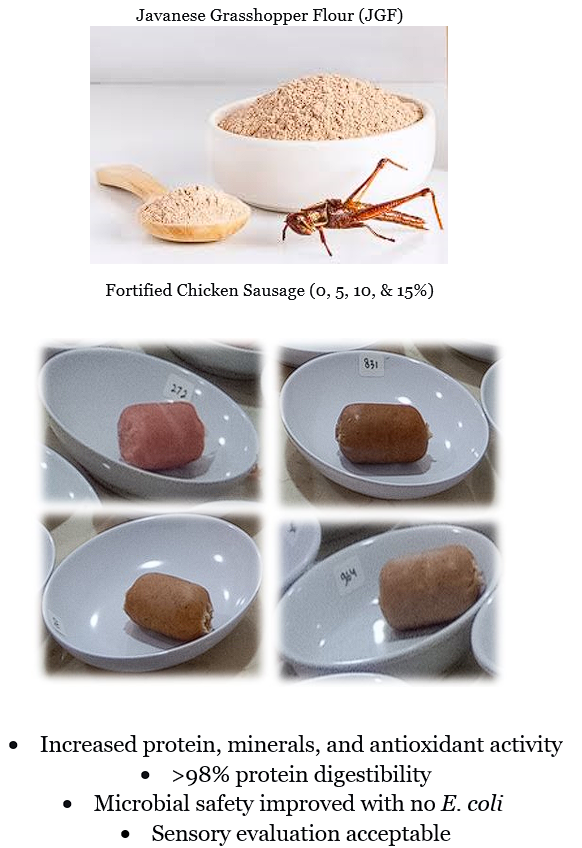
This research explores the potential of Javanese grasshopper (Valanga nigricornis Burm.) flour (JGF) as a sustainable fortification ingredient in chicken sausages, focusing on nutritional, functional, and sensory enhancements. A completely randomized design was employed to assess four formulations: a control (F0, 0% JGF) and three JGF levels at 5% (F3), 10% (F2), and 15% (F1). JGF-fortified sausages exhibited significantly higher protein, fat, and mineral content (calcium, zinc, magnesium, iron) compared to the control (p<0.05), alongside reduced carbohydrate and energy levels. All formulations achieved protein digestibility above 98%. Antioxidant activity, measured via DPPH and ABTS assays, was markedly elevated in JGF-fortified sausages, with F1 demonstrating the highest potency. Microbial analysis revealed lower total bacterial counts and no E. coli in JGF formulations, indicating improved food safety. Sensory analysis showed that F2 (10% JGF) was most preferred, despite slight reductions in color and texture appeal compared to the control. Principal component and hierarchical clustering analyses confirmed that JGF-fortified sausages outperformed the control in nutritional and antioxidant properties. These findings underscore the value of edible insects as innovative, nutrient-rich ingredients for advancing meat product quality and sustainability.
Downloads
References
1. Wahyono ND, Utami MMD, editors. A review of the poultry meat production industry for food safety in Indonesia. Journal of Physics: conference series; 2018: IOP Publishing. https://doi.org/10.1088/1742-6596/953/1/012125
2. Wati AM, Azizah S. Organoleptic Quality of Chicken Sausage with Different Brands in Kediri City. Jurnal Ternak. 2023;14(1):10-5.
ISSN 2684-6799 (Online), https://doi.org/10.30736/jt.v14i1.189
3. Montalvo-Puente AP, Torres-Gallo R, Acevedo-Correa D, Montero-Castillo PM, Tirado DF. Nutritional comparison of beef, pork and chicken meat from Maracaibo city (Venezuela). Advance Journal of Food Science and Technology. 2018;15(S):218-24, https://doi.org/10.19026/ajfst.14.5898
4. Sun G, Xiong Y, Feng X, Fang Z. Effects of incorporation of hempseed meal on the quality attributes of chicken sausage. Future Foods. 2022;6:100169, https://doi.org/10.1016/j.fufo.2022.100169
5. Huis Av, Itterbeeck JV, Klunder H, Mertens E, Halloran A, Muir G, Vantomme P. Edible insects: future prospects for food and feed security. 2013.
6. Soloman M, Ladeji O, Umoru H. Nutritional evaluation of the giant grasshopper (Zonocerus variegatus) protein and the possible effects of its high dietary fibre on amino acids and mineral bioavailability. African Journal of Food, Agriculture, Nutrition and Development. 2008;8(2):238-51, https://doi.org/10.4314/ajfand.v8i2.19191
7. Orkusz A. Edible insects versus meat—Nutritional comparison: Knowledge of their composition is the key to good health. Nutrients. 2021;13(4):1207, https://doi.org/10.3390/nu13041207
8. Ajai A, Bankole MT, Jacob JO. Determination of some essential minerals in selected edible insects. 2013; 7(5):194-197, https://doi.org/10.5897/AJPAC2013.0504
9. Iwansyah A, Kristanti D, Andriansyah R, Pramareti G, Aditya I, Azzahra F, Bakar SN, editors. Effect of javanese grasshopper (Valanga nigricornis Burm.) flour on chicken sausage physical properties and its microstructure. IOP Conference Series: Earth and Environmental Science; 2024: IOP Publishing, https://doi.org/10.1088/1755-1315/1377/1/012032.
10. Espitia-Hernández P, Ruelas-Chacón X, Chávez-González ML, Ascacio-Valdés JA, Flores-Naveda A, Sepúlveda-Torre L. Solid-state fermentation of Sorghum by Aspergillus oryzae and Aspergillus niger: Effects on tannin content, phenolic profile, and antioxidant activity. Foods. 2022;11(19):3121, https://doi.org/10.3390/foods11193121.
11. Roncolini A, Milanović V, Aquilanti L, Cardinali F, Garofalo C, Sabbatini R, et al. Lesser mealworm (Alphitobius diaperinus) powder as a novel baking ingredient for manufacturing high-protein, mineral-dense snacks. Food Res Int. 2020;131:109031, https://doi.org/10.1016/j.foodres.2020.109031.
12. Osimani A, Milanović V, Cardinali F, Roncolini A, Garofalo C, Clementi F, et al. Bread enriched with cricket powder (Acheta domesticus): A technological, microbiological and nutritional evaluation. Innov Food Sci Emerg Technol. 2018;48:150-63, https://doi.org/10.1016/j.ifset.2018.06.007.
13. Paulin IG, Purwanto MGM. Nutritional characteristics of teak grasshopper (Valanga nigricornis Burmeister), cricket (Brachytrupes portentosus L.), and mealworm (Tenebrio molitor) as alternative food sources in Indonesia. Indonesian journal of biotechnology and biodiversity. 2020;4(1):52-61, https://doi.org/10.47007/ijobb.v4i1.62.
14. Kuntadi K, Adalina Y, Maharani KE. Nutritional compositions of six edible insects in Java. Indonesian Journal of Forestry Research. 2018;5(1), https://doi.org/10.59465/ijfr.2018.5.1.57-68.
15. Oyeyinka SA, Bassey I-AV. Composition, functionality, and baking quality of flour from four brands of wheat flour. Journal of Culinary Science & Technology. 2025;23(1):87-107, https://doi.org/10.1080/15428052.2023.2191874.
16. Finke MD, Oonincx D. Insects as food for insectivores. Mass production of beneficial organisms: Elsevier; 2023. p. 511-40, https://doi.org/10.1016/B978-0-12-822106-8.00019-1.
17. Institute of Medicine (US) and National Research Council (US) Committee on the Review of the Use of Scientific Criteria and Performance Standards for Safe Food. Scientific Criteria to Ensure Safe Food. Washington (DC): National Academies Press (US); 2003. PMID: 25057659, https://doi.org/10.17226/10690.
18. Bedada TL, Feto TK, Awoke KS, Derra FA, Gebre SG, Sima WG, et al. Microbiological and public health status of cooked meat and fish in Ethiopia. The Open Microbiology Journal. 2020;14(1), http://dx.doi.org/10.2174/1874285802014010123.
19. Gravel A, Doyen A. The use of edible insect proteins in food: Challenges and issues related to their functional properties. Innov Food Sci Emerg Technol. 2020;59:102272, https://doi.org/10.1016/j.ifset.2019.102272.
20. Zielińska E, Pečová M, Pankiewicz U. Impact of mealworm powder (Tenebrio molitor) fortification on ice cream quality. Sustainability. 2023;15(22):16041, https://doi.org/10.3390/su152216041.
21. Gumul D, Berski W, Zięba T. The influence of fruit pomaces on nutritional, pro-health value and quality of extruded gluten-free snacks. Applied Sciences. 2023;13(8):4818, https://doi.org/10.3390/app13084818.

Downloads
Published
Submitted
Revised
Accepted
Issue
Section
License
Copyright (c) 2025 Ade Iwansyah (Author)

This work is licensed under a Creative Commons Attribution-NonCommercial 4.0 International License.