
Biotechnological Mitigation of Phthalates in the Food Chain: Packaging Migration, Dietary Exposure, and Probiotic Detoxification
Keywords:
Biosorption, Food packaging, Dietary exposure, Lactic acid bacteria, Migration, Phthalate , Plasticizers, Probiotic detoxificationAbstract
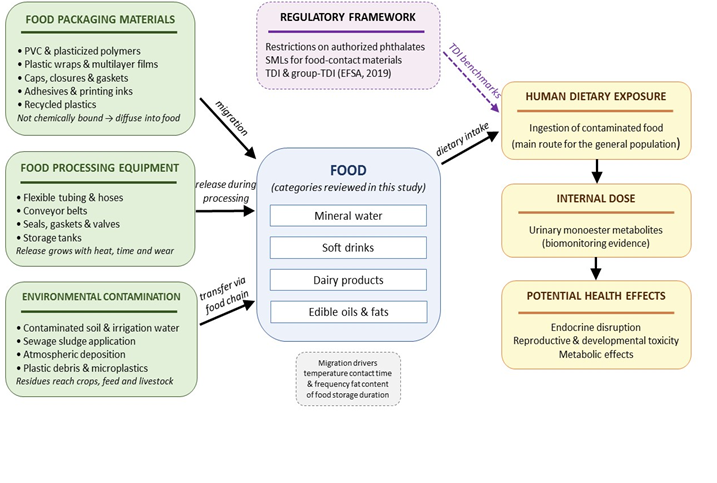
Background and aims: Phthalates are plasticizers produced in volumes so large that dietary exposure has become universal. Because they remain unbound within polymer networks, these compounds migrate into food during processing, storage, and distribution, with additional inputs entering crops and livestock through environmental contamination.
Materials and Methods: Following a structured search across four databases, this review synthesizes evidence on the routes of food contamination, analytical challenges, dietary intakes, toxicological endpoints, and emerging mitigation strategies.
Results and Conclusion: Occurrence data consistently show that lipid-rich items such as edible oils and dairy products accumulate the heaviest loads, though storage temperature and acidity can also drive measurable leaching into bottled water and soft drinks. Estimated intakes indicate that young children and high consumers of packaged foods absorb a noticeable share of established tolerable daily intakes, particularly when compounds are assessed as cumulative mixtures under European Food Safety Authority guidance. Given that current regulations and industrial substitutes like DINCH and DEHT leave historical residues in circulation, biological mitigation has emerged as a complementary safeguard. Food-grade lactic acid bacteria, notably strains of Lactobacillus and Lactiplantibacillus, can physically sequester phthalate diesters and reactive monoesters such as MEHP through peptidoglycan and exopolysaccharide surface binding, reducing free toxicant fractions in fermented matrices and accelerating fecal clearance in vivo. We conclude by outlining critical research priorities, including outdated occurrence surveys, single-compound regulatory baselines, and the need to validate microbial biosorption under commercial food-processing conditions.
Downloads
References
1. Wang, Y., & Qian, H. (2021). Phthalates and their impacts on human health. Healthcare, 9(5), 603. https://doi.org/10.3390/healthcare9050603
2. Agency for Toxic Substances and Disease Registry (ATSDR). (1995). Toxicological profile for diethyl phthalate. U.S. Department of Health and Human Services, Public Health Service, Atlanta, GA.
3. Schettler, T. (2006). Human exposure to phthalates via consumer products. International Journal of Andrology, 29(1), 134–139. https://doi.org/10.1111/j.1365-2605.2005.00567.x
4. Arrigo, F., Impellitteri, F., Piccione, G., & Faggio, C. (2023). Phthalates and their effects on human health: Focus on erythrocytes and the reproductive system. Comparative Biochemistry and Physiology Part C: Toxicology & Pharmacology, 270, 109645. https://doi.org/10.1016/j.cbpc.2023.109645
5. Calcaterra, V., Cena, H., Loperfido, F., Rossi, V., Grazi, R., Quatrale, A., De Giuseppe, R., Manuelli, M., & Zuccotti, G. (2024). Evaluating phthalates and bisphenol in foods: risks for precocious puberty and early-onset obesity. Nutrients, 16(16), 2732. https://doi.org/10.3390/nu16162732
6. Bradley, E. L., Burden, R. A., Leon, I., Mortimer, D. N., & Speck, D. R. (2012). Determination of phthalates in foods and establishing methodology to distinguish their source. Food Standards Agency Project C01048, Food and Environment Research Agency (FERA), York, UK.
7. Tumu, K., Vorst, K., & Curtzwiler, G. (2023). Endocrine modulating chemicals in food packaging: A review of phthalates and bisphenols. Compreh-ensive Reviews in Food Science and Food Safety, 22(2), 1337–1359. https://doi.org/10.1111/1541-4337.13113
8. Sathyanarayana, S. (2008). Phthalates and children's health. Current Problems in Pediatric and Adolescent Health Care, 38(2), 34–49. https://doi.org/10.1016/j.cppeds.2007.11.001
9. David, R. M., Bachman, A. N., Butala, J. H., Piper, J. T., & Shelp, C. J. (2012). Esters of mono-, di-, and tricarboxylic acids. In Patty's Toxicology (6th ed., Vol. 4, pp. 625–783). John Wiley & Sons. https://doi.org/10.1002/0471435139.tox080.pub2
10. Koch, H. M., & Calafat, A. M. (2009). Human body burdens of chemicals used in plastic manufacture. Philosophical Transactions of the Royal Society B: Biological Sciences, 364(1526), 2063–2078. https://doi.org/10.1098/rstb.2008.0208
11. Tanzer, M., Boissiere-O’Neill, T., Sly, P. D., & Vilcins, D. (2025). Phthalates, bisphenols and per-and polyfluoroalkyl substances migration from food packaging into food: a systematic review. Reviews on Environmental Health, 40(3), 616–625. https://doi.org/10.1515/reveh-2025-0027
12. Cao, X. L. (2010). Phthalate esters in foods: sources, occurrence, and analytical methods. Comprehensive Reviews in Food Science and Food Safety, 9(1), 21–43. https://doi.org/10.1111/j.1541-4337.2009.00093.x
13. Giuliani, A., Zuccarini, M., Cichelli, A., Khan, H., & Reale, M. (2020). Critical review on the presence of phthalates in food and evidence of their biological impact. International Journal of Environmental Research and Public Health, 17(16), 5655. https://doi.org/10.3390/ijerph17165655
14. Net, S., Sempéré, R., Delmont, A., Paluselli, A., & Ouddane, B. (2015). Occurrence, fate, behavior and ecotoxicological state of phthalates in different environmental matrices. Environmental Science & Technology, 49(7), 4019–4035. https://doi.org/10.1021/es505233b
15. Feng, Y.-L., Zhu, J., & Sensenstein, R. (2005). Development of a headspace solid-phase microextraction method combined with gas chromatography mass spectrometry for the determination of phthalate esters in cow milk. Analytica Chimica Acta, 538(1–2), 41–48. https://doi.org/10.1016/j.aca.2005.02.020
16. Cavaliere, B., Macchione, B., Sindona, G., & Tagarelli, A. (2008). Tandem mass spectrometry in food safety assessment: the determination of phthalates in olive oil. Journal of Chromatography A, 1205(1–2), 137–143. https://doi.org/10.1016/j.chroma.2008.08.009
17. Montuori, P., Jover, E., Morgantini, M., Bayona, J. M., & Triassi, M. (2008). Assessing human exposure to phthalic acid and phthalate esters from mineral water stored in polyethylene terephthalate and glass bottles. Food Additives and Contaminants, 25(4), 511–518. https://doi.org/10.1080/02652030701551800
18. Schmid, P., Kohler, M., Meierhofer, R., Luzi, S., & Wegelin, M. (2008). Does the reuse of PET bottles during solar water disinfection pose a health risk due to the migration of plasticisers and other chemicals into the water? Water Research, 42(20), 5054–5060. https://doi.org/10.1016/j.watres.2008.09.025
19. Sauvant, M. P., Pepin, D., & Bohatier, J. (1995). Chemical and in vitro toxicological evaluations of water packaged in polyvinyl chloride and polyethylene terephthalate bottles. Food Additives & Contaminants, 12(4), 567–584. https://doi.org/10.1080/02652039509374345
20. Castle, L., Mayo, A., Crews, C., & Gilbert, J. (1989). Migration of poly(ethylene terephthalate) (PET) oligomers from PET plastics into foods during microwave and conventional cooking and into bottled beverages. Journal of Food Protection, 52(5), 337–342. https://doi.org/10.4315/0362-028X-52.5.337
21. Lorusso, S., Gramiccioni, L., Di Marzio, S., Milana, M. R., Di Prospero, P., & Papetta, A. (1985). Acetaldehyde migration from poly (ethylene-terephthalate)(PET) containers. GC determination and toxicological assessment. Annali di Chimica, 75, 403–414.
22. Reimann, C., Birke, M., & Filzmoser, P. (2010). Bottled drinking water: water contamination from bottle materials (glass, hard PET, soft PET), the influence of colour and acidification. Applied Geochemistry, 25(7), 1030–1046. https://doi.org/10.1016/j.apgeochem.2010.04.009
23. Castle, L., Mayo, A., & Gilbert, J. (1989). Migration of plasticizers from printing inks into foods. Food Additives & Contaminants, 6(4), 437–443. https://doi.org/10.1080/02652038909373802
24. Biscardi, D., Monarca, S., De Fusco, R., Senatore, F., Poli, P., Buschini, A., Rossi, C., & Zani, C. (2003). Evaluation of the migration of mutagens/carcinogens from PET bottles into mineral water by Tradescantia/micronuclei test, Comet assay on leukocytes and GC/MS. Science of the Total Environment, 302(1–3), 101–108. https://doi.org/10.1016/s0048-9697(02)00349-2
25. Keresztes, S., Tatár, E., Czégény, Z., Záray, G., & Mihucz, V. G. (2013). Study on the leaching of phthalates from polyethylene terephthalate bottles into mineral water. Science of the Total Environment, 458–460, 451–458. https://doi.org/10.1016/j.scitotenv.2013.04.056
26. Casajuana, N., & Lacorte, S. (2003). Presence and release of phthalic esters and other endocrine disrupting compounds in drinking water. Chromatographia, 57(9), 649–655. https://doi.org/10.1007/BF02491744
27. Leivadara, S. V., Nikolaou, A. D., & Lekkas, T. D. (2008). Determination of organic compounds in bottled waters. Food Chemistry, 108(1), 277–286. https://doi.org/10.1016/j.foodchem.2007.10.031
28. Criado, M. V., Pinto, V. E. F., Badessari, A., & Cabral, D. (2005). Conditions that regulate the growth of moulds inoculated into bottled mineral water. International Journal of Food Microbiology, 99(3), 343–349. https://doi.org/10.1016/j.ijfoodmicro.2004.10.036
29. Wormuth, M., Scheringer, M., Vollenweider, M., & Hungerbühler, K. (2006). What are the sources of exposure to eight frequently used phthalic acid esters in Europeans? Risk Analysis, 26(3), 803–824. https://doi.org/10.1111/j.1539-6924.2006.00770.x
30. De Fusco, R., Monarca, S., Biscardi, D., Pasquini, R., & Fatigoni, C. (1990). Leaching of mutagens into mineral water from polyethyleneterephthalate bottles. Science of the Total Environment, 90, 241–248. https://doi.org/10.1016/0048-9697(90)90196-2
31. Selvaraj, K. K., Mubarakali, H., Rathinam, M., Harikumar, L., Sampath, S., Shanmugam, G., & Ramaswamy, B. R. (2016). Cumulative exposure and dietary risk assessment of phthalates in bottled water and bovine milk samples: A preliminary case study in Tamil Nadu, India. Human and Ecological Risk Assessment: An International Journal, 22(5), 1166–1182. https://doi.org/10.1080/10807039.2016.1146984
32. Xue, X., Su, Y., Su, H., Fan, D., Jia, H., Chu, X., Song, X., Liu, Y., Li, F., Liu, W., & Xue, J. (2021). Occurrence of phthalates in bottled drinks in the Chinese market and its implications for dietary exposure. Molecules, 26(19), 6054. https://doi.org/10.3390/molecules26196054
33. Bošnir, J., Puntarić, D., Galić, A., Škes, I., Dijanić, T., Klarić, M., Grgić, M., Čurković, M., & Šmit, Z. (2007). Migration of phthalates from plastic containers into soft drinks and mineral water. Food Technology and Biotechnology, 45(1), 91–95.
34. Ayofe, N. A., Oladoye, P. O., & Jegede, D. O. (2018). Extraction and quantification of phthalates in plastic coca-cola soft drinks using high performance liquid chromatography (HPLC). Chemical Inter-national, 4(2), 85–91.
35. Ruuska, R. M., Korkeala, H., Liukkonen-Lilja, H., Suortti, T., & Salminen, K. (1987). Migration of contaminants from milk tubes and teat liners. Journal of Food Protection, 50(4), 316–320. https://doi.org/10.4315/0362-028X-50.4.316
36. Blüthgen, A. (2000). Organic migration agents into milk at farm level (illustrated with diethylhexylphthalate). Bulletin of the International Dairy Federation, 350, 17–23.
37. Zhu, J., Phillips, S., & Cao, X.-L. (2010). Chemical contaminants: phthalates. In L. M. L. Nollet & F. Toldrá (Eds.), Handbook of Dairy Foods Analysis (pp. 777–800). CRC Press, New York. https://doi.org/10.1201/9781420046328-46
38. Guo, Y., Zhang, Z., Liu, L., Li, Y., Ren, N., & Kannan, K. (2012). Occurrence and profiles of phthalates in foodstuffs from China and their implications for human exposure. Journal of Agricultural and Food Chemistry, 60(27), 6913–6919. https://doi.org/10.1021/jf3021128
39. Zelenkin, S., Shur, P., Ulanova, T., Karnazhitskaya, T., Khoroshavin, V., & Ukhabov, V. (2018). Assessment of health risk caused by phthalates penetrating a body with milk in polymer and polymer-containing package. Health Risk Analysis, (1), 32–38. https://doi.org/10.21668/health.risk/2018.1.04.eng
40. Fierens, T., Van Holderbeke, M., Willems, H., De Henauw, S., & Sioen, I. (2013). Transfer of eight phthalates through the milk chain—A case study. Environment International, 51, 1–7. https://doi.org/10.1016/j.envint.2012.10.002
41. Gupta, R. K., Pipliya, S., Karunanithi, S., Eswaran U, G. M., Kumar, S., Mandliya, S., Srivastav, P. P., Suthar, T., Shaikh, A. M., & Harsányi, E. (2024). Migration of chemical compounds from packaging materials into packaged foods: Interaction, mechanism, assessment, and regulations. Foods, 13(19), 3125. https://doi.org/10.3390/foods13193125
42. Sungur, S., Okur, R., Turgut, F. H., Ustun, I., & Gokce, C. (2015). Migrated phthalate levels into edible oils. Food Additives & Contaminants: Part B, 8(3), 190–194. https://doi.org/10.1080/19393210.2015.1041065
43. Shi, L.-K., Zhang, M.-M., & Liu, Y.-L. (2016). Concentration and survey of phthalic acid esters in edible vegetable oils and oilseeds by gas chromatography-mass spectrometry in China. Food Control, 68, 118–123. https://doi.org/10.1016/j.foodcont.2016.03.027
44. Mo Dugo, G., Fotia, V., Turco, V. L., Maisano, R., Potorti, A. G., Salvo, A., & Di Bella, G. (2011). Phthalate, adipate and sebacate residues by HRGC-MS in olive oils from Sicily and Molise (Italy). Food Control, 22(6), 982–988. https://doi.org/10.1016/j.foodcont.2010.12.006
45. Fankhauser-Noti, A., & Grob, K. (2006). Migration of plasticizers from PVC gaskets of lids for glass jars into oily foods: amount of gasket material in food contact, proportion of plasticizer migrating into food and compliance testing by simulation. Trends in Food Science & Technology, 17(3), 105–112. https://doi.org/10.1016/j.tifs.2005.10.013
46. Guart, A., Bono-Blay, F., Borrell, A., & Lacorte, S. (2011). Migration of plasticizers, phthalates, bisphenol A and alkylphenols from plastic containers and evaluation of risk. Food Additives & Contaminants: Part A, 28(5), 676–685. https://doi.org/10.1080/19440049.2011.555845
47. James-Todd, T., Stahlhut, R., Meeker, J. D., Powell, S.-G., Hauser, R., Huang, T., & Rich-Edwards, J. (2012). Urinary phthalate metabolite concen-trations and diabetes among women in the National Health and Nutrition Examination Survey (NHANES) 2001–2008. Environmental Health Pers-pectives, 120(9), 1307–1313. https://doi.org/10.1289/ehp.1104717
48. Woodruff, T. J., Zota, A. R., & Schwartz, J. M. (2011). Environmental chemicals in pregnant women in the United States: NHANES 2003–2004. Environmental Health Perspectives, 119(6), 878–885. https://doi.org/10.1289/ehp.1002727
49. EFSA Panel on Food Contact Materials, Enzymes and Processing Aids (CEP), Silano, V., Barat Baviera, J. M., Bolognesi, C., Chesson, A., Cocconcelli, P. S., Crebelli, R., Gott, D. M., Grob, K., Lampi, E., Mortensen, A., Rivière, G., Steffensen, I.-L., Tlustos, C., Van Loveren, H., Vernis, L., Zorn, H., & Castle, L. (2019). Update of the risk assessment of di-butylphthalate (DBP), butyl-benzyl-phthalate (BBP), bis(2-ethylhexyl)phthalate (DEHP), di-isononyl-phthalate (DINP) and di-isodecylphthalate (DIDP) for use in food contact materials. EFSA Journal, 17(12), e05838. https://doi.org/10.2903/j.efsa.2019.5838
50. Cirillo, T., Fasano, E., Castaldi, E., Montuori, P., & Amodio Cocchieri, R. (2011). Children's exposure to Di(2-ethylhexyl)phthalate and dibutylphthalate plasticizers from school meals. Journal of Agricultural and Food Chemistry, 59(19), 10532–10538. https://doi.org/10.1021/jf2020446
51. Beg, M. A., & Sheikh, I. A. (2020). Endocrine disruption: structural interactions of androgen receptor against Di (2-ethylhexyl) phthalate and its metabolites. Toxics, 8(4), 115. https://doi.org/10.3390/toxics8040115
52. Chen, R., & Zhao, Y. (2017). Safety of food contact materials and articles in China. In Food Safety in China: Science, Technology, Management and Regulation (pp. 593–608). John Wiley & Sons. https://doi.org/10.1002/9781119238102.ch35
53. Sforzi, L., Piqué, V. A., Martellini, T., Cincinelli, A., Eljarrat, E., & Barbieri, M. V. (2026). Storage-driven migration of plastic additives from packaging to fish: Influencing factors and human exposure assessment. Environment International, 211, 110261. https://doi.org/10.1016/j.envint.2026.110261
54. European Commission. (2011). Commission Regulation (EU) No 10/2011 of 14 January 2011 on plastic materials and articles intended to come into contact with food (consolidated text, as amended by Commission Regulation (EU) 2020/1245). Official Journal of the European Union, L 12, 1–89. https://eur-lex.europa.eu/eli/reg/2011/10/oj
55. U.S. Food and Drug Administration (FDA). (2022). Phthalates in Food Packaging and Food Contact Applications: Final rule. Federal Register, 87(98),31080–31089.
56. Goyal, S. P., Agarwal, T., Mishra, V., Kumar, A., & Chakkaravarthi, S. (2023). Adsorption character-ization of Lactobacillus sp. for di-(2-ethylhexyl) phthalate. Probiotics and Antimicrobial Proteins, 16(2), 519–530. https://doi.org/10.1007/s12602-023-10055-9
57. Goyal, S. P., Agarwal, T., Mishra, V., & Chakkaravarthi, S. (2023). An insight into the critical role of gut microbiota in triggering the phthalate-induced toxicity and its mitigation using probiotics. Science of the Total Environment, 904, 166889. https://doi.org/10.1016/j.scitotenv.2023.166889
58. Zhao, L., Wei, J., Pan, X., Jie, Y., Zhu, B., Zhao, H., & Zhang, B. (2021). Critical analysis of peptidoglycan structure of Lactobacillus acidophilus for phthalate removal. Chemosphere, 282, 130982. https://doi.org/10.1016/j.chemosphere.2021.130982
59. Fan, Y., Shen, Y. L., Lin, Z. W., Zhou, Y., & Ye, B. C. (2021). Key role of exopolysaccharide on di-butyl phthalate adsorbing by Lactobacillus plantarum CGMCC18980. Applied Microbiology and Biotechnology, 105(6), 2587–2595. https://doi.org/10.1007/s00253-021-11145-w
60. Popli, S., & Chakkaravarthi, S. (2022). Biosorption of xenobiotics by probiotic lactic acid bacteria: Mechanisms, matrix influences, and nutritional applications. Trends in Food Science & Technology, 128, 240–252. https://doi.org/10.1016/j.tifs.2022.08.012
61. Zhu, Y., Lai, J., Liao, X., & Liu, S. (2018). Screening of lactic acid bacteria strains for their ability to bind phthalate monoesters in vitro and the binding characteristics. Food Control, 89, 44–51. https://doi.org/10.1016/j.foodcont.2018.02.013
62. Xiao, R., Yu, Y., Ning, D., Chen, Z., Ning, C., Yu, L., Cui, S., Zhao, J., Wang, G., Zhou, Y., & Jin, X. (2026). A detoxifying multi-strain probiotic formula attenuates toxicity induced by heavy metals and phthalates. Food Research International, 233, 119002. https://doi.org/10.1016/j.foodres.2026.119002

Downloads
Published
Submitted
Revised
Accepted
Issue
Section
License
Copyright (c) 2026 Mohammad Shakeri, Fatemeh Shakeri, Runak Ghobadi, Fatemeh Gholami (Author)

This work is licensed under a Creative Commons Attribution-NonCommercial 4.0 International License.