
Advances in the Processing and Stabilization of Collagen-Fortified Functional Drinks
Functional Beverage Including Collagen
Keywords:
Collagen , Beverage , Enriched , hydrolysisAbstract
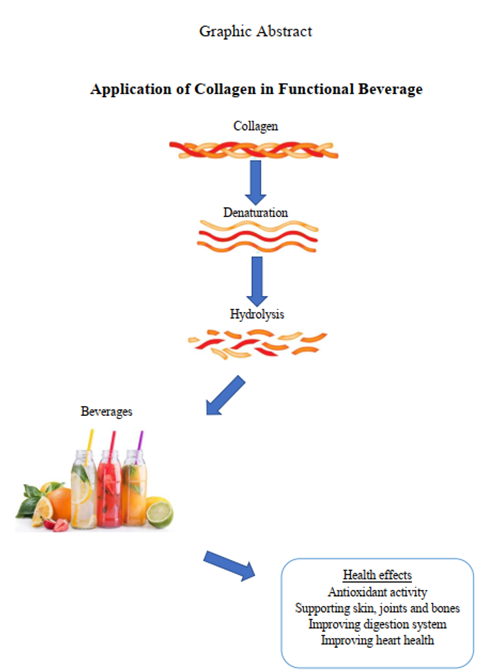
Enriched foodstuffs are absorbing attention based on consumers’ awareness all around the world. Collagen is one of the interests in foodstuff industry. This article reviews the collagens applications and function in beverage industry. Collagen is a great animal base protein. It plays the main role in sustaining the organs and tissues structure. Hydrolyzed collagen includes small and low-molecular-weight amino acid chains. Nowadays it is extensively consumed in beverage and food industries to ameliorate foodstuffs properties like food products stability, consistency and elasticity. In addition, it helps improving the intimacy, nutritional value and health benefits in foodstuffs. Collagen is applied as a useful food carrier, supplements, additive, coatings and film especially in beverages. Thus, this paper will review the collagens applications and functions in beverage industry as well as its composition and structure. The collagen application as an enrichment agent in beverage formulation enhance the biological and nutritional value of various beverages.
Downloads
References
1. Gupta A, Sanwal N, Bareen MA, Barua S, Sharma N, Olatunji OJ, Nirmal NP, Sahu JK. Trends in functional beverages: Functional ingredients, processing technologies, stability, health benefits, and consumer perspective. Food research international. 2023; 1; 170:113046. 10.1016/j.foodres.2023.113046
2. Sugajski M, Buszewska-Forajta M, Buszewski B. Functional beverages in the 21st century. Beverages. 2023; 9(1), 27. https://doi.org/10.3390/beverages9010027
3. Shenoy M, Abdul NS, Qamar Z, Al Bahri BM, Al Ghalayini KZ, Kakti A, Murad M, Fadul M, Alamri MA, Alqarni MA. Collagen structure, synthesis, and its applications: A systematic review. Cureus. 2022; 9:14(5). doi:10.7759/cureus.24856
4. Tang C, Zhou K, Zhu Y, Zhang W, Xie Y, Wang Z, Zhou H, Yang T, Zhang Q, Xu B. Collagen and its derivatives: From structure and properties to their applications in food industry. Food Hydrocolloids. 2022; 131:107748. doi.org/10.1016/j.foodhyd.2022.107748
5. Al Hajj W, Salla M, Krayem M, Khaled S, Hassan HF, El Khatib S. Hydrolyzed collagen: Exploring its applications in the food and beverage industries and assessing its impact on human health–A comprehensive review. Heliyon, 2024; 10(16), https://doi.org/10.1016/j.heliyon.2024.e36433
6. O'Grady JE, Bordon DM. Global regulatory registration requirements for collagen-based combination products: points to consider. Advanced drug delivery reviews. 2003; 28:55(12):1699-721. https://doi.org/10.1016/j.addr.2003.08.006
7. Hu YT, Tu ZC, Liu GX, Peng CY, Zhang P, Xie WM, Yang LY, Chen Y, Hu ZZ, Sha XM. Enzymatic hydrolysis affected the antioxidant activity and traceability identification of porcine collagen peptides. Food Chemistry. 2026; 15: 148451. 10.1016/j.foodchem.2026.148451
8. Shaik MI, Rahman SH, Yusri AS, Ismail‐Fitry MR. Kumar NS. Sarbon NM. A review on the processing technique, physicochemical, and bioactive properties of marine collagen. Journal of Food Science. 2024; 89(9): 5205-29. doi:10.1111/1750-3841.17273
9. Zülli F, & P H. Hydrolyzed Collagen—Sources and Applications. Molecules. 2019; 24(22): 4031. doi.org/10.3390/molecules24224031
10. Kisling A, Lust RM, Katwa LC. What is the role of peptide fragments of collagen I and IV in health and disease?Life sciences. 2019; 228:30-4. 10.1016/j.lfs.2019.04.042
11. Gauza-Włodarczyk M, Kubisz L, Włodarczyk D. Amino acid composition in determination of collagen origin and assessment of physical factors effects. International journal of biological macromolecules. 2017; 104:987-91. 10.1016/j.ijbiomac.2017.07.013
12. Dille MJ, Haug IJ, Draget KI. Gelatin and collagen. In: Handbook of hydrocolloids 2021 Woodhead Publishing.Kozlowska, J., et al. Collagen as a functional ingredient in food: A review of recent advancements. 2021. pp.:1073-1097. doi.org/10.1146/annurev-food-031414-111800
13. Cui P, Shao T, Liu W, Li M, Yu M, Zhao W, Song Y, Ding Y, Liu J. Advanced review on type II collagen and peptide: preparation, functional activities and food industry application. Critical Reviews in Food Science and Nutrition. 2024; 64(30):11302-19. doi.org/10.1080/10408398.2023.2236699
14. Sae-Leaw T, Aluko RE, Chantakun K, Benjakul S. Physicochemical, antioxidant and sensory properties of ready-to-drink chrysanthemum tea fortified with hydrolyzed collagen from salmon scale ossein. Journal of Aquatic Food Product Technology. 2021; 30(9):1159-72. doi.org/10.1080/10498850.2021.1974632
15. Marete EN, Jacquier JC, O’Riordan D. Feverfew as a source of bioactives for functional foods: Storage stability in model beverages. Journal of Functional Foods. 2011; 3(1):38-43. doi.org/10.1016/j.jff.2011.01.004
16. Gautieri A, Vesentini S, Redaelli A, Buehler MJ. Viscoelastic properties of model segments of collagen molecules. Matrix Biology. 2012; 31(2):141-9. 10.1016/j.matbio.2011.11.005
17. Varga-Tóth A, Németh C, Dalmadi I, Csurka T, Csorba R, Elayan M, Enkhbold M, Hidas K, Friedrich LF. Investigation of the effects of bovine collagen peptides and mixed berries on rheological properties and biological activity of egg white-based beverage via central composite design. Frontiers in Nutrition. 2023; 9:1011553. doi.org/10.3389/fnut.2022.1011553
18. Santana RC, Perrechil FA, Sato AC, Cunha RL. Emulsifying properties of collagen fibers: Effect of pH, protein concentration and homogenization pressure. Food Hydrocolloids. 2011; 25(4):604-12. doi.org/10.1016/j.foodhyd.2010.07.018
19. Zhang Y, Zhang Y, Liu X, Huang L, Chen Z, Cheng J. Influence of hydrolysis behaviour and microfluidisation on the functionality and structural properties of collagen hydrolysates. Food Chemistry. 2017; 15; 227: 211-8. 10.1016/j.foodchem.2017.01.049
20. Bai M, Wang N, Zhang M, Zhao Z, Yu J, She W, Obadina AO, Zhao Y, Li S, Wu H, Zhao T. Deep eutectic solvent-mediated extraction of collagen peptides from sturgeon skin: Molecular-weight control and mechanistic insights. Food Chemistry: X. 2026; 37:104078. doi.org/10.1016/j.fochx.2026.104078
21. Steele C. Collagen: a review of clinical use and efficacy. Nutritional Medicine Reviews. 2022;1(2):12-36. pureencapsulations.ca/sites/default/files/2023-07/11.
22. Bilek SE, Bayram SK. Fruit juice drink production containing hydrolyzed collagen. Journal of functional foods. 2015; 14:562-9. doi.org/10.1016/j.jff.2015.02.024
23. Kržišnik N, Kurent E, Roškar R. A comprehensive analytical approach for quality control of collagen in food supplements. Marine drugs. 2024; 22(10):435. doi.org/10.3390/md22100435
24. Gao J, Jia L, Guo Z, Xu L, Fan D, Zhang G. Qualitative and Quantitative Analysis Method of Recombinant Collagen in Complex Matrix. Separations. 2024; 26;11(12):339. https://doi.org/10.3390/separations11120339
25. León-López A, Morales-Peñaloza A, Martínez-Juárez VM, Vargas-Torres A, Zeugolis DI, Aguirre-Álvarez G. Hydrolyzed collagen—sources and applications. Molecules. 2019; 24(22):4031. doi.org/10.3390/molecules24224031
26. Dautkanova D, Kazhymurat A, Dautkanov N, Ussembayeva Z, Mussayeva S. Development of a functional instant drink using soy isolate and collagen hydrolysate. Caspian Journal of Environmental Sciences. 2025; 23(5):1241-51. doi:10.22124/cjes.2025.8857
27. de Miranda RB, Weimer P, Rossi RC. Effects of hydrolyzed collagen supplementation on skin aging: a systematic review and meta‐analysis. International journal of dermatology. 2021;60(12):1449-61. doi.org/10.1111/ijd.15518Digital Object Identifier
28. Shan F, Liu L, Li L, Wang W, Bi Y, Li M. Management, safety, and efficacy evaluation of nutraceutical and functional food: A global perspective. Comprehensive Reviews in Food Science and Food Safety. 2025; 24(4):70222. doi.org/10.1111/1541-4337.70222
29. Fisher GJ, Quan T, Purohit T, Shao Y, Cho MK, He T, Varani J, Kang S, Voorhees JJ. Collagen fragmentation promotes oxidative stress and elevates matrix metalloproteinase-1 in fibroblasts in aged human skin. The American journal of pathology. 2009; 174(1):101-14. doi.org/10.2353/ajpath. 2009.080599
30. Marangoni Júnior L, Rodrigues PR, da Silva RG, Vieira RP, Alves RM. Sustainable packaging films composed of sodium alginate and hydrolyzed collagen: preparation and characterization. Food and Bioprocess Technology. 2021;14(12):2336-46. doi.org/10.1016/j.foodhyd.2011.12.003.
31. Ezati P, Khan A, Bhattacharya T, Zaitoon A, Zhang W, Roy S, Rhim JW, Lim LT. Recent advances in collagen and collagen-based packaging materials: a review. ACS Food Science & Technology. 2025; 5(5):1767-84. doi.org/10.1021/acsfoodscitech.4c00938
32. Szopa K, Znamirowska-Piotrowska A, Szajnar K, Pawlos M. Effect of collagen types, bacterial strains and storage duration on the quality of probiotic fermented sheep’s milk. Molecules. 2022; 8;27(9):3028. https://doi.org/10.3390/molecules27093028
33. Mejía‐Calvo I, López‐Juárez LE, Vázquez‐Leyva S, López‐Morales CA, Montoya‐Escutia D, Merlos Rivera PG, Herbert‐Pucheta JE, Zepeda‐Vallejo LG, Velasco‐Velázquez M, Pavón L, Pérez‐Tapia SM. Quality attributes of partially hydrolyzed collagen in a liquid formulation used for skin care. Journal of Cosmetic Dermatology. 2021;20(1):150-8. https://doi.org/10.1111/jocd.13439
34. Soedarini B, Octavia S ET. A literature review of allergen properties in fish collagen and its derivative products. Jurnal Pengolahan Hasil Perikanan Indonesia. 2024 Aug 23;27(8):719-39. https://journal.ipb.ac.id/index.php/jphpi/issue/vi.
35. World Health Organization. Risk Assessment of Food Allergens. Part 1: Review and validation of Codex Alimentarius priority allergen list through risk assessment: Meeting report.

Downloads
Published
Submitted
Revised
Accepted
Issue
Section
License
Copyright (c) 2026 Dr. Ramona Massoud; Dorsa Zakipour , Sepideh Saboonchi (Author)

This work is licensed under a Creative Commons Attribution-NonCommercial 4.0 International License.