
Development and Characterization of Saffron Nanoemulsion Incorporated into Coffee Beverage Using Ultrasonic Emulsification and Ionic Gelation
Development and Characterization of Saffron Nanoemulsion
Keywords:
saffron, coffee beverage, nanoemulsion, Saffron , Coffee Beverage , Ultrasonic Emulsification , Ionic Gelation, chitosan, alginate, Antioxidant ActivityAbstract
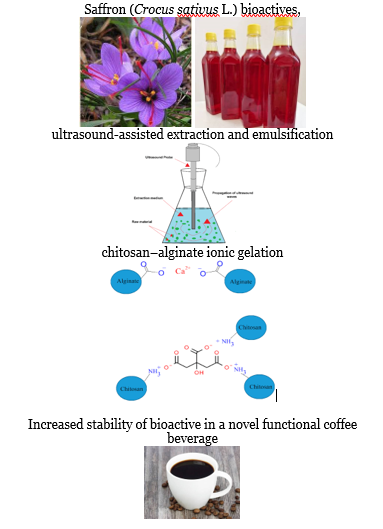
This study presents the development of a novel functional coffee beverage enriched with saffron (Crocus sativus L.) bioactives, employing an integrated strategy of ultrasound-assisted extraction, ultrasonic emulsification, and chitosan–alginate ionic gelation to address the inherent instability of saffron phytochemicals. Spray-dried saffron nanoemulsions (0.1–4% w/v) were successfully formulated and encapsulated via ionotropic gelation, then incorporated into a black coffee matrix. The resulting systems were comprehensively characterized in terms of physicochemical properties, particle size distribution, chromatographic composition, antioxidant activity, and sensory performance during storage.
Sensory optimization identified formulation SC05-2 (4% w/v saffron nanoemulsion) as the most acceptable, achieving the highest scores for aroma (4.30 ± 0.95), taste (4.30 ± 0.67), and color (4.60 ± 0.84). High-performance liquid chromatography confirmed effective preservation of key non-volatile bioactives, with picrocrocin and total crocin contents of 336.58 mg/L and 241.15 mg/L, respectively, while the volatile safranal was reduced to 0.11 mg/L, likely due to processing losses. Dynamic light scattering analysis revealed successful nanoencapsulation, with a mean hydrodynamic diameter of 179.6 nm and a dominant subpopulation at 96.89 nm (99.8% number distribution). However, a polydispersity index of 0.462 and a zeta potential of −7.87 mV indicated moderate heterogeneity and limited electrostatic stability.
The saffron-enriched coffee demonstrated enhanced antioxidant activity (22.5%) compared to the control (21.8%), suggesting that the biopolymer-based encapsulation enabled controlled release of bioactives and mitigated oxidative degradation. Colorimetric analysis over 35 days (CIELAB) revealed a significant decrease in lightness (L* 55.92 to 41.29) alongside an increase in redness (a* 26.85 to 28.75), confirming sustained diffusion of crocin pigments into the beverage matrix. Statistical analyses (Friedman and Kruskal–Wallis tests) indicated significant temporal changes (p < 0.05) in both sensory and physicochemical attributes.
Overall, the findings demonstrate that the combined use of ultrasonic emulsification and chitosan–alginate ionic gelation is a promising approach for the development of premium functional coffee beverages. Despite the need for further optimization of colloidal stability, this system effectively enhances bioactive retention, sensory quality, and functional performance.
Downloads
References
5. Wang Y, Wang X, Dong J, Li L, Du P, Liu X. Coffee blending : development trend under the new wave. Food Chem [Internet]. 2026;507(September 2025):148167. Available from: https://doi.org/10.1016/j.foodchem.2026.148167
6. Vasić D, Katanić Stanković JS, Urošević T, Kozarski M, Naumovski N, Khan H, et al. Insight into Bioactive Compounds, Antioxidant and Anti-Diabetic Properties of Rosehip (Rosa canina L.)-Based Tisanes with Addition of Hibiscus Flowers (Hibiscus sabdariffa L.) and Saffron (Crocus sativus L.). Beverages. 2024;10(1).
7. Bakshi RA, Sodhi NS, Wani IA, Khan ZS, Dhillon B, Gani A. Bioactive constituents of saffron plant: Extraction, encapsulation and their food and pharmaceutical applications. Appl Food Res [Internet]. 2022;2(1):100076. Available from: https://doi.org/10.1016/j.afres.2022.100076
8. Siyar Z, Motamedzadegan A, Mohammadzadeh Milani J, Rashidinejad A. The effect of the liposomal encapsulated saffron extract on the physicochemical properties of a functional ricotta cheese. Molecules. 2022;27(1):1–15.
9. Garavand F, Rahaee S, Vahedikia N, Jafari SM. SC. Trends Food Sci Technol [Internet]. 2019; Available from: https://doi.org/10.1016/j.tifs.2019.05.005
10. Valero-cases E, Juli J. Microencapsulated saffron floral waste extracts as functional ingredients for antioxidant fortification of yogurt : Stability during the storage. 2023;184(February).
11. Maleki G, Woltering EJ, Mozafari MR. Trends in Food Science & Technology Applications of chitosan-based carrier as an encapsulating agent in food industry. Trends Food Sci Technol [Internet]. 2022;120(November 2021):88–99. Available from: https://doi.org/10.1016/j.tifs.2022.01.001
12. Saroglu O, Bekiroglu H, Karadag A. Encapsulation of saffron bioactive compounds. Saffron. 2021. 183–220 p.
13. Detsi A, Kavetsou E, Kostopoulou I, Pitterou I, Pontillo ARN, Tzani A, et al. Nanosystems for the encapsulation of natural products: The case of chitosan biopolymer as a matrix. Pharmaceutics. 2020;12(7):1–68.
14. Kustyawati ME, Sugiharto R, Rini R. Microencapsulation of Green Capulaga (Elettaria cardamomum) Essential Oil with Maltodextrin and Its Applications in Coffee Drink. J Tek Pertan Lampung (Journal Agric Eng. 2022;11(3):531.
15. Maqbool Z, Arshad MS, Ali A, Aziz A, Khalid W, Afzal MF, et al. Potential Role of Phytochemical Extract from Saffron in Development of Functional Foods and Protection of Brain-Related Disorders. Oxid Med Cell Longev. 2022;2022.
16. Sharaf N. Formulation of Coffee Extract as Polymeric Nanoparticles and Studying their Potential Biological Activities Formulation of Coffee Extract as Polymeric Nanoparticles and Studying their Potential Biological Activities A Thesis Submitted to By : 2021;
17. Oblitas-delgado R, Mori-vigo S, Quispe-sanchez L, Medina-bocanegra D, Mena-chacon LM, Meléndez-mori JB, et al. Fortified Espresso Coffee With Essential Oils : Compositional Analysis , Matrix Stability , and Antimicrobial Performance. 2026;2026.
18. Rahaiee S, Shojaosadati SA, Hashemi M. An efficient ionic gelation based nano-delivery system to improve the stability and controlled release of saffron extracts. Biocatal Agric Biotechnol [Internet]. 2023;52(July):102831. Available from: https://doi.org/10.1016/j.bcab.2023.102831
19. Bashir S, Zameer S, Jan N, Naseer B, Dhekale B, Alam T, et al. Physicochemical characteristics , antioxidant capacity , bioactive compounds , and microbial stability of saffron-based functional beverage stored in glass bottles with and without secondary packaging at ambient conditions. Appl Food Res [Internet]. 2025;5(2):101474. Available from: https://doi.org/10.1016/j.afres.2025.101474
20. Saberian H, Pasban Noghabi V. Thermal stabilization of the anthocyanin extract of saffron petal using encapsulation and its application in the model drink. J Food Sci Technol. 2023;19(132):17–31.
21. Vahedi M, Kabiri M, Alireza S, Rezadoost H, Mirzaie M. Industrial Crops & Products Quantitative HPLC-based metabolomics of some Iranian sa ff ron ( Crocus sativus L .) accessions. Ind Crop Prod [Internet]. 2018;118(March):26–9. Available from: https://doi.org/10.1016/j.indcrop.2018.03.024
22. Santanatoglia A, Angeloni S, Caprioli G, Fioretti L, Ricciutelli M, Vittori S, et al. Comprehensive investigation of coffee acidity on eight different brewing methods through chemical analyses , sensory evaluation and statistical elaboration. Food Chem [Internet]. 2024;454(May):139717. Available from: https://doi.org/10.1016/j.foodchem.2024.139717
23. Dermesonlouoglou E, Palaioxari-kampisiouli V, Tsimogiannis D. Design and Production of an Instant Coffee Product Based on Greek Coffee Oil : Study of the Effect of Storage Conditions on Product Aroma and Quality. 2025;
24. Córdoba N, Fernandez-alduenda M, Moreno FL, Ruiz Y. Coffee extraction: A review of parameters and their influence on the physicochemical characteristics and flavour of coffee brews. Trends Food Sci Technol [Internet]. 2020; Available from: https://doi.org/10.1016/j.tifs.2019.12.004
25. Lopes GR, Petronilho S, Ferreira AS, Pinto M, Passos P. Insights on Single-Dose Espresso Coffee Capsules ’ Volatile Profile : From Ground Powder Volatiles to Prediction of. 2021;

Downloads
Published
Submitted
Revised
Accepted
Issue
Section
License
Copyright (c) 2026 BiotechIntellect

This work is licensed under a Creative Commons Attribution-NonCommercial 4.0 International License.