
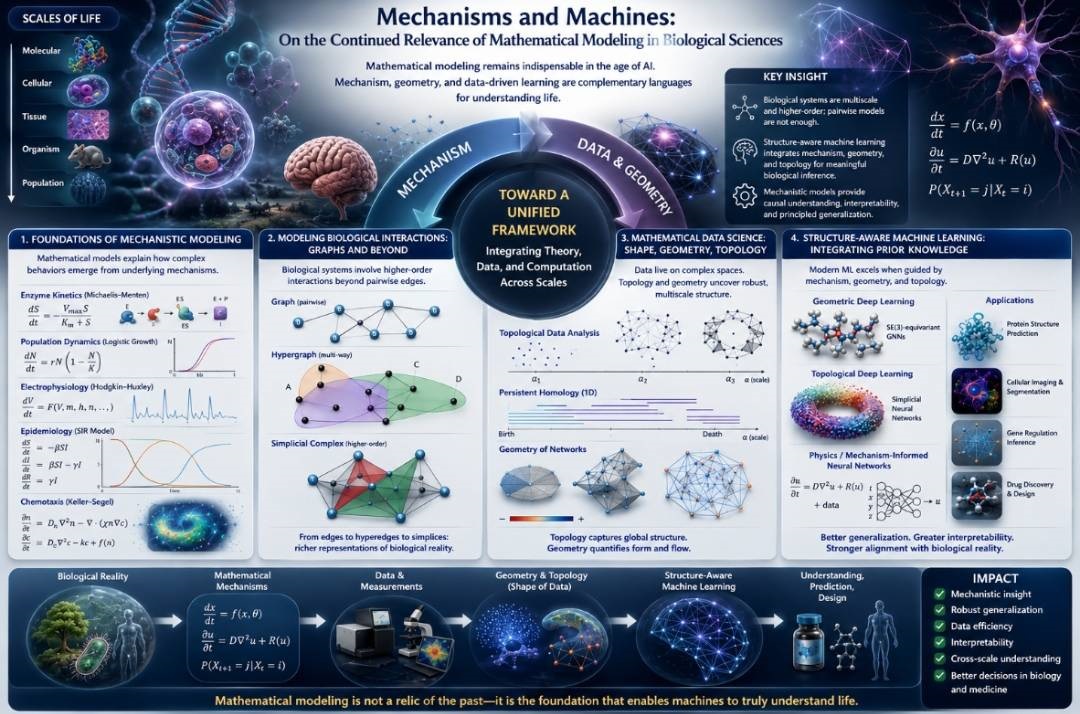
Mechanisms and Machines: On the Continued Relevance of Mathematical Modeling in Biological Sciences
Keywords:
Biological systems, mathematical modeling, Machine learning, Deep learning, Modern Biological InferenceAbstract
Mathematical modeling has long provided mechanistic insight and predictive power across biological scales, from the structure and dynamics of biomolecules to neural activity and even up to population dynamics and epidemics. With the rise of machine learning and large-scale data, its continued relevance is sometimes questioned. We argue that mathematical models remain indispensable: they support interpretability, causal insight, and principled generalization beyond what is commonly attainable with purely data-driven methods. At the same time, modern machine learning increasingly embeds mathematical structure, through geometric and graph-based learning, topological data analysis, and physics-informed networks, showing that progress in data-driven approaches often relies on theoretical foundations rather than replacing them.
Downloads
References
[1] Murray, J.D. Mathematical Biology I: An Introduction. Springer, 3 edition, 2002.
[2] Jost, J. (2017). Object Oriented Models vs. Data Analysis – Is This the Right Alternative?. In: Lenhard, J., Carrier, M. (eds) Mathematics as a Tool. Boston Studies in the Philosophy and History of Science, vol 327. Springer, Cham. https://doi.org/10.1007/978-3-319-54469-4_14.
[3] Jost, J. Biological information. Theory Biosci. 139, 361–370 (2020). https://doi.org/10.1007/s12064-020-00327-1
[4] Jost, J. Biology, geometry and information. Theory Biosci. 141, 65–71 (2022). https://doi.org/10.1007/s12064-021-00351-9
[5] Darwin, C. (1859). On the origin of species by means of natural selection, or the preservation of favoured races in the struggle for life. London, England: John Murray.
[6] Provine, W.B. The Origins of Theoretical Population Genetics. University of Chicago Press, Chicago, 1971.
[7] Cornish-Bowden, A. Fundamentals of Enzyme Kinetics. Wiley-Blackwell, 4 edition, 2012.
[8] Harper, M. Information geometry and evolutionary game theory. arXiv, 0911.1383, 2009.
[9] Hofrichter, J., Jost, J. Tran, T.D. Information Geometry and Population Genetics: The Mathematical Structure of the Wright–Fisher Model. Understanding Complex Systems. Springer International Publishing, Cham, Switzerland, 2017. ISBN 978-3319520445.
[10] Carlo Laing and Gabriel J. Lord, editors. Stochastic Methods in Neuroscience. Oxford University Press, New York, 2010. https://doi.org/10.1093/acprof:oso/9780199235070.001.0001.
[11] Eidi, Z., Khorasani, N Sadeghi M. Reactive/less-cooperative individuals advance population’s synchronization: Modeling of dictyostelium discoideum concerted signaling during aggregation phase. PLOS ONE, 2021. https://doi.org/10.1371 /journal.pone. 0259742.
[12] Eidi Z., Sadeghi, M. A compartmentalized model to directional sensing: How can an amoeboid cell unify pointwise external signals as an integrated entity? Physica A: Statistical Mechanics and its Applications, 2025. https://doi.org/10.1016 /j.physa. 2025.130564.
[13] Turing, A.M. The chemical basis of morphogenesis. Philosophical Transactions of the Royal Society B, 1952.
[14] Eidi, Z., Khorasani, N., Sadeghi, M. Correspondence between multiple signaling and developmental cellular patterns: a computational perspective. Frontiers in Cell and Developmental Biology, 2024. https://doi.org/10.3389/fcell.2024.-1310265.
[15] Keller, E.F., Segel, L.A. Initiation of slime mold aggregation viewed as an instability. Journal of Theoretical Biology, 1970. https://doi.org/10. 1016/0022-5193(70)90092-5.
[16] Keller E.F., Segel, LA. Traveling bands of chemotactic bacteria. Journal of Theoretical Biology, 1971. https://doi.org/10.1016/ 0022-5193(71)90051-8.
[17] Nakagaki, T., Yamada, H., Tóth, A. Maze-solving by an amoeboid organism. Nature, 2000. https://doi.org/10.1038/35035159.
[18] Eidi, Z. Discrete modeling of amoeboid locomotion and chemotaxis in dictyostelium discoideum by tracking pseudopodium growth direction. Sci Rep 7, 12675 (2017).
[19] Eidi, Z., Mohammad-Rafiee, F., Khorrami, M., Gholami, A. Modelling of dictyostelium discoideum movement in a linear gradient of chemoattractant. Soft Matter, 2017,13, 8209-8222. https://doi.org/10.1039/C7SM01568B.
[20] Friedl P., Gilmour, D. Collective cell migration in morphogenesis, regeneration and cancer. Nature Reviews Molecular Cell Biology, 2009. https://doi.org/10.1038/nrm2720
[21] Barabási, A., Oltvai, Z.N. Network biology: understanding the cell’s functional organization. Nature Reviews Genetics, 2004. https://doi.org/10.1038/nrg1272.
[22] Stelzl, U., Worm, U., Lalowski, M., Haenig, C., Brembeck, H.F., Goehler, H., Stroedicke, M., Zenkner, M., Schoenherr, A., Koeppen, S., Timm, J, Mintzlaff, S., Abraham, C., Bock, N., Kietzmann, S., Goedde, A., Toksöz, E., Droege, A., Krobitsch, S., Korn, B., Birchmeier, W., Lehrach, H., Wanker, E.E. A human protein-protein interaction network: a resource for annotating the proteome. Cell, 2005. https://doi.org/ 10.1016/j.cell.2005.08.029.
[23] Davidson, E.H., Levin, M. Gene regulatory networks. Proceedings of the National Academy of Sciences, 2005. https://doi.org/10.1073 /pnas.0502024102.
[24] Jeong, H., Tombor, B., Albert, R., Oltvai, Z. N., Barabási, A.L. The large-scale organization of metabolic networks. Nature, 2000. https://doi.org/10.1038/35036627.
[25] Harary, F. On the notion of balance of a signed graph. Michigan Mathematical Journal, 1953.
[26] Sporns, O., Tononi, G., Kötter, R. The human connectome: a structural description of the human brain. PLOS Computational Biology, 2005. https://doi.org/10.1371/journal.pcbi.0010042.
[27] Newman, M.E.J. Analysis of weighted networks. Physical Review E, 2004. https://doi.org/10.1103/PhysRevE.70.056131.
[28] Luecken, M.D., Theis, F.J. Current best practices in single-cell rna-seq analysis: a tutorial. Molecular Systems Biology, 2019. https://doi.org/10.15252 /msb.20188746.
[29] Milo, R., Shen-Orr, S., Itzkovitz, S., Kashtan, N., Chklovskii, U., Alon, D. Network motifs: simple building blocks of complex networks. Science, 2002. https://doi.org/10.1126/science.298.5594.824.
[30] Sporns, O., Tononi, G., Edelman, G.M. Theoretical neuroanatomy: relating anatomical and functional connectivity in graphs and cortical connection matrices. Cerebral Cortex, 2000. https://doi.org/10.1093/cercor/10.2.127.
[31] Benson, AR. Gleich, DF., Leskovec, J. Higher-order organization of complex networks. Science, 2016. https://doi.org/10.1126 /science.aad9029.
[32] Bick, C., Gross, E., Harrington, H.A. Schaub, M.T. What are higher-order networks? SIAM Review, 2023. https://doi.org/10.1137/21M1414024. Open Access.
[33] Xia, K., Wei, G.W. Persistent homology analysis of protein structure, flexibility and folding. International Journal for Numerical Methods in Biomedical Engineering, 2014. https://doi.org/10.-1002/cnm.2655.PMCID:PMC4131872.
[34] Reimann, M.W., Nolte, M., Scolamiero, M., Turner, K., Perin, R., Chindemi, G., Dl otko, P., Levi, R., Hess, K., Markram, H. Cliques of neurons bound into cavities provide a missing link between structure and function. Frontiers in Computational Neuroscience, 2017. https://doi.org/10.3389/fncom.-2017.00048. Open-access article.
[35] McDonald, J.H. Correlation and linear regression”. In: Handbook of Biological Statistics. Sparky House Publishing, Baltimore, Maryland, U.S.A., 2014.
[36] Gardner, R.J., Hermansen, E., Pachitariu, M., Burak, Y., Bass, N.A., Dunn, B.A., Moser, M.B., Moser, EI. Toroidal topology of population activity in grid cells. Nature, 2022. https://doi.org/10.1038/ s41586-021-04268-7.
[37] Yoon, I.H.R., Henselman-Petrusek, G., Yu, Y., Ghrist, R., Smith, S.L., Giusti, C. Tracking the topology of neural manifolds across populations. Proceedings of the National Academy of Sciences, November 2024. ISSN 1091-6490. https://doi.org/10.1073/pnas.2407997121
[38] Carlsson, G. Topology and data. Bulletin of the American Mathematical Society, 2009. https://doi.org/10.1090/S0273-0979-09-01249-X.
[39] Edelsbrunner, H., Letscher, D., Zomorodian, A. Topological persistence and simplification. Discrete Comput. Geom., 2002. ISSN 0179-5376. https://doi.org/10.1007/s00454-002-2885-2.
[40] Zomorodian, A., Carlsson, G. Computing persistent homology. Discrete & Computational Geometry, 2005. https://doi.org/10.1007/ s00454-004-1146-y.
[41] Otter, N., Porter, M.A., Tillmann, U., Grindrod, P., Harrington, H.A. A roadmap for the computation of persistent homology. EPJ Data Science, 2017. https://doi.org/10.1140/ epjds/s13688-017-0109-5.
[42] Amézquita, E.J. Quigley, M.Y., Ophelders, T., Munch, E., Chitwood, D.H. The shape of things to come: Topological data analysis and biology, from molecules to organisms. Developmental Dynamics, 2020. https://doi.org/10.1002/dvdy.175.
[43] Skaf, Y., Laubenbacher, R. Topological data analysis in biomedicine: A review. Journal of Biomedical Informatics, 2022. https://doi.org/10.-1016/j.jbi.2022.104082.
[44] Girvan, M., Newman, M.E.J. Community structure in social and biological networks. Proceedings of the National Academy of Sciences USA, 2002. https://doi.org/10.1073 /pnas. 122653799.
[45] Fortunato, S. Community detection in graphs. Physics Reports, 2010. https://doi.org/10.1016/j.-physrep.2009.11.002.
[46] Manipur, I., Giordano, M., Piccirillo, M., Parashuraman, S., & Maddalena, L. (2023). Community detection in protein-protein interaction networks and applications. IEEE/ACM Transactions on Computational Biology and Bioinformatics, 20(1), 217–237. https://doi.org/10.1109/TCBB.2021.3138142.
[47] Hao, D., Ren, C. & Li, C. Revisiting the variation of clustering coefficient of biological networks suggests new modular structure. BMC Syst Biol 6, 34 (2012). https://doi.org/10.1186/1752-0509-6-34.
[48] Jaemthaworn, T., Kalapanulak, S., Saithong, T. Topological clustering of regulatory genes confers pathogenic tolerance to cassava brown streak virus (cbsv) in cassava. Scientific Reports, 2021. https://doi.org/10.1038 /s41598-021-86806-x.
[49] Calderer, G., Kuijjer, M.L. Community detection in large-scale bipartite biological networks. Frontiers in Genetics, 2021. https://doi.org/10.3389 /fgene. 2021.649440.
[50] Eidi, M., Jost, J. Ollivier ricci curvature of directed hypergraphs. Scientific Reports, 2020. https://doi.org/10.1038/s41598-020-68619-6.
[51] Samal, A., Sreejith, R.P., Gu, J., Liu, S., Saucan, E., Jost, J. Comparative analysis of two discretizations of Ricci curvature for complex networks. Scientific Reports, 2018. https://doi.org/10.1038/s41598-018-27001-3.
[52] Karampour, E., Malek, M.R., Eidi, M. Discrete ricci flow: A powerful method for community detection in locationbased social networks. Computers and Electrical Engineering, 2025. https://doi.org/10.1016 /j.compeleceng. 2025.110302.
[53] Eidi, M., Farzam, A., Leal, W., Samal, A., Jost, J. Edge-based analysis of networks: Curvatures of graphs and hypergraphs. Theory in Biosciences, 2020. https://doi.org/10.1007/s12064-020-00328-0.
[54] Leal, W., Eidi, M. & Jost, J. Ricci curvature of random and empirical directed hypernetworks. Appl Netw Sci 5, 65 (2020). https://doi.org/10.1007/s41109-020-00309-8.
[55] Leal, W., Eidi, M., Jost, J. Curvature-based analysis of directed hypernetworks. In Proceedings of the 8th International Conference on Complex Networks & Their Applications, 2019.
[56] Sandhu, R., Georgiou, T., Reznik, E., Zhu, L., Kolesov, I, Senbabaoglu, Y, Tannenbaum, A. Graph curvature for differentiating cancer networks. Scientific Reports, 2015. https://doi.org/10.-1038/srep12323.
[57] Sia, J, Zhang, W, Jonckheere, E, Cook, D, Bogdan, P. Inferring functional communities from partially observed biological networks exploiting geometric topology and side information. Scientific Reports, 2022. https://doi.org/10.1038/s41598-022-14631-x.
[58] Pouryahya, M., Mathews, J, Tannenbaum, A. Comparing three notions of discrete ricci curvature on biological networks, 2017. https://arxiv.org/abs/1712. 02943.
[59] Sun, Y., Kong, L., Huang, J., Deng, H., Bian, X., Li, X., Cui, F., Dou, L., Cao, C., Zou, Q., Zhang, Z. A comprehensive survey of dimensionality reduction and clustering methods for singlecell and spatial transcriptomics data. Briefings in Functional Genomics, 2024. https://doi.org/10.1093/ bfgp/elae023.
[60] Huang, H., Wang, Y., Rudin, C., Browne, E.P. Towards a comprehensive evaluation of dimension reduction methods for transcriptomic data visualization. Communications Biology, 2022. https://doi.org/10.1038/ s42003-022-03628-x.
[61] Eidi, M., Jost, J, Zhang, D. From the discrete to the continuous, from simplicial complexes to Riemannian manifolds: Approximating flows and cuts on manifolds by discrete versions, 2025. Surveys in Differential Geometry. https://doi.org/10.4310/SDG.260604001039; https://arxiv.org/abs/ 2512.05319.
[62] Eidi, M., Jost, J. Floer homology: From generalized Morse-Smale dynamical systems to Forman’s combinatorial vector fields Communications in Mathematics and Statistics, 12(4), 695–720. https://doi.org/10.1007/s40304-022-00314-6; https://arxiv.org/abs/ 2105.02567.
[63] Eidi, M. Topological and Geometric Methods with a View Towards Data Analysis. PhD thesis, Universität Leipzig, 2022. URL https://nbn-resolving.org/urn:nbn: de:bsz:15-qucosa2-788338.
[64] Eidi, M., Mukherjee, S. Irreducibility of Markov chains on simplicial complexes, the spectrum of the discrete Hodge Laplacian and homology, 2023. URL https://arxiv.org/ abs/2310.07912.
[65] Eidi, M., & Otter, N. (2026). Geometric characterisation of structural and regular equivalences in undirected (hyper)graphs. Journal of Physics: Complexity. https://doi.org/10.1088/2632-072X/ae6f5e.
[66] Eidi, M., Mukherjee, S. Higher order bipartiteness vs bi-partitioning in simplicial complexes. In 41st International Symposium on Computational Geometry (SoCG 2025), 2025. https://doi.org/10.4230 /LIPIcs.SoCG.2025.45
[67] LeCun, Y., Bengio, Y., Hinton, G. Deep learning. Nature, 2015. https://doi.org/10.1038 /nature14539.
[68] Papamarkou, T., Birdal, T, Bronstein, M.M., Carlsson, G. E., Curry, J., Gao, Y., Hajij, M., Kwitt, R., Lio, P., Lorenzo, P.D., Maroulas, V., Miolane, N., Nasrin, F., Ramamurthy, K.N., Rieck, B., Scardapane, S., Schaub, M.T., Veličković, P., Wang, B., Wang, Y., Wei, G., Zamzmi, G. Topological deep learning is the new frontier for relational learning. In Ruslan Salakhutdinov, Zico Kolter, Katherine Heller, Adrian Weller, Nuria Oliver, Jonathan Scarlett, and Felix Berkenkamp, editors, Proceedings of the 41st International Conference on Machine Learning. PMLR, 2024. URL https://proceedings.mlr.press-v235/ papamarkou24a.html.
[69] Taha, D., Chapman, J., Eidi, M., Devriendt, K., Montúfar, G. Demystifying topological message-passing with relational structures: A case study on oversquashing in simplicial message-passing. In International Conference on Learning Representation, (ICLR 2025), 2025.
[70] Nguyen, D.D., Cang, Z., Wu, K., Wang, M., Cao, Y., Wei, G.W. Mathematical deep learning for pose and binding affinity prediction and ranking in d3r grand challenges. Journal of Computer-Aided Molecular Design, 2019. https://doi.org/10.1007/s10822-018-0146-6.
[71] Weber, M. Geometric machine learning. AI Magazine, 2025. https://doi.org/10.1002/aaai.12210.
[72] Ganea, O.E., Pattanaik, L., Coley, C.W., Barzilay, R., Jensen K.F., Green, W.H., Jaakkola, T.S. Geomol: torsional geometric generation of molecular 3d conformer ensembles. In Proceedings of the 35th International Conference on Neural Information Processing Systems, NIPS ’21, Red Hook, NY, USA, 2021. Curran Associates Inc. ISBN 9781713845393.
[73] Diepeveen, W., Esteve- Yagüe, C., Lellmann, J., Oktem, O., Schönlieb, C.B. Riemannian geometry for efficient analysis of protein dynamics data. Proceedings of the National Academy of Sciences, 2024. https://doi.org/10.1073/pnas.2318951121.
[74] Bekkers, E.J., Lafarge, M.W., Veta, M., Eppenhof, K.A.J., Pluim, J.P.W., Duits, R. Roto-translation covariant convolutional networks for medical image analysis. In Alejandro F. Frangi, Julia A. Schnabel, Christos Davatzikos, Carlos Alberola- López, and Gabor Fichtinger, editors, Medical Image Computing and Computer Assisted Intervention – MICCAI 2018. Springer International Publishing, 2018. ISBN 978-3-030-00928-1. URL https: //arxiv.org/pdf/1804.03393.pdf.
[75] Su, Z., Liu, X., Hamdan, L.B., Maroulas, V, Wu, J., Carlsson, G.E., Wei, G.W. Topological data analysis and topological deep learning beyond persistent homology: a review. Artificial Intelligence Review, 2025. URL https://api.semanticscholar. org/CorpusID:280323566.
[76] Bronstein, M.M., Bruna, J., Cohen, T., Veliˇckovi´c, P. Geometric deep learning: Grids, groups, graphs, geodesics, and gauges, 2021. URL https://arxiv.org/abs/2104.13478.
[77] Jumper, J., Evans, R., Pritzel, A. et al. Highly accurate protein structure prediction with AlphaFold. Nature 596, 583–589 (2021). https://doi.org/10.1038/s41586-021-03819-2

Downloads
Published
Submitted
Revised
Accepted
Issue
Section
License
Copyright (c) 2025 Zahra Eidi; Marzieh Eidi (Author)

This work is licensed under a Creative Commons Attribution-NonCommercial 4.0 International License.