
Optimization of Culture Conditions for a New Mutant Penicillium EZ-ZH390 to Increase Tannase Activity in Submerged Fermentation
Increase tannase activity in submerged culture by Penicillium
DOI:
https://doi.org/10.66224/BiotechIntellect.3.1.49Keywords:
Fermenter, Penicillium EZ -ZH390, submerged fermentation , tannase , walnut hullsAbstract
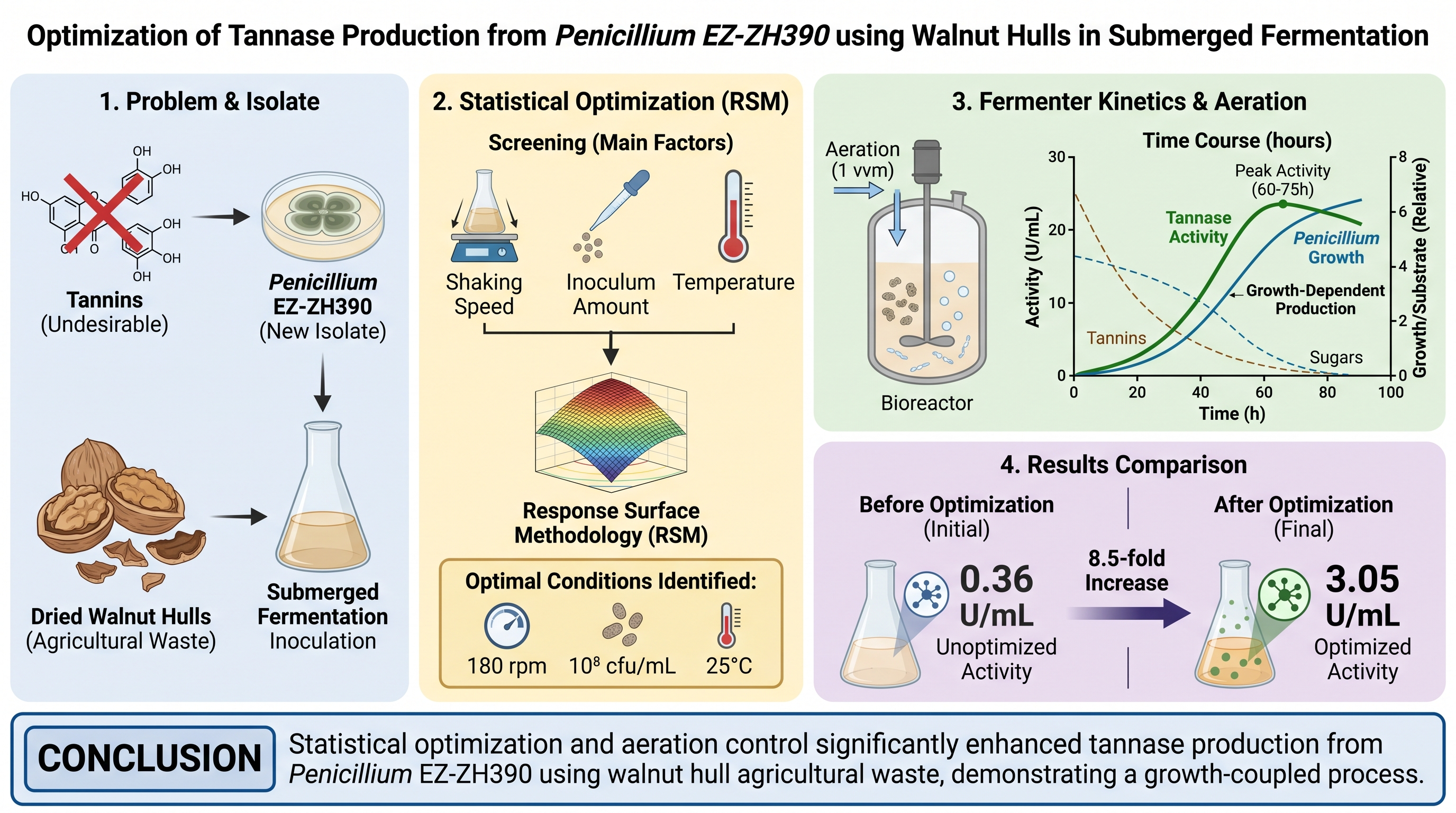
Back Ground and Aims: Tannins have some undesirable impact and should be broken down by tannase enzymes. One of the major problems of microbial produced tannase is the high total cost which could be reduced by using agricultural waste as a substrate.
Method: A submerged fermentation system was used to optimize production of tannase from newly isolated Penicillium EZ-ZH390. Dried walnut hulls were used as carbon substrate. Statistical design screening was used to find main variables. In the next step, these three factors were used to optimize tannase using response surface methodology.
Results and Discussion: According to the statistical design screening results, shaking, spore inoculum amount, and temperature had the greatest impact on tannase activity. Without optimization, the activity of tannase in walnut hull medium was 0.36 U mL-1. A shaking speed of 180 rpm and an inoculum of 108 cfu mL-1 spores at 25°C were obtained as the optimal conditions using the model. It was also examined whether aeration affects tannase activity and growth kinetics of Penicillium EZ-ZH390 in the fermenter as well as the enzyme activity over time. The aeration 1vvm produced the greatest effect on tannase activity. The highest enzyme activity was observed between hours 60 and 75. As total sugars, reducing sugars, and tannin levels continue to decrease, Penicillium EZ-ZH390 is growing. Tannase production from Penicillium EZ-ZH390 in walnut hulls submerged fermentation medium is dependent on microorganism growth. The highest enzyme activity measured using this method was 3.05 U mL-1.
Downloads
References
[1] S. Tandon, A. Sharma, S. Singh, S. Sharma, S.J. Sarma, Therapeutic enzymes: discoveries, production and applications, J. Drug Deliv. Sci. Technol. 63 (2021) 102455. https://doi.org/10.1016/j.jddst.2021.102455
[2] D. Cianciosi, T.Y. Forbes-Hernández, L. Regolo, J.M. Alvarez-Suarez, M.D. Navarro-Hortal, J. Xiao, J.L. Quiles, M. Battino, F. Giampieri, The reciprocal interaction between polyphenols and other dietary compounds: Impact on bioavailability, antioxidant capacity and other physico-chemical and nutritional parameters, Food Chem. 375 (2022) 131904. 10.1016/j.foodchem.2021.131904
[3] M.P. Majewska, R. Miltko, G. Bełżecki, A. Kędzierska, B. Kowalik, Comparison of the effect of synthetic (tannic acid) or natural (oak bark extract) hydrolysable tannins addition on fatty acid profile in the rumen of sheep, Animals 12(6) (2022) 699. https://doi.org/10.3390/ani12060699
[4] N. Sarwar, T. Ahmed, Tannins, Handbook of Plant and Animal Toxins in Food, CRC Press2022, pp. 37-72.
[5] S. Paul, S. Joshi, Industrial Perspectives of Fungi, Industrial Microbiology and Biotechnology, Springer, 2022, pp. 81-105.
[6] A. Baldwin, B.W. Booth, Biomedical applications of tannic acid. Journal of Biomaterials Applications (2022); 36(8): 1503-1523. https://doi.org/10.1177/08853282211058099
[7] H. Nath, M. Samtiya, T. Dhewa, Beneficial attributes and adverse effects of major plant-based foods anti-nutrients on health: A review, Human Nutrition & Metabolism (2022) 200147. https://doi.org/10.1016/j.hnm.2022.200147
[8] M. Vera, B.F. Urbano, Tannin polymerization: an overview, Polymer Chemistry 12(30) (2021) 4272-4290. https://doi.org/10.1039/d1py00542a
[9] W. Chariyarangsitham, S. Krungchanuchat, P. Khuemjun, C. Pilapong, Effect of advanced oxidation and amino acid addition on antioxidant capability, iron chelating property and anti-cancer activity of tannic acid, Arabian Journal of Chemistry 14(9) (2021) 103312. https://doi: 10.1016/j.arabjc.2021.103312
[10] N. Kaur, A. Agarwal, M. Sabharwal, N. Jaiswal, Natural Food Toxins as Anti‐Nutritional Factors in Plants and Their Reduction Strategies, Food Chemistry: The Role of Additives, Preservatives and Adulteration (2021) 217-248. https://doi.org/10.1002/9781119792130
[11] J. Zawistowski, A. Kopeć, Effect of functional food ingredients on nutrient absorption and diges-tion, Nutrition and Functional Foods in Boosting Digestion, Metabolism and Immune Health, Elsevier, 2022, pp. 173-189. https://doi.org/10.1016/B978-0-12-821232-5.00003-3
[12] R. Lekshmi, S.A. Nisha, P.T. Vasan, B. Kaleeswaran, A comprehensive review on tannase: Microbes associated production of tannase exploiting tannin rich agro-industrial wastes with special reference to its potential environmental and industrial applications, Environmental Research 201 (2021) 111625. https://doi.org/10.1016/j.envres.2021.111625
[13] Y. Li, R. Lin, F. Lv, X. Zhao, T. Yong, X. Zuo, Tannic acid-Fe complex derivative-modified electrode with pH regulating function for environmental remediation by electro-Fenton process, Environmental Research 204 (2022) 111994. https://doi.org/10.1016/j.envres.2021.111994
[14] F. Spennati, A. Ricotti, G. Mori, G. Siracusa, S. Becarelli, S.D. Gregorio, V. Tigini, G.C. Varese, G. Munz, The role of cosubstrate and mixing on fungal biofilm efficiency in the removal of tannins, Environmental Technology 41(26) (2020) 3515-3523. https://doi.org/10.1080/09593330.2019.1615128
[15] V. Kavitha, B. Kandasubramanian, Tannins for wastewater treatment, SN Applied Sciences 2(6) (2020) 1-21.
[16] A.P. Ghandahari Yazdi, M. Barzegar, M.A. Sahari, H. Ahmadi Gavlighi, Optimization of the enzyme‐assisted aqueous extraction of phenolic compounds from pistachio green hull, Food Science & Nutrition 7(1) (2019) 356-366.
[17] M.F. Ramadan, Enzymes in fruit juice processing, Enzymes in food biotechnology, Elsevier2019, pp. 45-59. https://10.1016/B978-0-12-813280-7.00004-9
[18] J. Merrylin, R.Y. Kannah, J.R. Banu, I.T. Yeom, Production of organic acids and enzymes, biocatalysts from food waste, Food Waste to Valuable Resources, Elsevier2020, pp. 119-141. https://10.1016/B978-0-12-818353-3.00006-7
[19] V. Kumar, V. Ahluwalia, S. Saran, J. Kumar, A.K. Patel, R.R. Singhania, Recent developments on solid-state fermentation for production of microbial secondary metabolites: Challenges and solutions, Bioresource Technology. 323 (2021) 124566. https://10.1016/j.biortech.2020.124566
[20] A. Tarafdar, R. Sirohi, V.K. Gaur, S. Kumar, P. Sharma, S. Varjani, H.O. Pandey, R. Sindhu, A. Madhavan, R. Rajasekharan, Engineering interventions in enzyme production: Lab to industrial scale, Bioresource Technology. 326 (2021) 124771. https://10.1016/j.biortech.2021.124771
[21] K. Subramanian, M.K. Sarkar, H. Wang, Z.-H. Qin, S.S. Chopra, M. Jin, V. Kumar, C. Chen, C.-W. Tsang, C.S.K. Lin, An overview of cotton and polyester, and their blended waste textile valorisation to value-added products: A circular economy approach–research trends, oppor-tunities and challenges, Critical Review Environmental Science and Technology (2021) 1-22. https://doi.org/10.1080/10643389.2021.1966254
[22] J.P. López-Gómez, J. Venus, Potential role of sequential solid-state and submerged-liquid fermentations in a circular bioeconomy, Fermentation 7(2) (2021) 76. https://doi.org/10.3390/fermentation7020076
[23] B. Koul, M. Yakoob, M.P. Shah, Agricultural waste management strategies for environmental sustainability, Environmental Research. 206 (2022) 112285. https://doi.org/10.1016/j.envres.2021.112285
[24] E. Zakipour-Molkabadi, Z. Hamidi-Esfahani, M.A. Sahari, M.H. Azizi, A new native source of Tannase producer, Penicillium sp. EZ-ZH190: characterization of the enzyme, Iranian Journal of Biotechnology 11(4) (2013) 244-250.
[25] R. McCready, J. Guggolz, V. Silviera, H. Owens, Determination of starch and amylose in vegetables, Analytical Chemistry 22(9) (1950) 1156-1158.
[26] G.L. Miller, Use of dinitrosalicylic acid reagent for determination of reducing sugar, Analytical Chemistry 31(3) (1959) 426-428.
[27] H. Makkar, B. Singh, S. Vats, R. Sood, Total phenols, tannins and condensed tannins in different parts of Rumex hastatus, Bioresource Technology 45(1) (1993) 69-71. https://10.1016/0960-8524(93)90147-4
[28] R. Markham, A steam distillation apparatus suitable for micro-Kjeldahl analysis, Biochemical Journal 36(10-12) (1942) 790. https://10.1016/0960-8524(93)90147-4
[29] K. Mondal, D. Banerjee, M. Jana, B. Pati, Colorimetric assay method for determination of the tannin acyl hydrolase (EC 3.1. 1.20) activity, Analytical Biochemistry 295(2) (2001) 168-171. https://10.1006/abio.2001.5185
[30] P. Aguilar-Zarate, M.A. Cruz-Hernandez, J.C. Montanez, R.E. Belmares-Cerda, C.N. Aguilar, Enhancement of tannase production by Lactobacillus plantarum CIR1: validation in gas-lift bioreactor, Bioprocess and Biosystems Engineering 37(11) (2014) 2305-2316.
[31] O.A. Jahanban-Esfahlan A, Tabibiazar M, Amarowicz R. , A comprehensive review on the chemical constituents and functional uses of walnut (Juglans spp.) husk, International Journal of Molecular Sciences 16(20) (2019) 3920.
[32] H. Iqbal, A. Kapoor, Culture Conditions for the Production of Tannase from Trichoderma harzianum MTCC 10841, International Journal of Science and Technology 1(11) (2012) 584-595.
[33]D. Lal, J.J. Gardner, Production, characterization and purification of tannase from Aspergillus niger, European Journal of Experimental Biology 2(5) (2012) 1430-1438.
[34] S.N. Muslim, A.N. Mahammed, H.K. Musafer, I. AL_Kadmy, S.A. Shafiq, S.N. Muslim, Detection of the Optimal Conditions for Tannase Productivity and Activity by Erwinia Carotovora, Journal of Medical and Bioengineering Vol 4(3) (2015).
[35] R. Kumar, J. Sharma, R. Singh, Production of tannase from Aspergillus ruber under solid-state fermentation using jamun (Syzygium cumini) leaves, Microbiological Research 162(4) (2007) 384-390.
[36] Z. Tang, L. Shi, S. Liang, J. Yin, W. Dong, C. Zou, Y. Xu, Recent advances of tannase: Production, characterization, purification, and application in the tea industry, Foods 14(1) (2024) 79.
[37] A.G. de Melo, R.C.F. Pedroso, L.H.S. Guimar, J.G.L.F. Alves, E.S. Dias, M.L.V. de Resende, P.G. Cardoso, The optimization of Aspergillus sp. GM4 tannase production under submerged fermentation, Advances in Microbiology 2014 (2014).
[38] I. Darah, G. Sumathi, K. Jain, L.S. Hong, Involvement of physical parameters in medium improvement for tannase production by Aspergillus niger FETL FT3 in submerged fermentation. Biotechnology Research International. 2011; 2011: 897931. https://doi.org/10.4061/2011/897931. Epub 2011 Jul 28. PMID: 21826273; PMCID: PMC3150781.
[39] P. Sharma, A. Chaturvedi, L. Sharma, Parametric optimization for extracellular tannase production in submerged fermentation by isolated Aspergillus Species, International Journal of Current Microbiology and Applied Science 4(4) (2015) 232-239.
[40] L. Purwanto, D. Ibrahim, H. Sudrajat, Effect of agitation speed on morphological changes in Aspergillus niger hyphae during production of tannase, World Journal of Chemistry 4 (2009) 34-38.
[41] A. Singh, M. Shahid, M. Srivastava, S. Pandey, A. Sharma, V. Kumar, Optimal physical parameters for growth of Trichoderma species at varying pH, temperature and agitation, Virology & Mycology 2014 (2014).
[42] A. Singh, M. Shahid, N. Pandey, S. Kumar, M. Srivastava, S. Biswas, Influence of temperature, pH and media for growth and sporulation of Trichoderma atroviride and its Shelf life study in different carrier based formulation, Journal of Plant Disease Sciences 6(1) (2011) 32-34.
[43] N. Kannan, R. Aravindan, T. Viruthagiri, Effect of culture conditions and kinetic studies on extracellular tannase production by Lactobacillus plantarum MTCC 1407, Indian Journal of Biotechnology 10(3) (2011) 321-328.
[44] D. Prasad, R.K. Gupta, G. Venkataratnam, N. Kamini, M. Gowthaman, Utilization of Bahera Fruits for Production of Tannase and Gallic Acid by Aspergillus heteromorphus MTCC 5466 and Synthesis of Propyl Gallate Thereof, Global Journal of Biotechnology & Biochemistry 6(3) (2011) 119-128.
[45] C. Bellido, G. González-Benito, M. Coca, S. Lucas, M.T. García-Cubero, Influence of aeration on bioethanol production from ozonized wheat straw hydrolysates using Pichia stipitis, Bioresource Technology 133 (2013) 51-58. https://10.1016/j.biortech.2013.01.104
[46] M. Seth, S. Chand, Biosynthesis of tannase and hydrolysis of tannins to gallic acid by Aspergillus awamori—optimisation of process parameters, Process Biochemistry 36(1) (2000) 39-44. https://doi.org/10.1016/S0032-9592(00) 00179-5
[47] G.F. Karimi A, Mehrnia MR, Neghab M, Mohammad K, Nikpey A, Pourmand MR, Oxygen mass transfer in a stirred tank bioreactor using different impeller configurations for environmental purposes, Iranian Journal of Environmental Health Science & Engineering (1) (2013) 6.
[48] T. Yuwa-amompitak, K. Chookietwattana, L-lactic acid production from Cassava starch by thermotolerant Rhizopus microsporus LTH23, Journal of Biological Sciences 14(4) (2014) 284.
[49] J.A. Ascacio‐Valdés, J.J. Buenrostro, R. De la Cruz, L. Sepúlveda, A.F. Aguilera, A. Prado, J.C. Contreras, R. Rodríguez, C.N. Aguilar, Fungal biodegradation of pomegranate ellagitannins, Journal of Basic Microbiology 54(1) (2014) 28-34. https://doi.org/10.1002/jobm.201200278
[50] M.-G. Marco, L.V. Rodríguez, E.L. Ramos, J. Renovato, M.A. Cruz-Hernández, R. Rodríguez, J. Contreras, C.N. Aguilar, A novel tannase from the xerophilic fungus Aspergillus niger GH1, Journal of Microbiology and Biotechnology 1 (2009) 1-10.
[51] C.N. Aguilar, R. Rodríguez, G. Gutiérrez-Sánchez, C. Augur, E. Favela-Torres, L.A. Prado-Barragan, A. Ramírez-Coronel, J.C. Contreras-Esquivel, Microbial tannases: advances and perspectives, Applied Microbiology and Biotechnology 76(1) (2007) 47-59.
[52] W.-l. Ma, F.-f. Zhao, Q. Ye, Z.-x. Hu, D. Yan, J. Hou, Y. Yang, Production and partial purifica-tion of tannase from Aspergillus ficuum Gim 3.6, Preparative Biochemistry and Biotechnology 45(8) (2015) 754-768. https://doi.org/10.1080/10826068.2014.952384
[53] M. Cruz-Hernández, C. Augur, R. Rodríguez, J.C. Contreras-Esquivel, C.N. Aguilar, Evaluation of culture conditions for tannase production by Aspergillus niger GH1, Food Technology and Biotechnology 44(4) (2006) 541-544.
[54] J. Van de Lagemaat, D. Pyle, Modelling the uptake and growth kinetics of Penicillium glabrum in a tannic acid-containing solid-state fermentation for tannase production, Process Biochemistry 40(5) (2005) 1773-1782.
Downloads
Publication Timeline
- Submitted
- Revised
- Accepted
Issue
Section
License
Copyright (c) 2026 Nadia Oraz (Author); Zohreh Hamidy

This work is licensed under a Creative Commons Attribution-NonCommercial 4.0 International License.