
Characterization of Chlorella vulgaris and Spirulina platensis Extracts: Feasibility of Functional Drinks Formulation
Formulation of functional drink by microalgal extracts
Keywords:
Microalgal extract, , Hydro-ethanolic extraction, Antioxidant activity, Functional beverage, Chlorella vulgaris , Spirulina platensisAbstract
Abstract
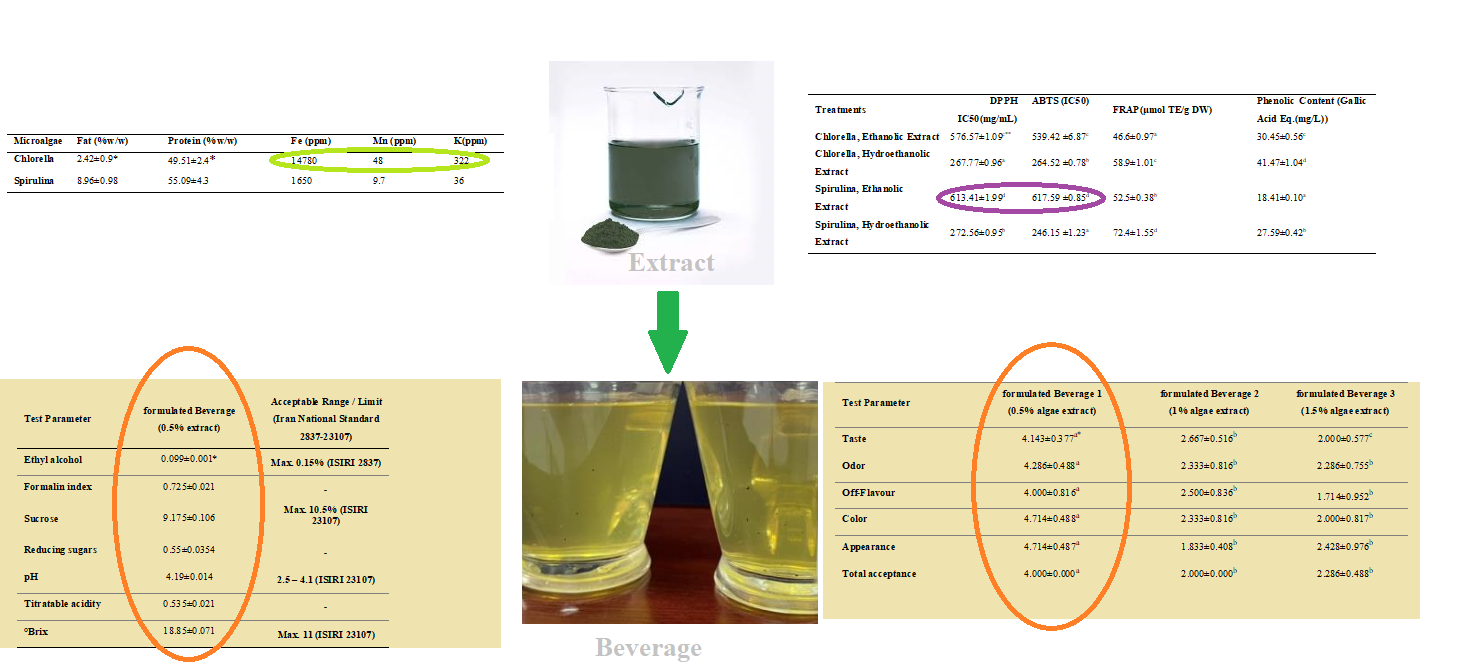
Background and Objective: Microalgae, such as Chlorella (C.) vulgaris and Spirulina (S.) platensis, are rich sources of bioactive compounds, including proteins, polyphenols, carotenoids, and essential fatty acids, which can enhance the nutritional and functional profiles of beverages. This study aimed to extract ethanolic and hydro-ethanolic extracts from C. vulgaris and S. platensis, evaluate their functional properties, and develop a consumer-acceptable functional beverage.
Materials and Methods: The nutritional composition (protein, lipid, and mineral content) of the microalgae was determined. Both ethanolic and hydro-ethanolic extracts were prepared, and their antioxidant activities were analyzed using DPPH, ABTS, and FRAP assays, alongside the determination of total phenolic content (TPC). For beverage formulation, varying concentrations (0.5%, 1%, and 1.5%) of the extracts were incorporated, followed by sensory evaluation. Physical and chemical parameters, including Brix, pH, titratable acidity, reducing sugars, sucrose, ethyl alcohol, and formol number, were measured for the optimized formulations.
Results: The hydro-ethanolic extracts exhibited significantly higher antioxidant activity and phenolic content compared to the ethanolic extracts. S. platensis showed higher protein and lipid contents, while C. vulgaris was superior in mineral composition. Sensory analysis revealed that the beverage containing 0.5% of the microalgal extract mixture achieved the highest consumer acceptance. The optimized formulations maintained acceptable physicochemical properties and high sensory scores.
Conclusion: The hydro-ethanolic extracts of Chlorella and Spirulina serve as potent natural antioxidant sources for functional beverage production. This study demonstrates that incorporating these microalgal extracts can result in a beverage with enhanced nutritional value and high bioactivity without compromising consumer acceptability.
Downloads
References
1. Martirosyan D. Functional food science and bioactive compounds. Bioactive Compounds in Health and Disease. (2025):Online ISSN: 2574–0334, 8(6), 218–229.
2. Beheshtipour H, Mortazavian AM, Mohammadi R, Sohrabvandi S, Khosravi‐Darani K. Supplem-entation of Spirulina platensis and Chlorella vulgaris algae into probiotic fermented milks. Comprehensive Reviews in Food Science and Food Safety, 2013; 12(2): 144–154. https://doi.org/10.1111/1541-4337.12004
3. Fadaei V, Mohamadi-Alasti F, Khosravi-Darani K. Influence of Spirulina platensis powder on the starter culture viability in probiotic yoghurt containing spinach during cold storage. European Journal of Experimental Biology. 2013; 3:389-393.
4. Beheshtipour H, Mortazavian AM, Haratian P, Khosravi-Darani K. Effects of Chlorella vulgaris and Arthrospira platensis addition on viability of probiotic bacteria in yogurt and its biochemical properties. European Food Research and Technology, 2012; 235(4): 719–728. https://doi.org/10.1007/s00217-012-1798-4
5. Santiago-Morales IS, Trujillo-Valle L, Márquez-Rocha FJ, Hernández JL. Tocopherols, phycocyanin and superoxide dismutase from microalgae: as potential food antioxidants. Applied Food Biotechnology, 2018; 5(1): 19–27 . https://doi.org/10.22037/afb.v5i1.17884
6. Soheili M, Khosravi-Darani K. The potential health benefits of algae and micro algae in medicine: a review on Spirulina platensis. Current Nutrition & Food Science, 2011; 7(4): 279–85. https://doi.org/10.2174/1573401311107040279
7. Marzieh Hosseini S, Shahbazizadeh S, Khosravi-Darani K, Mozafari MR. Spirulina paltensis: Food and function. Current Nutrition & Food Science, 2013; 9(3): 189–193. https://doi.org/10.2174/1573401311309030003
8. Nishimoto Y, Nomaguchi T, Mori Y, Ito M, Nakamura Y, Fujishima M, et al. The nutritional efficacy of Chlorella supplementation depends on the individual gut environment: a randomised control study. Frontiers in Nutrition. 2021; 8: 648073. https://doi.org/10.3389/fnut.2021.648073
9. Adeniyi-Martins O, Fasuba OA, Bolajoko AA, Nwankwo DI, Adesalu TA. Antioxidant and antibacterial activities of Oscillatoria sp. and Chlorella sp. Journal of Scientific Research and Development. 2023; 22(1): 126–40.
10. Fadaei V, Mazinani S, Khosravi-Darani K. Influence of Spirulina platensis powder on viability of Lactococcus strains in probiotic UF feta cheese containing Mentha longifolia L. International Journal of Biology and Biotech-nology. 2013; 10(3): 475–478.
11. Fadaei V, Eslami-Moshkenani A, Khosravi-Darani K. Effects of powdered Spirulina platensis biomass on pH and titratable acidity of probiotic doogh containing powdered mint during cold storage. International Journal of Biology and Biotechnology, 2013; 10: 631–635.
12. Khosravi-Darani K, Gholami Z, Gouveia L. Effect of Arthrospira platensis on the shelf life, sensorial and rheological properties of strudel. Romanian Biotechnological Letters, 2017; 22(1): 12250–12258.
13. Massoud R, Khosravi-Darani K, Nakhsaz F, Varga L. Evaluation of physicochemical, microbiological and sensory properties of croissants fortified with Arthrospira platensis (Spirulina). Czech Journal of Food Sciences, 2016; 34(4): 350–355.
14. Çelekli A, Özbal B, Bozkurt H. Challenges in functional food products with the incorporation of some microalgae. Foods, 2024; 13(5): 725. https://doi.org/10.3390/foods13050725
15. Tavakoli S, Hong H, Wang K, Yang Q, Gahruie HH, Zhuang S, et al. Ultrasonic-assisted food-grade solvent extraction of high-value added compounds from microalgae Spirulina platensis and evaluation of their antioxidant and antibacterial properties. Algal Research. 2021; 60: 102493.
16. Georgiopoulou I, Tzima S, Pappa GD, Louli V, Voutsas E, Magoulas K. Experimental design and optimization of recovering bioactive compounds from chlorella vulgaris through conventional extr-action. Molecules. 2021; 27(1): 29. https://org.doi/10.3390/molecules27010029
17. Brand-Williams W, Cuvelier M-E, Berset C. Use of a free radical method to evaluate antioxidant activity. LWT-Food science and Technology. 1995; 28(1): 25–30. https://org.doi/10.1016/S0023 6438(95)80008 5
18. Re R, Pellegrini N, Proteggente A, Pannala A, Yang M, Rice-Evans C. Antioxidant activity applying an improved ABTS radical cation decolorization assay. Free Radical Biology and Medicine. 1999; 26 (9-10): 1231–1237 . https://org.doi/10.1016/S0891 5849(98)00315 3
19. Benzie IF, Strain JJ. The ferric reducing ability of plasma (FRAP) as a measure of “antioxidant power”: the FRAP assay. Analytical biochemistry. 1996; 239(1): 70–76. https://org.doi/10.1006/abio.1996.0292
20. Carloni P, Tiano L, Padella L, Bacchetti T, Customu C, Kay A, et al. Antioxidant activity of white, green and black tea obtained from the same tea cultivar. Food Research International. 2013; 53(2): 900–908 . https://org.doi/10.1016/j.foodres.2013.07.057
21. White C, Gadd G. Determination of metals and metal fluxes in algae and fungi. Science of the Total environment. 1995; 176(1-3): 107–115.
22. Association of Official Analytical Chemists (AOAC). Official Methods of Analysis, 18th ed.; Method 984.13: Protein (Kjeldahl) in Foods. AOAC International: Gaithersburg, MD, USA, (2005).
23. ISIRI. National Standard of Iran No. 2685: Fruit Juices – Test Methods. Tehran, Iran: Institute of Standards & Industrial Research of Iran. 2007.
24. Masoumifeshani B, Abedian Kenari A, Sottorff I, Crüsemann M, Amiri Moghaddam J. Iden-tification and evaluation of antioxidant and anti-aging peptide fractions from enzymatically hydrolyzed proteins of Spirulina platensis and Chlorella vulgaris. Marine Drugs. 2025; 23(4): 162. https://org.doi/10.3390/md23040162
25. Sadeghi T, Marvizadeh MM, Ebrahimi F, Mafi S, Foughani O, Nafchi AM. Assessment of nutritional and antioxidant activity of sport drink enriched with Spirulina platensis. Journal of Chemical Health Risks. 2023; 13(3). https://org.doi/10.22034/jchr.2022. 1953680.1516
26. Fernandes R, Campos J, Serra M, Fidalgo J, Almeida H, Casas A, et al. Exploring the benefits of phycocyanin: From Spirulina cultivation to its widespread applications. Pharmaceuticals. 2023; 16(4): 592. https://org.doi/10.3390/ph16040592
27. Mendes AR, Spínola MP, Lordelo M, Prates JA. Chemical compounds, bioactivities, and applica-tions of Chlorella vulgaris in food, feed and medicine. Applied Sciences. 2024; 14(23): 10810. https://org.doi/10.3390/app142310810
28. Barouh N, Wind J, Chuat V, Gagnaire N, Valence F, Bourlieu-Lacanal C, et al. Variations in Chlorella lipid content in commercial and in-lab produced biomass. 2024.
29. Aprilia BE, Fibri DLN, Rahayu ES. Development and characterization of high-protein flakes made from Spirulina platensis in instant cereal drinks enriched with probiotic milk powder. Food Production, Processing and Nutrition. 2025; 7(1): 24. https://org.doi/10.1186/s43014 025 00274 6
30. Mahmoud N, Ferreira J, Raymundo A, Nunes MC. Enhancing the protein, mineral content, and bioactivity of wheat bread through the utilisation of microalgal biomass: a comparative study of Chlorella vulgaris, Phaeodactylum tricornutum, and Tetraselmis chuii. Applied Sciences. 2024; 14(6): 2483. https://org.doi/10.3390/app14062483
31. Hassanzadeh H, Ghanbarzadeh B, Galali Y, Bagheri H. The physicochemical properties of the spirulina‐wheat germ‐enriched high‐protein func-tional beverage based on pear‐cantaloupe juice. Food Science & Nutrition. 2022; 10(11): 3651–3661. https://org.doi/10.1002/fsn3.2963
32. Pyne S, Paria K, Mandal SM, Srivastav PP, Bhattacharjee P, Barik TK. Green microalgae deri-ved organic nanodots used as food preservative. Current Research in Green and Sustainable Chemistry. 2022; 5: 100276. https://org.doi/10.1016/j.crgsc.2022.100276
33. Sylvetsky AC, Rother KI. Nonnutritive sweeteners in weight management and chronic disease: a review. Obesity. 2018; 26(4): 635–640. https://org.doi/10.1002/oby.22139

Downloads
Published
Submitted
Revised
Accepted
Issue
Section
License
Copyright (c) 2026 Mehdi Jarrahzadeh, Maryam Moslehishad (Author); Fataneh Hashempour

This work is licensed under a Creative Commons Attribution-NonCommercial 4.0 International License.