
Multi-Targeting the DNA Damage Response in Breast Cancer: An In Silico Study of Zerumbone–Protein Interactions
Zerumbone interactions with DNA damage response protein
DOI:
https://doi.org/10.66224/BiotechIntellect.3.1.60Keywords:
Breast Cancer, Zerumbone, Molecular Docking, Molecular Dynamic Simulations, DNA DamageAbstract
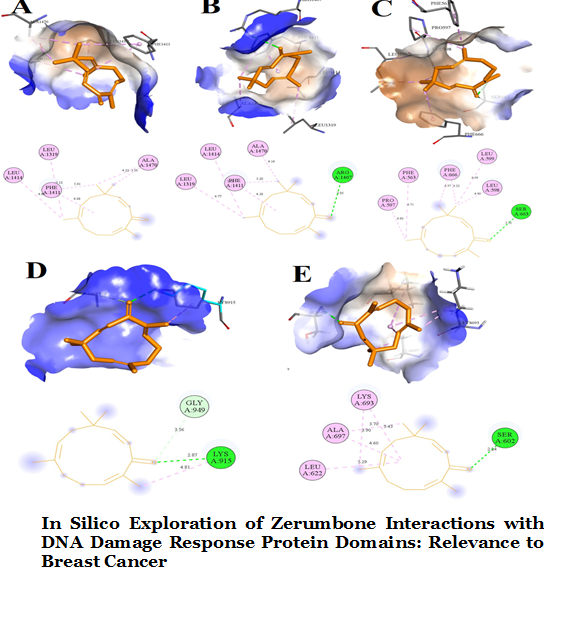
Background and Objective: Breast cancer remains a major cause of cancer-related mortality among women, with tumor heterogeneity and therapeutic resistance presenting significant challenges to treatment. The DNA damage response (DDR) pathway is essential for DNA repair and may contribute to cancer cell survival and treatment resistance, making DDR-associated proteins potential therapeutic targets. This study investigated the potential interactions of zerumbone, a bioactive compound derived from Zingiber zerumbet, with DDR-related proteins using molecular docking, molecular dynamics (MD) simulations, and molecular mechanics Poisson–Boltzmann surface area (MM/PBSA) analysis.
Materials and Methods: Molecular docking of 12 DDR-related protein structures identified favorable predicted interactions, with docking scores ranging from −5.24 to −6.69 kcal/mol. Five complexes with the most favorable docking scores were selected for three independent 100-ns MD simulations.
Results and Conclusion: Root-mean-square deviation and fluctuation (RMSD & RMSF) analyses revealed differences in global structural deviations and residue-level flexibility, with 3JVE–zerumbone exhibiting relatively low RMSD values and 7CMZ–zerumbone showing greater structural fluctuations. Radius of gyration analyses indicated that overall structural compactness remained relatively consistent during the simulations, while principal component analysis revealed comparatively restricted conformational sampling for 3JVE–zerumbone and broader conformational exploration for 7CMZ–zerumbone. MM/PBSA calculations, performed without an entropy term, yielded estimated binding energies ranging from −8.20 to −26.53 kcal/mol, with 7CMZ–zerumbone and 3AL2–zerumbone exhibiting the most favorable estimates. Notably, 3JVE–zerumbone displayed relatively low RMSD values but the least favorable MM/PBSA estimate, illustrating that limited structural deviation does not necessarily correspond to more favorable estimated binding energetics. Collectively, these findings provide structural and energetic insights into the predicted interactions of zerumbone with DDR-related protein domains and identify candidate complexes for further investigation.
Downloads
References
[1] F. Bray, M. Laversanne, H. Sung, J. Ferlay, R.L. Siegel, I. Soerjomataram, A. Jemal, Global cancer statistics 2022: GLOBOCAN estimates of incidence and mortality worldwide for 36 cancers in 185 countries, CA. Cancer J. Clin. 74 (2024) 229–263. https://doi.org/10.3322/caac.21834.
[2] M. Arnold, E. Morgan, H. Rumgay, A. Mafra, D. Singh, M. Laversanne, J. Vignat, J.R. Gralow, F. Cardoso, S. Siesling, I. Soerjomataram, Current and future burden of breast cancer: Global statistics for 2020 and 2040, Breast 66 (2022) 15–23. https://doi.org/10.1016/j.breast.2022.08.010.
[3] P.A. Williams, S.K. Zaidi, R. Sengupta, AACR Cancer Progress Report 2023: Advancing the Frontiers of Cancer Science and Medicine, Clin. Cancer Res. 29 (2023) 3850–3851. https://doi.org/10.1158/1078-0432.CCR-23-2591.
[4] M.T. Van Leeuwen, S. Luu, H. Gurney, M.R. Brown, S.A. Pearson, K. Webber, L. Hunt, S. Hong, G.P. Delaney, C.M. Vajdic, Cardiovascular toxicity of targeted therapies for cancer: An overview of systematic reviews, JNCI Cancer Spectr. 4 (2021) pkaa076. https://doi.org/10.1093/JNCICS/PKAA076.
[5] G. Ioele, M. Chieffallo, M.A. Occhiuzzi, M. De Luca, A. Garofalo, G. Ragno, F. Grande, Anticancer Drugs: Recent Strategies to Improve Stability Profile, Pharmacokinetic and Pharmacodynamic Properties, Molecules 27 (2022) 5436. https://doi.org/10.3390/molecules27175436.
[6] R.A. Ward, S. Fawell, N. Floc, V. Flemington, D. Mckerrecher, P.D. Smith, Challenges and Opportunities in Cancer Drug Resistance, Chem. Rev. 121 (2021) 3297–3351. https://doi.org/10.1021/acs.chemrev.0c00383.
[7] D. Jurkovicova, C.M. Neophytou, A. ˇCipak Gašparovi´c, A.C. Gonçalves, DNA Damage Response in Cancer Therapy and Resistance : Challenges and Opportunities, Int. J. Mol. Sci. 23 (2022) 14672.
[8] B. Cheng, W. Pan, Y. Xing, Y. Xiao, J. Chen, Z. Xu, Recent advances in DDR ( DNA damage response) inhibitors for cancer therapy, Eur. J. Med. Chem. 230 (2022) 114109. https://doi.org/10.1016/j.ejmech.2022.114109.
[9] W. Choi, E.S. Lee, Therapeutic Targeting of DNA Damage Response in Cancer, Int. J. Mol. Sci. 23 (2022) 1701.
[10] G. Danovski, G. Panova, B. Keister, R. Stamatov, P. Kanev, R. Aleksandrov, K.B. Blagoev, S.S. Stoynov, Diffusion of activated ATM explains gH2AX and MDC1 spread beyond the DNA damage site, ISCIENCE 27 (2024) 110826. https://doi.org/10.1016/j.isci.2024.110826.
[11] S.E. Ruff, S.K. Logan, M.J. Garabedian, T.T. Huang, Roles for MDC1 in cancer development and treatment, DNA Repair (Amst). 95 (2020) 102948. https://doi.org/10.1016/j.dnarep.2020.102948.
[12] I. Dikic, T. Johansen, V. Kirkin, Selective autophagy in cancer development and therapy, Cancer Res. 70 (2010) 3431–3434. https://doi.org/10.1158/0008-5472.CAN-09-4027.
[13] K. Yamamoto, A. Venida, R.M. Perera, A.C. Kimmelman, Selective autophagy of MHC-I promotes immune evasion of pancreatic cancer, Autophagy 16 (2020) 1524–1525. https://doi.org/10.1080/15548627.2020.1769973.
[14] Y. Liu, L. Yu, BRCA1 : a key player at multiple stages of homologous recombination in DNA double ‑ strand break repair, Genome Instab. Dis. 2 (2021) 164–174. https://doi.org/10.1007/s42764-021-00042-1.
[15] X. Li, L. Zou, BRCAness , DNA gaps , and gain and loss of PARP inhibitor – induced synthetic lethality, J. Clin. Invest. 134 (2024) e181062.
[16] P. Moudry, K. Watanabe, K.M. Wolanin, J. Bartkova, I.E. Wassing, S. Watanabe, R. Strauss, R.T. Pedersen, V.H. Oestergaard, M. Lisby, M. Andújar-Sánchez, A. Maya-Mendoza, F. Esashi, J. Lukas, J. Bartek, TOP BP1 regulates RAD51 phosphorylation and chromatin loading and determines PARP inhibitor sensitivity, J. Cell Biol. 212 (2016) 281–288. https://doi.org/10.1083/jcb.201507042.
[17] Z. Yan, X. Ge, J. Wang, F. Xu, M. Li, X. Liu, X. Yu, C. Wu, The impact of TOPBP1 mutations in human cancers on the DNA damage response, Genome Instab. Dis. 3 (2022) 144–162. https://doi.org/10.1007/s42764-022-00072-3.
[18] X. Xu, S. Vaithiyalingam, G.G. Glick, D.A. Mordes, W.J. Chazin, D. Cortez, The Basic Cleft of RPA70N Binds Multiple Checkpoint Proteins , Including RAD9 , To Regulate ATR Signaling, Mol. Cell. Biol. 28 (2008) 7345–7353. https://doi.org/10.1128/MCB.01079-08.
[19] M.D. Feldkamp, A.O. Frank, J.P. Kennedy, J.D. Patrone, B. Vangamudi, A.G. Waterson, S.W. Fesik, W.J. Chazin, Surface Reengineering of RPA70N Enables Cocrystallization with an Inhibitor of the Replication Protein A Interaction Motif of ATR Interacting Protein, Biochemistry 52 (2013) 6515–6524.
[20] M. Huang, J. Lu, J. Ding, Natural Products in Cancer Therapy : Past , Present and Future, Nat. Products Bioprospect. 11 (2021) 5–13. https://doi.org/10.1007/s13659-020-00293-7.
[21] S. Ghosh, S.K. Das, K. Sinha, B. Ghosh, K. Sen, N. Ghosh, P.C. Sil, The Emerging Role of Natural Products in Cancer Treatment, Springer Berlin Heidelberg, 2024. https://doi.org/10.1007/s00204-024-03786-3.
[22] R. Pavithra, M.R. Khan, M.S. Khan, Recent advancements in natural compounds for cancer therapy and prevention, Phytochem. Rev. 23 (2024) 1835–1859. https://doi.org/10.1007/s11101-024-09940-0.
[23] J. Chen, L. Zhou, X. Li, X. Wu, Y. Li, L. Si, Y. Deng, Protective effect of zerumbone on sepsis ‑ induced acute lung injury through anti ‑ inflammatory and antioxidative activity via NF ‑ κB pathway inhibition and HO ‑ 1 activation, Naunyn. Schmiedebergs. Arch. Pharmacol. 397 (2024) 2241–2255. https://doi.org/10.1007/s00210-023-02706-z.
[24] M.D. Ibáñez, N.M. Sánchez-Ballester, M.A. Blázquez, Healthy Zerumbone : From Natural Sources to Strategies to Improve Its Bioavailability and Oral Administration, Plants 12 (2023).
[25] H.M. AbuZahra, P. Rajendran, M.B. Ismail, Zerumbone Exhibit Protective Effect against Zearalenone Induced Toxicity via Ameliorating Inflammation and Oxidative Stress Induced Apoptosis, Antibiotics 10 (2021) 1593.
[26] A. Soroush, S. Pourhossein, D. Hosseingholizadeh, A. Hjazi, R. Shahhosseini, H. Kavoosi, N. Kermanshahi, P. Behnamrad, N. Ghavamikia, M. Dadashpour, S.K. Shayan, Anti ‑ cancer potential of zerumbone in cancer and glioma : current trends and future perspectives, Med. Oncol. 41 (2024) 1–14. https://doi.org/10.1007/s12032-024-02327-3.
[27] A. Ostadi, M.M. Vahedi, F. Abbasinezhad-moud, Y. Metanat, F.Q.M. Seraj, A.R. Afshari, S.S. Ahmadi, G.A. Ferns, A. Bahrami, Zerumbone Induces Apoptosis and Inhibits Migration of A2058 Melanoma stem-like Cells by Producing Reactive Oxygen Species , Causing G2 / M Cell Cycle Arrest , and Controlling the Expression of Genes Linked to Metastasis, Indian J. Clin. Biochem. (2024). https://doi.org/10.1007/s12291-024-01260-6.
[28] A. Sehrawat, K. Sakao, S. V. Singh, Notch2 activation is protective against anticancer effects of zerumbone in human breast cancer cells, Breast Cancer Res. Treat. 146 (2015) 543–555. https://doi.org/10.1007/s10549-014-3059-7.
[29] M. Jeon, J. Han, S.J. Nam, J.E. Lee, S. Kim, Elevated IL-1β expression induces invasiveness of triple negative breast cancer cells and is suppressed by zerumbone, Chem. Biol. Interact. 258 (2016) 126–133. https://doi.org/10.1016/j.cbi.2016.08.021.
[30] J. Han, S.Y. Bae, S.J. Oh, J. Lee, J.H. Lee, H.C. Lee, S.K. Lee, W.H. Kil, S.W. Kim, S.J. Nam, S. Kim, J.E. Lee, Zerumbone suppresses IL-1β-induced cell migration and invasion by inhibiting IL-8 and MMP-3 expression in human triple-negative breast cancer cells, Phyther. Res. 28 (2014) 1654–1660. https://doi.org/10.1002/ptr.5178.
[31] A. Sehrawat, J.A. Arlotti, A. Murakami, S. V. Singh, Zerumbone causes Bax and Bak-mediated apoptosis in human breast cancer cells and inhibits orthotopic xenograft growth in vivo, Breast Cancer Res. Treat. 136 (2013) 429–441. https://doi.org/10.1007/s10549-012-2280-5.
[32] B. Sung, S. Jhurani, S.A. Kwang, Y. Mastuo, T. Yi, S. Guha, M. Liu, B.B. Aggarwal, Zerumbone down-regulates chemokine receptor CXCR4 expression leading to inhibition of CXCL12-induced invasion of breast and pancreatic tumor cells, Cancer Res. 68 (2008) 8938–8944. https://doi.org/10.1158/0008-5472.CAN-08-2155.
[33] S. Kim, J. Lee, M. Jeon, J.E. Lee, S.J. Nam, Zerumbone suppresses the motility and tumorigenecity of triple negative breast cancer cells via the inhibition of TGF-β1 signaling pathway, Oncotarget 7 (2016) 1544–1558. https://doi.org/10.18632/oncotarget.6441.
[34] P.K. Chiang, W.K. Tsai, M. Chen, W.R. Lin, Y.C. Chow, C.C. Lee, J.M. Hsu, Y.J. Chen, Zerumbone Regulates DNA Repair Responding to Ionizing Radiation and Enhances Radiosensitivity of Human Prostatic Cancer Cells, Integr. Cancer Ther. 17 (2018) 292–298. https://doi.org/10.1177/1534735417712008.
[35] V. Zarezade, Z. Nazeri, S. Azizidoost, M. Cheraghzadeh, H. Babaahmadi-Rezaei, A. Kheirollah, Paradoxical effect of Aβ on protein levels of ABCA1 in astrocytes, microglia, and neurons isolated from C57BL/6 mice: an in vitro and in silico study to elucidate the effect of Aβ on ABCA1 in the brain cells, J. Biomol. Struct. Dyn. 42 (2024) 274–287. https://doi.org/10.1080/07391102.2023.2201835.
[36] M. Yazdi, M. Hasanzadeh Kafshgari, F. Khademi Moghadam, V. Zarezade, R. Oellinger, M. Khosravi, S. Haas, C.C. Hoch, A.G. Pockley, E. Wagner, B. Wollenberg, G. Multhoff, A. Bashiri Dezfouli, Crosstalk Between NK Cell Receptors and Tumor Membrane Hsp70-Derived Peptide: A Combined Computational and Experimental Study, Adv. Sci. 11 (2024) 1–15. https://doi.org/10.1002/advs.202305998.
[37] K.S. McPherson, D.M. Korzhnev, Targeting protein-protein interactions in the DNA damage response pathways for cancer chemotherapy, RSC Chem. Biol. 2 (2021) 1167–1195. https://doi.org/10.1039/d1cb00101a.
[38] S.P. Singh, K. Nongalleima, N.I. Singh, W.K. Chanu, T.R. Singh, C.B. Singh, Computational Investigation of Zerumbone as an Inhibitor of TNF-alpha Using Molecular Dynamics and Molecular Docking Methods, Lett. Drug Des. Discov. 18 (2020) 258–268. https://doi.org/10.2174/1570180817999201110112221.
[39] S.P. Singh, N.I. Singh, K. Nongalleima, P. Doley, C.B. Singh, D. Sahoo, Molecular docking, MD simulation, DFT and ADME-toxicity study on analogs of zerumbone against IKK-β enzyme as anti-cancer agents, Netw. Model. Anal. Heal. Informatics Bioinforma. 7 (2018) 1–8. https://doi.org/10.1007/s13721-018-0171-3.
[40] E.E.M. Eid, F. Azam, M. Hassan, I.M. Taban, M.A. Halim, Zerumbone binding to estrogen receptors: An in-silico investigation, J. Recept. Signal Transduct. 38 (2018) 342–351. https://doi.org/10.1080/10799893.2018.1531886.
[41] S. Kim, J. Chen, T. Cheng, A. Gindulyte, J. He, S. He, Q. Li, B.A. Shoemaker, P.A. Thiessen, B. Yu, L. Zaslavsky, J. Zhang, E.E. Bolton, PubChem 2023 update, Nucleic Acids Res. 51 (2023) D1373–D1380. https://doi.org/10.1093/nar/gkac956.
[42] J. Eberhardt, D. Santos-Martins, A.F. Tillack, S. Forli, AutoDock Vina 1.2.0: New Docking Methods, Expanded Force Field, and Python Bindings, J. Chem. Inf. Model. 61 (2021) 3891–3898. https://doi.org/10.1021/acs.jcim.1c00203.
[43] E.F. Pettersen, T.D. Goddard, C.C. Huang, G.S. Couch, D.M. Greenblatt, E.C. Meng, T.E. Ferrin, UCSF Chimera - A visualization system for exploratory research and analysis, J. Comput. Chem. 25 (2004) 1605–1612. https://doi.org/10.1002/jcc.20084.
[44] M.J. Abraham, T. Murtola, R. Schulz, S. Páll, J.C. Smith, B. Hess, E. Lindah, Gromacs: High performance molecular simulations through multi-level parallelism from laptops to supercomputers, SoftwareX 1–2 (2015) 19–25. https://doi.org/10.1016/j.softx.2015.06.001.
[45] S.A. Showalter, R. Brüschweiler, Validation of molecular dynamics simulations of biomolecules using NMR spin relaxation as benchmarks: Application to the AMBER99SB force field, J. Chem. Theory Comput. 3 (2007) 961–975. https://doi.org/10.1021/ct7000045.
[46] J. Wang, W. Wang, P.A. Kollman, D.A. Case, Automatic atom type and bond type perception in molecular mechanical calculations, J. Mol. Graph. Model. 25 (2006) 247–260. https://doi.org/10.1016/j.jmgm.2005.12.005.
[47] A. Jakalian, D.B. Jack, C.I. Bayly, Fast, efficient generation of high-quality atomic charges. AM1-BCC model: II. Parameterization and validation, J. Comput. Chem. 23 (2002) 1623–1641. https://doi.org/10.1002/jcc.10128.
[48] J. Zielkiewicz, Structural properties of water: Comparison of the SPC, SPCE, TIP4P, and TIP5P models of water, J. Chem. Phys. 123 (2005). https://doi.org/10.1063/1.2018637.
[49] E.J. Haug, J.S. Arora, K. Matsui, A steepest-descent method for optimization of mechanical systems, J. Optim. Theory Appl. 19 (1976) 401–424. https://doi.org/10.1007/BF00941484.
[50] H.J.C. Berendsen, J.P.M. Postma, W.F. Van Gunsteren, A. Dinola, J.R. Haak, Molecular dynamics with coupling to an external bath, J. Chem. Phys. 81 (1984) 3684–3690. https://doi.org/10.1063/1.448118.
[51] M. Parrinello, A. Rahman, Polymorphic transitions in single crystals: A new molecular dynamics method, J. Appl. Phys. 52 (1981) 7182–7190. https://doi.org/10.1063/1.328693.
[52] S. Miyamoto, P.A. Kollman, Settle: An analytical version of the SHAKE and RATTLE algorithm for rigid water models, J. Comput. Chem. 13 (1992) 952–962. https://doi.org/10.1002/jcc.540130805.
[53] B. Hess, H. Bekker, H.J.C. Berendsen, J.G.E.M. Fraaije, LINCS: A Linear Constraint Solver for molecular simulations, J. Comput. Chem. 18 (1997) 1463–1472. https://doi.org/10.1002/(SICI)1096-987X(199709)18:12<1463::AID-JCC4>3.0.CO;2-H.
[54] T. Darden, D. York, L. Pedersen, Particle mesh Ewald: An N·log(N) method for Ewald sums in large systems, J. Chem. Phys. 98 (1993) 10089–10092. https://doi.org/10.1063/1.464397.
[55] J. Lenhard, S. Stephan, H. Hasse, On the History of the Lennard-Jones Potential, Ann. Phys. 536 (2024) 1–4. https://doi.org/10.1002/andp.202400115.
[56] W. Humphrey, A. Dalke, K. Schulten, VMD: Visual molecular dynamics, J. Mol. Graph. 14 (1996) 33–38. https://doi.org/10.1016/0263-7855(96)00018-5.
[57] M.S. Valdés-Tresanco, M.E. Valdés-Tresanco, P.A. Valiente, E. Moreno, Gmx_MMPBSA: A New Tool to Perform End-State Free Energy Calculations with GROMACS, J. Chem. Theory Comput. 17 (2021) 6281–6291. https://doi.org/10.1021/acs.jctc.1c00645.
[58] N. Nezhad, S.S. Saleem, O. Michael, C. Haznie, A. Che, A. Bazli, Evolutionary clade-guided consensus redesign of Is PETase : A computational framework for enhancing thermodynamic stability and MM / PBSA-derived binding energetics, Comput. Biol. Chem. 124 (2026) 109139. https://doi.org/10.1016/j.compbiolchem.2026.109139.
[59] R. Ferreira De Freitas, M. Schapira, A systematic analysis of atomic protein-ligand interactions in the PDB, Medchemcomm 8 (2017) 1970–1981. https://doi.org/10.1039/c7md00381a.
[60] J. Biswal, P. Jayaprakash, R. Rangaswamy, J. Jeyakanthan, Synergistic Effects of Hydration Sites in Protein Stability: A Theoretical Water Thermodynamics Approach, Front. Protein Struct. Funct. Dyn. (2020) 187–212. https://doi.org/10.1007/978-981-15-5530-5_8.
[61] S.P. Singh, K. Nongalleima, N.I. Singh, P. Doley, C.B. Singh, T.R. Singh, D. Sahoo, Zerumbone reduces proliferation of HCT116 colon cancer cells by inhibition of TNF-alpha, Sci. Rep. 8 (2018) 1–11. https://doi.org/10.1038/s41598-018-22362-1.
[62] N.G. Nezhad, A. Eskandari, O.F. Omotayo, S.H. Albayati, S.B. Buhari, T.C. Leow, In Silico Structural Insights into a Glucanase from Clostridium perfringens and Prediction of Structural Stability Improvement Through Hydrophobic Interaction Network and Aromatic Interaction, Mol. Biotechnol. 68 (2025) 187–199. https://doi.org/10.1007/s12033-025-01371-2.
[63] N.G. Nezhad, S.B. Buhari, A. Eskandari, S.H. Albayati, O.F. Omotayo, T.C. Leow, Improving the thermostability and substrate affinity of IsPETase through the S209H mutation, and exploring the structural role of the N-terminal: a computational study, 3 Biotech 15 (2025). https://doi.org/10.1007/s13205-025-04258-w.
[64] N.G. Nezhad, M.Y. Borzehandani, A. Eskandari, R.N.Z.R.A. Rahman, N.M. Yahaya, S.N. Oslan, F.M. Shariff, A.L.T. Chor, A comparative investigation of predicted protein structures of a histidine acid phosphatase from Saccharomyces cerevisiae through molecular docking and MD simulations, J. Proteins Proteomics 16 (2025) 35–47. https://doi.org/10.1007/s42485-025-00174-y.
[65] N.G. Nezhad, R.N.Z. Abd Rahman, Y.M. Normi, S.N. Oslan, F.M. Shariff, T.C. Leow, Recent advances in simultaneous thermostability-activity improvement of industrial enzymes through structure modification, Int. J. Biol. Macromol. 232 (2023) 123440. https://doi.org/10.1016/j.ijbiomac.2023.123440.
[66] N.G. Nezhad, R.N.Z. Abd Rahman, Y.M. Normi, S.N. Oslan, F.M. Shariff, T.C. Leow, Thermostability engineering of industrial enzymes through structure modification, Appl. Microbiol. Biotechnol. 106 (2022) 4845–4866. https://doi.org/10.1007/s00253-022-12067-x.
[67] S.B. Buhari, N.G. Nezhad, Y.M. Normi, F.M. Sharif, T.C. Leow, Homology modeling and thermostability enhancement of Vibrio palustris PETase via hydrophobic interactions, J. Biomol. Struct. Dyn. (2025) 1–14. https://doi.org/10.1080/07391102.2024.2440646.
[68] N. Rana, P. Solanki, R. Mehra, A. Manhas, Identification of natural compound inhibitors for substrate-binding site of MTHFD2 enzyme: Insights from structure-based drug design and biomolecular simulations, Chem. Phys. Impact 10 (2025) 100809. https://doi.org/10.1016/j.chphi.2024.100809.
Downloads
Publication Timeline
- Submitted
- Revised
- Accepted
Issue
Section
License
Copyright (c) 2026 Zahra Sanaimehr, Nasim Forgani, Nima Ghahremani Nezhad, Ahmed Issa Al-Tameemi (Author)

This work is licensed under a Creative Commons Attribution-NonCommercial 4.0 International License.