Antimicrobial Potential of Rhizosphere-Associated Actinomycetes Isolated from Salvia rosmarinus and Mentha spicata
Antimicrobial Rhizosphere Actinomycete from Salvia & Mentha
DOI:
https://doi.org/10.66224/BiotechIntellect.3.1.59Keywords:
Rhizosphere, Salvia rosmarinus, Mentha spicata, Antimicrobial activity, StreptomycesAbstract
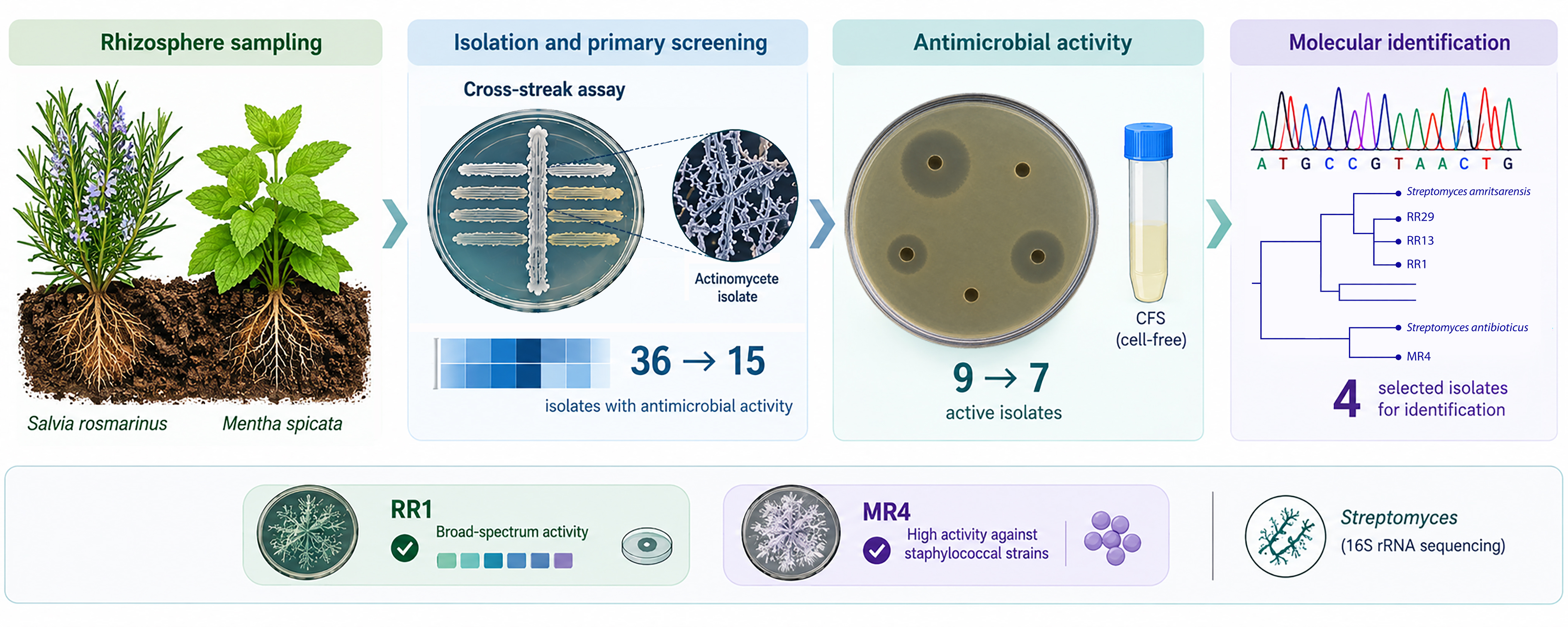
Background and Objective: Rhizosphere-associated actinomycetes are promising sources of microorganisms with antimicrobial potential. This study aimed to isolate actinomycetes from the rhizospheres of rosemary (Salvia rosmarinus) and spearmint (Mentha spicata) and evaluate their antagonistic activity against selected bacterial and fungal pathogens.
Materials and Methods: Rhizosphere soil samples were collected from rosemary and spearmint plants, and actinomycetes were isolated using culture-based methods involving sample pretreatment, serial dilution, and cultivation on selective media. All isolates were screened for antagonistic activity using the cross-streak method on International Streptomyces Project medium 2 (ISP2) and tryptic soy agar (TSA). The target microorganisms included Escherichia coli, Pseudomonas aeruginosa, methicillin-susceptible Staphylococcus aureus (MSSA), methicillin-resistant S. aureus (MRSA), Enterococcus faecalis, Listeria monocytogenes, and Candida albicans. Nine isolates were selected for further investigation. The isolates were cultivated in tryptic soy broth, and cell-free culture supernatants (CFS) were prepared by centrifugation and membrane filtration. The antimicrobial activity of the CFS was evaluated using the agar-well diffusion method. Four selected isolates were subjected to 16S rRNA gene sequencing for molecular identification.
Results and Conclusion: Of the 36 isolates screened by the cross-streak method, 15 exhibited antimicrobial activity, with inhibition profiles varying according to the isolate, test organism, and culture medium. RR1 showed the broadest antagonistic activity in this assay. In the agar-well diffusion assay, the CFS of RR1 inhibited all seven test organisms, with inhibition zones of 12–19 mm, whereas MR4 produced 20-mm inhibition zones against both MSSA and MRSA but showed no detectable inhibition of the other test organisms. The activity profiles differed between the two assays for some isolates. Based on 16S rRNA gene sequence comparisons, RR1, RR13, and RR29 showed 100% sequence identity with Streptomyces amritsarensis, while MR4 showed 100% identity with Streptomyces antibioticus. These results identify RR1 as a promising candidate for further investigation of broad-spectrum antimicrobial activity and MR4 for studies of anti-staphylococcal activity. However, further characterization, including minimum inhibitory concentration determination and chemical analysis of active compounds, is required to establish the potency and nature of their antimicrobial activity.
Downloads
References
1. World Health Organization. WHO bacterial priority pathogens list, 2024: Bacterial pathogens of public health importance to guide research, development and strategies to prevent and control antimicrobial resistance. Geneva: World Health Organization; 2024. https://www.who.int/publications/i/item/9789240093461.
2. Alam K, Mazumder A, Sikdar S, Zhao YM, Hao J, Song C, et al. Streptomyces: the biofactory of secondary metabolites. Front Microbiol 2022;13:968053. https://doi.org/10.3389/fmicb.2022.968053.
3. Lacey HJ, Rutledge PJ. Recently discovered secondary metabolites from Streptomyces species. Molecules 2022;27(3):887. https://doi.org/10.3390/molecules27030887.
4. Parra J, Beaton A, Seipke RF, Wilkinson B, Hutchings MI, Duncan KR. Antibiotics from rare actinomycetes, beyond the genus Streptomyces. Curr Opin Microbiol 2023;76:102385. https://doi.org/10.1016/j.mib.2023.102385.
5. Sweeney D, Chase AB, Bogdanov A, Jensen PR. MAR4 Streptomyces: a unique resource for natural product discovery. J Nat Prod 2024;87(2):439–452. https://doi.org/10.1021/acs.jnatprod.3c01007.
6. Ait Assou S, El Hassouni M. New Streptomyces-derived antibacterial compounds targeting Gram-positive bacteria: a systematic review. ScientificWorldJournal 2025;2025:6659874. https://doi.org/10.1155/tswj/6659874.
7. Hassan MK, McInroy JA, Kloepper JW. The interactions of rhizodeposits with plant growth-promoting rhizobacteria in the rhizosphere: a review. Agriculture 2019;9(7):142. https://doi.org/10.3390/agriculture9070142.
8. Olanrewaju OS, Babalola OO. Streptomyces: implications and interactions in plant growth promotion. Appl Microbiol Biotechnol 2019;103:1179–1188. https://doi.org/10.1007/s00253-018-09577-y.
9. Zhao K, Penttinen P, Chen Q, Guan T, Lindström K, Ao X, et al. The rhizospheres of traditional medicinal plants in Panxi, China, host a diverse selection of actinobacteria with antimicrobial properties. Appl Microbiol Biotechnol 2012;94(5):1321–1335. https://doi.org/10.1007/s00253-011-3862-6.
10. Alinejad Delahzi F, Khodakaramian G, Chandramowli D, Devreese B. Catechol-type siderophore producer Streptomyces spp. with quorum-quenching activity isolated from wild medicinal plants rhizosphere. The Microbe 2024;2:100033. https://doi.org/10.1016/j.microb.2023.100033.
11. Du Y, Wang T, Jiang J, Wang Y, Lv C, Sun K, et al. Biological control and plant growth promotion properties of Streptomyces albidoflavus St-220 isolated from Salvia miltiorrhiza rhizosphere. Front Plant Sci 2022;13:976813. https://doi.org/10.3389/fpls.2022.976813.
12. Velho-Pereira S, Kamat NM. Antimicrobial screening of actinobacteria using a modified cross-streak method. Indian J Pharm Sci 2011;73(2):223–228. https://doi.org/10.4103/0250-474x.91566.
13. Clinical and Laboratory Standards Institute. Performance standards for antimicrobial disk susceptibility tests. 14th ed. Wayne (PA): Clinical and Laboratory Standards Institute; 2024.
14. Saba F, Papizadeh M, Khansha J, Sedghi M, Rasooli M, Amoozegar MA, et al. A rapid and reproducible genomic DNA extraction protocol for sequence-based identification of archaea, bacteria, cyanobacteria, diatoms, fungi, and green algae. J Med Bacteriol 2016;5(3–4):22–28.
15. Delbari Y, Mohassel Y, Kakaei E, Bahrami Y. Identification and anti-bacterial property of endophytic actinobacteria from Thymes kotschyanus, Allium hooshidaryae, and Cerasus microcarpa. Sci Rep 2023;13(1):13145. https://doi.org/10.1038/s41598-023-40478-x.
16. Tistechok S, Roman I, Fedorenko V, Luzhetskyy A, Gromyko O. Diversity and bioactive potential of Actinomycetia from the rhizosphere soil of Juniperus excelsa. Folia Microbiol 2023;68:645–653. https://doi.org/10.1007/s12223-023-01047-x.
17. Sáhó A, Karikás V, Ásványi B, Lakatos E, Varga L, Greff B. Bioactive potential of actinobacteria strains isolated from the rhizosphere of lavender, lemon balm, and oregano. Agriculture 2024;14(10):1758. https://doi.org/10.3390/agriculture14101758.
18. Elshafie HS, Camele I. Rhizospheric actinomycetes revealed antifungal and plant-growth-promoting activities under controlled environment. Plants 2022;11(14):1872. https://doi.org/10.3390/plants11141872.
19. Wazzani Y, Tavaszi-Sárosi S, Patonay K, Olasz F, Juhász Á, Posta K. Microbial communities in the rhizosphere of three Mentha species: links to soil properties and essential oil profiles. PLoS One 2026;21(7). https://doi.org/10.1371/journal.pone.0354132.
20. Barka EA, Vatsa P, Sanchez L, Gaveau-Vaillant N, Jacquard C, Klenk HP, et al. Taxonomy, physiology, and natural products of Actinobacteria. Microbiol Mol Biol Rev 2016;80(1):1–43. https://doi.org/10.1128/MMBR.00019-15.
21. Kiepas AB, Hoskisson PA, Pritchard L. 16S rRNA phylogeny and clustering is not a reliable proxy for genome-based taxonomy in Streptomyces. Microb Genom 2024;10(9):001287. https://doi.org/10.1099/mgen.0.001287.
22. Mispelaere M, De Rop AS, Hermans C, De Maeseneire SL, Soetaert WK, De Mol ML, et al. Whole genome-based comparative analysis of the genus Streptomyces reveals many misclassifications. Appl Microbiol Biotechnol 2024;108:453. https://doi.org/10.1007/s00253-024-13290-4.
23. Sharma D, Mandal SM, Manhas RK. Purification and characterization of a novel lipopeptide from Streptomyces amritsarensis sp. nov. active against methicillin-resistant Staphylococcus aureus. AMB Express 2014;4:50. https://doi.org/10.1186/s13568-014-0050-y.
24. Sharma D, Mayilraj S, Manhas RK. Streptomyces amritsarensis sp. nov., exhibiting broad-spectrum antimicrobial activity. Antonie Van Leeuwenhoek 2014;105(5):943–949. https://doi.org/10.1007/s10482-014-0151-2.
25. Sharma D, Kanwar K, Manhas RK. Genomic analysis of Streptomyces amritsarensis MTCC 11845 and characterization of novel lanthipeptide 2A. Indian J Exp Biol 2025;63(3):229–238. https://doi.org/10.56042/ijeb.v63i03.13585.
26. Sharma M, Manhas RK. Purification and characterization of actinomycins from Streptomyces strain M7 active against methicillin-resistant Staphylococcus aureus and vancomycin-resistant Enterococcus. BMC Microbiol 2019;19:44. https://doi.org/10.1186/s12866-019-1405-y.
27. Shahid M, Singh BN, Verma S, et al. Bioactive antifungal metabolites produced by Streptomyces amritsarensis V31 help to control diverse phytopathogenic fungi. Braz J Microbiol 2021;52(4):1687–1699. https://doi.org/10.1007/s42770-021-00625-w.
28. Geiger A, Keller-Schierlein W, Brandl M, Zähner H. Metabolites of microorganisms. 247. Phenazines from Streptomyces antibioticus, strain TÜ 2706. J Antibiot 1988;41(11):1542–1551. https://doi.org/10.7164/antibiotics.41.1542.
29. Kim BS, Oh H, Kim SY, Park JA, Yoon YJ, Lee SK, et al. Identification and antibacterial activity of a new oleandomycin derivative from Streptomyces antibioticus. J Antibiot 2005;58(3):196–201. https://doi.org/10.1038/ja.2005.23.
30. Xu LY, Quan XS, Wang C, Sheng HF, Zhou GX, Lin BR, et al. Antimycins A19 and A20, two new antimycins produced by marine actinomycete Streptomyces antibioticus H74-18. J Antibiot 2011;64:661–665. https://doi.org/10.1038/ja.2011.65.
31. Rui Z, Ye M, Wang S, et al. Insights into a divergent phenazine biosynthetic pathway governed by a plasmid-born esmeraldin gene cluster. Chem Biol 2012;19(9):1116–1125. https://doi.org/10.1016/j.chembiol.2012.07.025.
32. Li Y, Zhang J, Zheng J, Guan H, Liu W, Tan H. Co-expression of a SARP family activator ChlF2 and a type II thioesterase ChlK led to high production of chlorothricin in Streptomyces antibioticus DSM 40725. Front Bioeng Biotechnol 2020;8:1013. https://doi.org/10.3389/fbioe.2020.01013.
Downloads
Publication Timeline
- Submitted
- Revised
- Accepted
Issue
Section
License
Copyright (c) 2026 Mahsa Khooshehgir, Shaghayegh Nasr (Author); Nayyereh Alimadadi

This work is licensed under a Creative Commons Attribution-NonCommercial 4.0 International License.