
Screening of Pigment Producer from Native Halophilic Archaea
DOI:
https://doi.org/10.66224/BiotechIntellect.3.1.58Keywords:
Pigments, haloarchaea, carotenoid, antioxidant, Screening, antibacterialAbstract
Purpose and aim: Halophilic archaea have a high potential to discover new compounds with high biotechnological potential, one of these compounds is carotenoids.
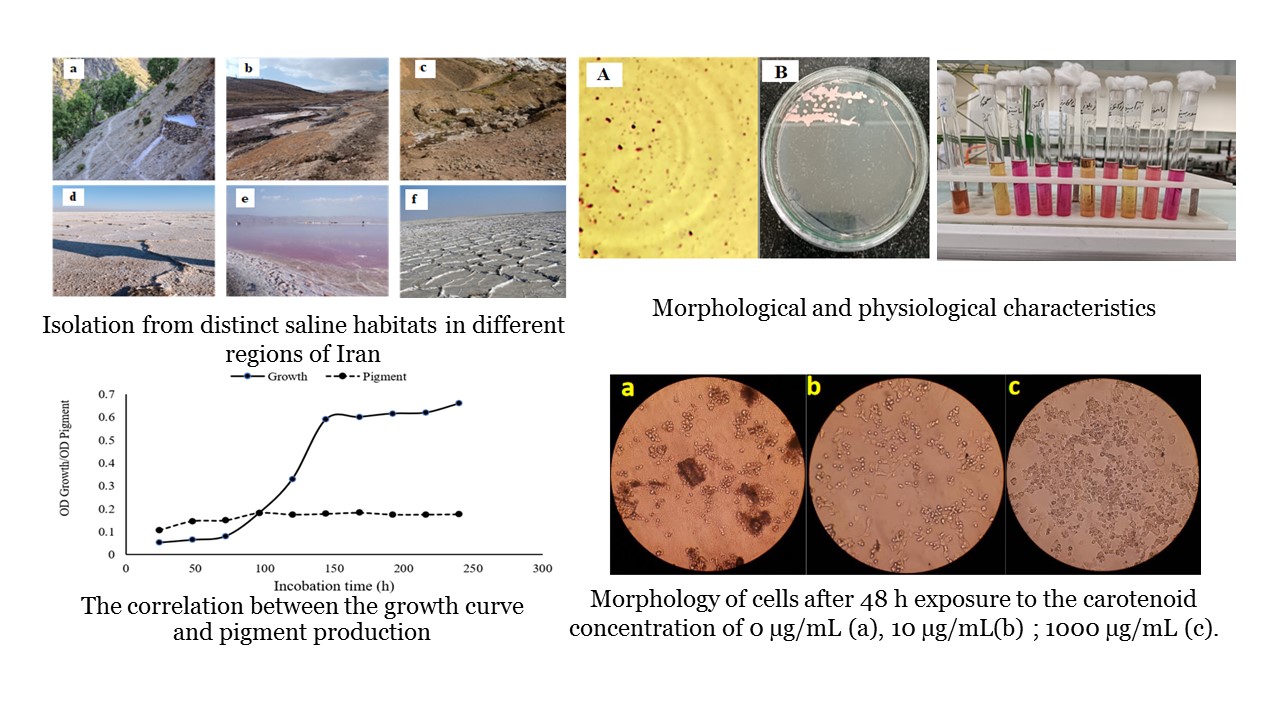
Material and Methods: A collection of 23 native highly halophilic archaea isolates were isolated from distinct saline habitats in different regions of Iran. Among the examined isolates, the isolates that had produced colored colonies within a week were further investigated by absorption spectrophotometric method in order to extract and measure the amount of pigment produced with different solvents of methanol, acetone, hexane, ethernet and ethanol. UV, TLC, FT-IR, LC-MS spectroscopic methods were used to investigate and determine the carotenoid pigment structure of Haloferax Mediterranei ASFM403 strain. Its antioxidant and antimicrobial properties were investigated. Also, the effect of produced carotenoid toxicity on melanoma cancer cells and human fibroblast cells was studied
Results and Discussion: According to the results obtained from the screening of the strains, the best methanol solvent and the best absorbance 0.239 at the wavelength of 498 belonged to the Haloferax Mediterranei ASFM403 strain. The light absorption data of the pigment shows the structural similarity of this carotenoid with bacterioruberin.
Conclusion: The information obtained from carotenoid identification with TLC, FT-IR and LC-MS shows that bacterioruberin is the dominant carotenoid. The antioxidant activity of carotenoid obtained at a concentration of 5 μg reached 83%, which was higher than ascorbic acid as a standard. And the antibacterial effect was significant against pathogenic bacteria. It also has a toxic effect on melanoma cancer cells in concentrations of 10 and 50 micrograms/liter. While, it helps the growth of fibroblast cells.
Downloads
References
1. Milani, A., M. Basirnejad, S. Shahbazi and A. Bolhassani, Carotenoids: biochemistry, pharmacology and treatment. British Journal of Pharmacology, 2017. 174(11): p. 1290-1324. https://doi.org/10.1111/bph.13625
1. Mortensen, A., L.H. Skibsted and T.G. Truscott, The interaction of dietary carotenoids with radical species. Archives of Biochemistry and Biophysics, 2001. 385(1): p. 13-19.
https://doi.org/10.1006/abbi.2000.2172
2. Bayir, H., Reactive oxygen species. Critical Care Medicine, 2005. 33(12 Suppl): p. S498-S501. https://doi.org/10.1097/01.ccm.0000186787.64500.12
3. Jomova, K. and M. Valko, Health protective effects of carotenoids and their interactions with other biological antioxidants. European Journal of Medicinal Chemistry, 2013. 70: p. 102-110. https://doi.org/10.1016/j.ejmech.2013.09.054
4. Koklesova, L., A. Liskova, M. Samec, C. Buhrmann, S.M. Samuel, E. Varghese, M. Ashrafizadeh, M. Najafi, M. Shakibaei, D. Büsselberg, F.A. Giordano, O. Golubnitschaja and P. Kubatka, Carotenoids in cancer apoptosis—The road from bench to bedside and back. Cancers, 2020. 12(9): p. 2425. https://doi.org/10.3390/cancers12092425
5. Oren, A., The microbiology of red brines. Advances in Applied Microbiology, 2020. 113: p. 57-110. https://doi.org/10.1016/bs.aambs.2020.07.003
6. Massoud, R. and K. Khosravi-Darani, A review on the impacts of process variables on microbial production of carotenoid pigments. In: Food Biosynthesis, 2017. p. 183-211.
https://doi.org/10.1016/B978-0-12-811372-1.00006-3
7. Vílchez, C., E. Forján, M. Cuaresma, F. Bédmar, I. Garbayo and J.M. Vega, Marine carotenoids: biological functions and commercial applications. Marine Drugs, 2011. 9(3): p. 319-333. https://doi.org/10.3390/md9030319
8. Rønnekleiv, M., Bacterial carotenoids 53. C50-carotenoids 23; carotenoids of Haloferax volcanii versus other halophilic bacteria. Biochemical Systematics and Ecology, 1995. 23(6): p. 627-634.
https://doi.org/10.1016/0305-1978(95)00047-X
9. Nicolaus, B., V.S. Moriello, L. Lama, A. Poli and A. Gambacorta, Polysaccharides from extremophilic microorganisms. Origins of Life and Evolution of the Biosphere, 2004. 34(1-2): p. 159-169. https://doi.org/10.1023/B:ORIG.0000009837.37412.D3
10. Karthikeyan, P., S.G. Bhat and M. Chandra-sekaran, Halocin SH10 production by an extreme haloarchaeon Natrinema sp. BTSH10 isolated from salt pans of South India. Saudi Journal of Biological Sciences, 2013. 20(2): p. 205-212. https://doi.org/10.1016/j.sjbs.2013.02.002
11. Chaudhary, M., B. Bajpai, K. Suthar and J. Saxena, Characterization of a halotolerant archaeon Haloferax larsenii HA8 isolated from solar saltern for halocin production. Chiang Mai Journal of Science, 2018. 45(6): p. 2244-2255.
13. Enache, M., T. Itoh, M. Kamekura, G. Teodosiu and L. Dumitru, Haloferax prahovense sp. nov., an extremely halophilic archaeon isolated from a Romanian salt lake. International Journal of Systematic and Evolutionary Microbiology, 2007. 57(2): p. 393-397. https://doi.org/10.1099/ijs.0.64674-0
14. Kumar, V. and S.K. Tiwari, Halocin diversity among Halophilic Archaea and their applications. In: Microbial Diversity in Ecosystem Sustainability and Biotechnological Applications: Volume 1. Microbial Diversity in Normal & Extreme Environments, 2019. p. 497-532. https://doi.org/10.1007/978-981-13-8315-1_16
15. Grivard, A., I. Goubet, L.M.d.S. Duarte Filho, V. Thiéry, S. Chevalier, R.G. de Oliveira-Junior, N. El Aouad, J.R.G.d.S. Almeida, P. Sitarek, L.J. Quintans-Junior, R. Grougnet, H. Agogué and L. Picot, Archaea carotenoids: natural pigments with unexplored innovative potential. Marine Drugs, 2022. 20(8): p. 524.
https://doi.org/10.3390/md20080524
16. Oren, A., Molecular ecology of extremely halophilic Archaea and Bacteria. FEMS Microbiology Ecology, 2002. 39(1): p. 1-7.
https://doi.org/10.1111/j.1574-6941.2002.tb00900.x
17. Asgarani, E., H. Funamizu, T. Saito, H. Terato, Y. Ohyama, O. Yamamoto and H. Ide, Mechanisms of DNA protection in Halobacterium salinarium, an extremely halophilic bacterium. Microbiological Research, 1999. 154(2): p. 185-190.
https://doi.org/10.1016/S0944-5013(99)80013-5
18. Saito, T., H. Terato and O. Yamamoto, Pigments of Rubrobacter radiotolerans. Archives of Microbiology, 1994. 162(6): p. 414-421.
Downloads
Publication Timeline
- Submitted
- Revised
- Accepted
Issue
Section
License
Copyright (c) 2026 Milad Behroozi (Author); Maryam Jalili Tabaii ; Soheila Abbasi, Giti Emtiazi (Author); Ramona Massoud

This work is licensed under a Creative Commons Attribution-NonCommercial 4.0 International License.