
Activity of a Carbohydrate-rich Extracellular Fraction from Ganoderma lucidum
DOI:
https://doi.org/10.66224/BiotechIntellect.3.1.52Keywords:
Antimicrobial activity, Extracellular polysaccharide , Ganoderma lucidum , Micro-dilution , submerged cultureAbstract
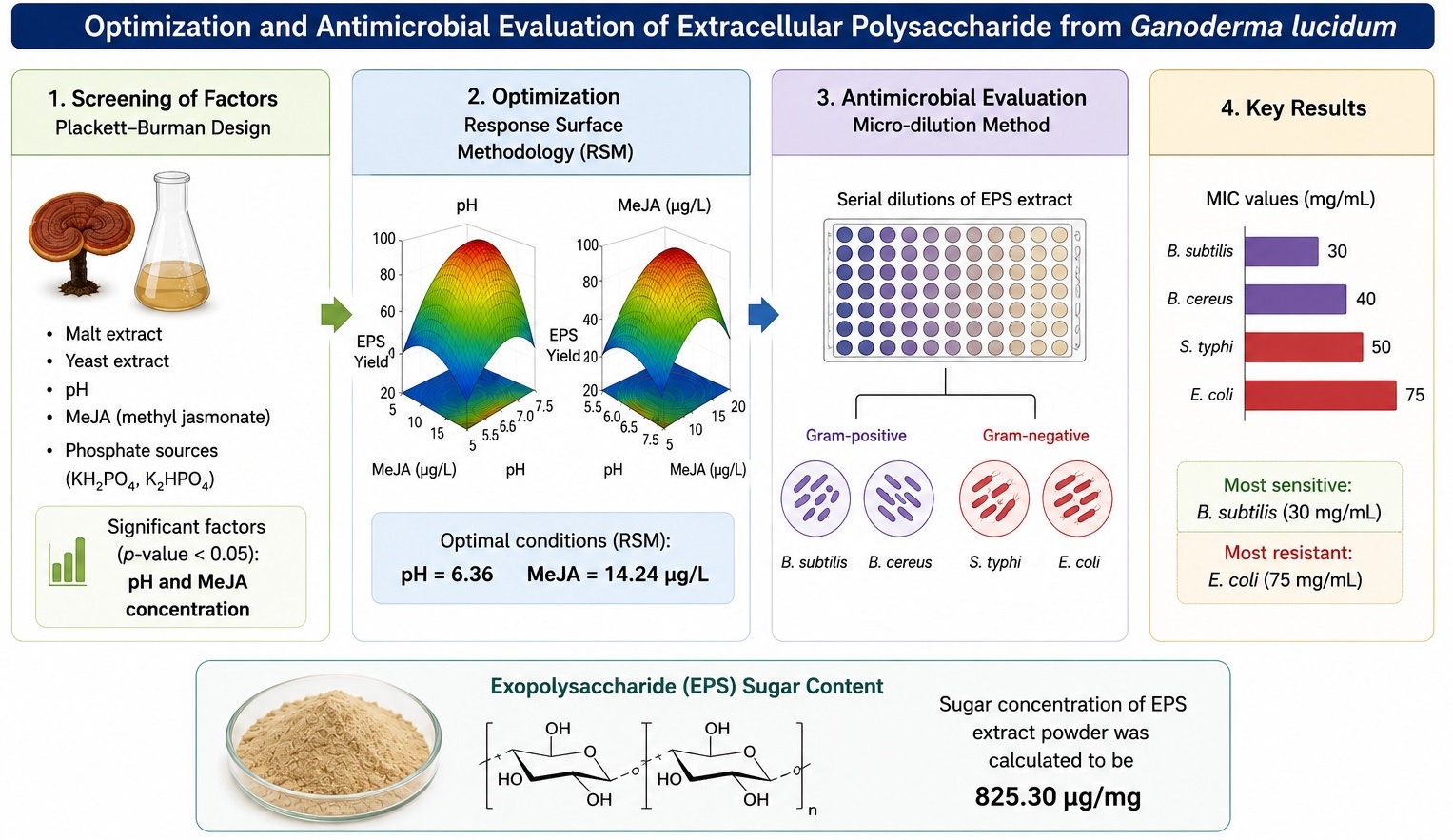
Background and aims: In this study, the antimicrobial activity of a carbohydrate-rich extracellular fraction produced from submerged cultures of Ganoderma lucidum was investigated together with a statistical evaluation of culture conditions.
Materials and Methods: Five culture-related factors, including malt extract, yeast extract, pH, methyl jasmonate (MeJA), and the phosphate-source system, were screened using a Plackett–Burman design. pH and MeJA concentration were subsequently evaluated by response surface methodology using MIC as the biological response.
Results and Conclusion:The model-derived operating condition was pH 6.36 and 14.24 µg/L MeJA. Under the investigated conditions, the recovered extracellular fraction showed antibacterial activity against Bacillus subtilis, Bacillus cereus, Salmonella typhi, and E. coli. The lowest MIC was observed for B. subtilis (30 mg/mL), whereas E. coli showed lower susceptibility, with a MIC of 75 mg/mL under the selected condition. The total carbohydrate content of the recovered dry fraction was 825.30 µg glucose equivalents per mg. These findings show that culture conditions, particularly pH and MeJA concentration, influence the antibacterial performance of the recovered carbohydrate-rich extracellular fraction.
Downloads
References
[1] R.R.M. Paterson, Ganoderma - A therapeutic fungal biofactory, Phytochemistry, 67(18) (2006), pp. 1985–2001. https://doi.org/10.1016/j.phytochem.2006.07.004
[2] Y. Gao, W. Tang, H.E. Gao, E. Chan, J. Lan, X. Li, S. Zhou, Antimicrobial activity of the medicinal mushroom Ganoderma, Food Rev. Int., 21(2) (2005), pp. 211–29.
[3] U. Lindequist, T.H.J. Niedermeyer, W.D. Jülich, The pharmacological potential of mushrooms, Evidence-Based Complement. Altern. Med., 2(3) (2005), pp. 285–99. https://doi.org/10.1093/ecam/neh107
[4] X.-F. Bao, X.-S. Wang, Q. Dong, J.-N. Fang, X.-Y. Li, Structural features of immunologically active polysaccharides from Ganoderma lucidum, Phytochemistry, 59(2) (2002), pp. 175–81.
[5] W.M. Breene, Nutritional and medicinal value of specialty mushrooms, J. Food Prot., 53(10) (1990), pp. 883–95.
[6] S. Ren, H. Liu, Q. Sang, M. Lu, Q. Gao, W. Chen, A Review of Bioactive Components and Pharmacological Effects of Ganoderma lucidum, Food Sci. Nutr., 13(7) (2025), pp. e70623. https://doi.org/10.1002/fsn3.70623.
[7] X.-C. Wang, R.-J. Xi, Y. Li, D.-M. Wang, Y.-J. Yao, The species identity of the widely cultivated Ganoderma,‘G. lucidum’(Ling-zhi), in China, PLoS One, 7(7) (2012), pp. e40857.
[8] M. Yamaç, F. Bilgili, Antimicrobial activities of fruit bodies and/or mycelial cultures of some mushroom isolates, Pharm. Biol., 44(9) (2006), pp. 660–7. https://doi.org/10.1080/13880200601006897.
[9] A.O. Tzianabos, Polysaccharide immuno -modulators as therapeutic agents: Structural aspects and biologic function, Clin. Microbiol. Rev., 13(4) (2000), pp. 523–33. https://doi.org/10.1128/CMR.13.4.523-533.2000.
[10] S. Nie, H. Zhang, W. Li, M. Xie, Current development of polysaccharides from Ganoderma: Isolation, structure and bioactivities, Bioact. Carbohydrates Diet. Fibre, 1(1) (2013), pp. 10–20. https://doi.org/10.1016/j.bcdf.2013.01.001.
[11] V. U. Girjal, S. Neelagund, M. Krishnappa, Ganoderma lucidum: A Source for Novel Bioactive Lectin, Protein Pept. Lett., 18(11) (2011), pp. 1150–7. https://doi.org/10.2174/092986611797200986.
[12] M.F. Moradali, G.A. Hedjaroude, H. Mostafavi, M. Abbasi, S. Ghods, A. Sharifi-Tehrani, The genus Ganoderma (Basidiomycota) in Iran, Mycotaxon, 99 (2007), pp. 251–69. https://doi.org/10.5962/p.419195.
[13] P. Wu, C. Zhang, Y. Yin, X. Zhang, Q. Li, L. Yuan, Y. Sun, S. Zhou, S. Ying, J. Wu, Bioactivities and industrial standardization status of Ganoderma lucidum: A comprehensive review, Heliyon, 10(19) (2024).
[14] Y. Lai, Y. Ma, Z. Gan, Z. Jian, A. Tao, G. Jiang, A review of Ganoderma lucidum spore polysaccharides: Sources, characteristics, properties, food, and health products applications, Carbohydr. Res., 567 (2026), pp. 110009. https://doi.org/10.1016/j.carres.2026.110009
[15] G.Y. Celık, D. Onbaslı, B. Altınsoy, H. Allı, In vitro antimicrobial and antioxidant properties of Ganoderma lucidum extracts grown in Turkey. (2014).
[16] C.A. Zárate-Chaves, M.C. Romero-Rodríguez, F.C. Niño-Arias, J. Robles-Camargo, M. Linares-Linares, M.X. Rodríguez-Bocanegra, I. Gutiérrez-Rojas, Optimizing a culture medium for biomass and phenolic compounds production using Ganoderma lucidum, Brazilian J. Microbiol., 44(1) (2013), pp. 215–23.
[17] R. Wagner, D.A. Mitchell, G.L. Sassaki, M.A.L. De Almeida Amazonas, M. Berovič, Current Techniques for the cultivation of Ganoderma lucidum for the production of biomass, ganoderic acid and polysaccharides, Food Technol. Biotechnol., 41(4) (2003), pp. 371–82.
[18] J. Lu, R. He, P. Sun, F. Zhang, R.J. Linhardt, A. Zhang, Molecular mechanisms of bioactive polysaccharides from Ganoderma lucidum (Lingzhi), a review, Int. J. Biol. Macromol., 150 (2020), pp. 765–74. https://doi.org/10.1016/j.ijbiomac.2020.02.035
[19] M. Yang, X. Qin, X. Liu, A review of polysaccharides from Ganoderma lucidum: Preparation methods, structural characteristics, bioactivities, structure-activity relationships and potential applications, Int. J. Biol. Macromol., 303 (2025), pp. 140645. https://doi.org/10.1016/j.ijbiomac.2025.140645.
[20] B. Yuan, X. Chi, R. Zhang, Optimization of exopolysaccharides production from a novel strain of Ganoderma lucidum CAU5501 in submerged culture, Brazilian J. Microbiol., 43(2) (2012), pp. 490–7. https://doi.org/10.1590/S1517-83822012000200009
[21] Y.H. Shieh, C.F. Liu, Y.K. Huang, J.Y. Yang, I.L. Wu, C.H. Lin, S.C. Lin, Evaluation of the hepatic and renal-protective effects of ganoderma lucidum in mice, Am J Chin Med. 29(3–4) (2001), pp. 501–7. https://doi.org/10.1142/s0192415x01000526
[22] S. Keypour, H. Riahi, M.-F. Moradali, H. Rafati, Investigation of the antibacterial activity of a chloroform extract of Ling Zhi or Reishi medicinal mushroom, Ganoderma lucidum P. Karst.(Aphyllophoromycetideae), from Iran. Int J Med Mushrooms, 10(4) (2008).
[23] S. Quereshi, A.K. Pandey, S.S. Sandhu, Evaluation of antibacterial activity of different Ganoderma lucidum extracts, People’s J. Sci. Res., 3(1) (2010), pp. 1–13.
[24] P. Roupas, J. Keogh, M. Noakes, C. Margetts, P. Taylor, The role of edible mushrooms in health: Evaluation of the evidence, J. Funct. Foods, 4(4) (2012), pp. 687–709. https://doi.org/10.1016/j.jff.2012.05.003
[25] A. Singh, N.R. Bishnoi, Optimization of ethanol production from microwave alkali pretreated rice straw using statistical experimental designs by Saccharomyces cerevisiae, Ind. Crops Prod., 37(1) (2012), pp. 334–41. https://doi.org/10.1016/j.indcrop.2011.12.033
[26] S. Anuradha Jabasingh, C. Valli Nachiyar, Utilization of pretreated bagasse for the sustainable bioproduction of cellulase by Aspergillus nidulans MTCC344 using response surface methodology, Ind. Crops Prod., (2011). https://doi.org/10.1016/j.indcrop.2011.05.017
[27] T.S. Tikhomirova, M.R. Taraskevich, Y.A. Lepekhin, M.P. Shevelyova, V.A. Nemashkalov, Optimization and scaling up of extracellular polysaccharide production by submerged culture of Ganoderma lucidum on starch-containing medium using response surface methodology and laboratory bioreactors of various designs, Lett. Appl. Microbiol., 77(12) (2024), pp. ovae115.
[28] S. Luo, Y. Luo, Y. Yuan, J. Zhou, W. Huang, X. Wu, T.X. Cao, P. Du, Optimization of submerged fermentation conditions for polysaccharide production in species of the genus Ganoderma (agaricomycetes) and comparative analysis of the antioxidant activities of different strains, Int. J. Med. Mushrooms, 27(1) (2025), pp. 13–27. https://doi.org/10.1615/IntJMedMushrooms.2024056392
[29] S. Zheng, L. Zhang, Y. Yang, S. Liu, Q. Wei, Q. Huang, W. Zhang, Optimization of a natural fermentative medium for submerged mycelial culture of Ganoderma lucidum and the nutritional and bioactive composition of the cultured food-grade mycelia, PLoS One, 21(1) (2026), pp. e0337539.
[30] G. Sharmila, B. Nidhi, C. Muthukumaran, Sequential statistical optimization of red pigment production by Monascus purpureus (MTCC 369) using potato powder, Ind. Crops Prod., 44 (2013), pp. 158–64. https://doi.org/10.1016/j.indcrop.2012.11.007.
[31] X. Yu, S.G. Hallett, J. Sheppard, A.K. Watson, Application of the Plackett-Burman experimental design to evaluate nutritional requirements for the production of Colletotrichum coccodes spores, Appl Microbiol Biotechnol. 47(3) (1997), pp. 301–5. https://doi.org/10.1007/s002530050930
[32] Q.-X. Yue, X.-Y. Song, C. Ma, L.-X. Feng, S.-H. Guan, W.-Y. Wu, M. Yang, B.-H. Jiang, X. Liu, Y.-J. Cui, Effects of triterpenes from Ganoderma lucidum on protein expression profile of HeLa cells, Phytomedicine,17(8–9) (2010),pp. 606–13.
[33] M.-Y. Chang, G.-J. Tsai, J.-Y. Houng, Optimization of the medium composition for the submerged culture of Ganoderma lucidum by Taguchi array design and steepest ascent method, Enzyme Microb. Technol., 38(3–4) (2006), pp. 407–14.
[34] J. Guo, C. Tang, Y. Liu, J. Shi, J. Vunduk, C. Tang, J. Feng, J. Zhang, Innovative submerged directed fermentation: Producing high molecular weight polysaccharides from Ganoderma lucidum, Food Chem., 471 (2025), pp. 142759. https://doi.org/10.1016/j.foodchem.2025.142759.
[35] Y.J. Tang, J.J. Zhong, Fed-batch fermentation of Ganoderma lucidum for hyperproduction of polysaccharide and ganoderic acid, Enzyme Microb. Technol., 31(1–2) (2002), pp. 20–8. https://doi.org/10.1016/S0141-0229(02)00066-2
[36] T. Masuko, A. Minami, N. Iwasaki, T. Majima, S.I. Nishimura, Y.C. Lee, Carbohydrate analysis by a phenol-sulfuric acid method in microplate format, Anal. Biochem., 339(1) (2005), pp. 69–72. https://doi.org/10.1016/j.ab.2004.12.001
[37] F. Oroojalian, R. Kasra-Kermanshahi, M. Azizi, M.R. Bassami, Phytochemical composition of the essential oils from three Apiaceae species and their antibacterial effects on food-borne pathogens, Food Chem., 120(3) (2010), pp. 765–70. https://doi.org/10.1016/j.foodchem.2009.11.008
[38] K. Skalicka-Wozniak, J. Szypowski, R. Los, M. Siwulski, K. Sobieralski, K. Glowniak, A. Malm, Evaluation of polysaccharides content in fruit bodies and their antimicrobial activity of four Ganoderma lucidum (W Curt.: Fr.) P. Karst. strains cultivated on different wood type substrates, Acta Soc. Bot. Pol., 81(1) (2012).
[39] A. Sharifi, S. Jahedi, M. Naghmachi, Antimicrobial effect of polysaccharide extract of Ganodermaon on some pathogen microorganisms, Eur. J. Clin. Microbiol. Infect. Dis., 113 (2009), pp. 219–26.
Downloads
Publication Timeline
- Submitted
- Revised
- Accepted
Issue
Section
License
Copyright (c) 2026 Fatemeh Yazdian, Ashrafsadat Hatamian-Zarmi; Fariba Soleimani, Nima Ghahremani Nezhad (Author)

This work is licensed under a Creative Commons Attribution-NonCommercial 4.0 International License.