
Yeast-Based Microencapsulation, Food and Pharmaceutical Applications
Yeast-based microencapsulation
Keywords:
Drug delivery, Microencapsulation, Food, Pharmaceutical applications , Yeast, S. cerevisiaeAbstract
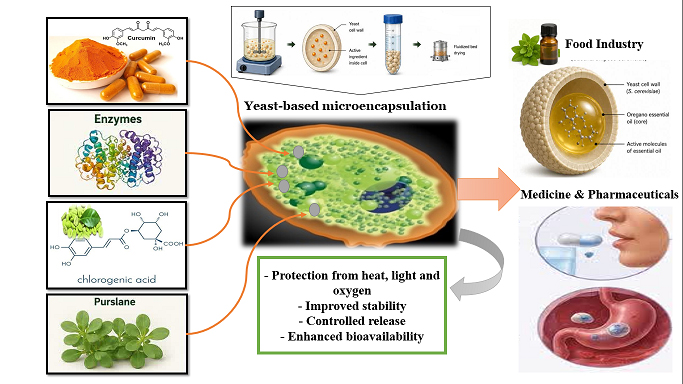
Background and Aimes: Remarkable functional compounds endowed with nutraceutical properties, but are vulnerable to stressful conditions. Encapsulation may overcome this problem. This paper aims to introduce yeast cells as a desirable vehicle in the microencapsulation procedure.
Material and Method:
A narrative review was conducted using Web of Science, Scopus, PubMed, Science Direct, and Google Scholar. The literature search covered studies published in the last 7 years. The keywords were wide enough to cover all application in drug delivery (therapeutic medications including insulin) and food sectors.
Results and Conclusion: Yesat are suitable carriers for functional compounds due to their cost-effectiveness, simplicity in production, and distinctive architecture comprising a cell wall and two plasma membranes, possess. Anyway, yeast-based microencapsulation is an innovative platform with great industrial potential, but its practical success depends on overcoming technological, regulatory, economic, and safety challenges while providing more comparative and mechanism-based evidence.
Downloads
References
1. Madene A, Jacquot M, Scher J, Desobry S. Flavour encapsulation and controlled release–a review. Int J Food Sci Technol 2006;41(1):1-21. https://doi.org/10.1111/j.1365-2621.2005.00980.x.
2. Pham-Hoang BN, Romero-Guido C, Phan-Thi H, Waché Y. Encapsulation in a natural, preformed, multi-component and complex capsule: yeast cells. Appl Microbiol Biotechnol 2013;97:6635-45. https://doi.org/10.1007/s00253-013-5044-1
3. Dewettinck K, Huyghebaert A. Fluidized bed coating in food technology. Trends Food Sci Technol 1999;10(4-5):163-8. https://doi.org/10.1016/S0924-2244(99)00041-2
4. Schrooyen PM, van der Meer R, De Kruif C. Microencapsulation: its application in nutrition. Proc Nutr Soc 2001;60(4):475-9. https://doi.org/10.1079/PNS2001112
5. Nii T, Ishii F. Encapsulation efficiency of water-soluble and insoluble drugs in liposomes prepared by the microencapsulation vesicle method. Int J Pharm 2005;298(1):198-205. https://doi.org/10.1016/j.ijpharm.2005.04.029
6. Sultana A, Miyamoto A, Hy QL, Tanaka Y, Fushimi Y, Yoshii H. Microencapsulation of flavors by spray drying using Saccharomyces cerevisiae. J Food Eng 2017;199:36-41. https://doi.org/10.1016/j.jfoodeng.2016.12.002
7. Gouin S. Microencapsulation: industrial appraisal of existing technologies and trends. Trends Food Sci Technol 2004;15(7-8):330-47. https://doi.org/10.1016/j.tifs.2003.10.005
8. Mirbagheri M, Nahvi I, Emamzadeh R, Emtiazi G, Shirani E. Oil wastes management: medium optimization for the production of alpha-linolenic acid in Mucor circinelloides. Int J Env Sci technol 2016;13:31-8. https://doi.org/10.1007/s13762-015-0849-3
9. Mohammadi Nasr M, Nahvi I, Keyhanfar M, Mirbagheri M. The effect of carbon and nitrogen sources on the fatty acids profile of Mortierella vinacea. Biol J Microorganism 2017;5(20):1-8.
10. Montes de Oca R, Salem A, Kholif A, Monroy H, Pérez L, Zamora J, et al. Yeast: description and structure. Yeast Additives and Animal Production 2016:4-13.
11. Zlotnik H, Fernandez MP, Bowers B, Cabib E. Saccharomyces cerevisiae mannoproteins form an external cell wall layer that determines wall porosity. J Bacteriol 1984;159(3):1018-26. https://doi.org/10.1128/jb.159.3.1018-1026.1984
12. Scherrer R, Louden L, Gerhardt P. Porosity of the yeast cell wall and membrane. J Bacterial 1974; 118(2): 534-40. https://doi.org/10.1128/jb.118.2.534-540.1974
13. De Nobel J, Dijkers C, Hooijberg E, Klis F. Increased cell wall porosity in Saccharomyces cerevisiae after treatment with dithiothreitol or EDTA. Microbiology 1989;135(7):2077-84. https://doi.org/10.1099/00221287-135-7-2077
14. Dardelle G, Normand V, Steenhoudt M, Bouquerand P-E, Chevalier M, Baumgartner P. Flavour-encapsulation and flavour-release per-formances of a commercial yeast-based delivery system. Food Hydrocoll 2007;21(5-6):953-60. https://doi.org/10.1016/j.foodhyd.2006.12.013
15. Mohan A, Rajendran SR, He QS, Bazinet L, Udenigwe CC. Encapsulation of food protein hydrolysates and peptides: A review. Rsc Advances 2015; 5(97):79270-79278. https://doi.org/10.1039/c5ra13419f
16. Bishop JRP, Nelson G, Lamb J. Microencapsulation in yeast cells. J Microencapsul 1998;15(6):761-73. https://doi.org/10.3109/02652049809008259
17. Mirbagheri M, Nahvi I, Emamzade R. Reduction of chemical and biological oxygen demands from oil wastes via oleaginous fungi: an attempt to convert food by products to essential fatty acids. Iran J Biotechnol 2015;13(2):25. https://doi.org/10.15171/ijb.1026
18. Paramera EI, Konteles SJ, Karathanos VT. Microencapsulation of curcumin in cells of Saccharomyces cerevisiae. Food Chem 2011; 125(3): 892-902. https://doi.org/10.1016/j.foodchem.2010.09.063
19.Coradello G, Tirelli N. Yeast cells in microencapsulation. General features and controlling factors of the encapsulation process. Molecules 2021 ;26(11):3123. https://doi.org/10.3390/molecules26113123
20. Ciamponi F, Duckham C, Tirelli N. Yeast cells as microcapsules. Analytical tools and process variables in the encapsulation of hydrophobes in S. cerevisiae. Appl Microbiol Biotechnol 2012;95:1445-56. https://doi.org/10.1007/s00253-012-4127-8
21. Khoshakhlagh K, Koocheki A, Mohebbi M, Allafchian A. Development and characterization of electrosprayed Alyssum homolocarpum seed gum nanoparticles for encapsulation of d-limonene. J Colloid Interface Sci 2017;490:562-75. https://doi.org/10.1016/j.jcis.2016.11.067
22. Murtadza SAA, Jai J, Zaki NAM, Hamzah F. Essential oils encapsulation performance evaluation: A review on encapsulation parameters. Malays J Chem Eng Technol (MJCET) 2021;4(2):114-23. https://doi.org/10.24191/mjcet.v4i2.14481
23. Márquez‐Gómez M, Galicia‐García T, Márquez‐Meléndez R, Ruiz‐Gutiérrez M, Quintero‐Ramos A. Spray‐dried microencapsulation of orange essential oil using modified rice starch as wall material. J Food Process Preserv 2018;42(2):e13428. https://doi.org/ 10.1111/jfpp.13428
24. Kavosi M, Mohammadi A, Shojaee-Aliabadi S, Khaksar R, Hosseini SM. Characterization and oxidative stability of purslane seed oil micro-encapsulated in yeast cells biocapsules. J Sci Food Agric 2018;98(7):2490-2497. https://doi.org/10.1002/jsfa.8696
25. Karaman K. Fabrication of gallic acid loaded yeast (Saccharomyces cerevisiae) microcapsules: Effect of plasmolysis treatment and solvent type on bioactivity and release kinetics. LWT Food Sci Technol 2021; 148: 111640. https://doi.org/10.1016/j.lwt.2021.111640.
26. He L, Zhu Y, Shen X, Chen G, Xiao H, Wang J, Tan C. Yeast cell wall capsules for delivery of oat biomarker avenanthramide-C. Food Chem 2024;448:139062. https://doi.org/10.1016/j.foodchem.2024.139062.
27. Kilcher G, Delneri D, Duckham C, Tirelli N. Probing (macro) molecular transport through cell walls. Faraday Discuss 2008;139:199-212. https://doi.org/ 10.1039/b717840a
28. Günal-Köroğlu D, Bilgin AB, Karabulut G, Saricaoglu B, & Capanoglu E. Encapsulation of hydrophobic compounds in yeast cells: methods, characterization, and applications. Exploration of Foods and Foodomics 2024;2(3): 252-274. https://doi.org/10.37349/eff.2024.00037
29. de Souza CJF, da Silva CS, Ramos AV, Garcia-Rojas EE, Pierucci APTR. Yeast cells-xanthan gum coacervation for hydrosoluble bioactive encapsulation. Int J Biological Macromol2023; 253: 127148. https://doi.org/10.1016/j.ijbiomac.2023.127148
30. Kiralan M, Özkan G, Bayrak A, Ramadan MF. Physicochemical properties and stability of black cumin (Nigella sativa) seed oil as affected by different extraction methods. Ind Crops Prod 2014;57:52-8. https://doi.org/ 10.1016/j.indcrop.2014.03.026
31. Edris AE. The chemical composition and the content of volatile oil: potential factors that can contribute to the oxidative stability of Nigella sativa L. crude oil. J Diet Suppl 2011;8(1):34-42. https://doi.org/ 10.3109/19390211.2010.547242
32. Ly MH, Naïtali-Bouchez M, Meylheuc T, Bellon-Fontaine M-N, Le TM, Belin J-M, Waché Y. Importance of bacterial surface properties to control the stability of emulsions. Int J Food Microbiol 2006; 112(1):26-34. https://doi.org/10.1016/j.ijfoodmicro.2006.05.022
33. Karaman K. Characterization of Saccharomyces cerevisiae based microcarriers for encapsulation of black cumin seed oil: Stability of thymoquinone and bioactive properties. Food Chem 2020;313:126129. https://doi.org/10.1016/j.foodchem.2019.126129
34. Kono Y, Kobayashi K, Tagawa S, Adachi K, Ueda A, Sawa Y, Shibata H. Antioxidant activity of polyphenolics in diets: rate constants of reactions of chlorogenic acid and caffeic acid with reactive species of oxygen and nitrogen. Biochim Biophys Acta (BBA)-General Subjects 1997; 1335(3): 335-42. https://doi.org/10.1016/s0304-4165(96)00151-1
35. Naczk M, Amarowicz R, Sullivan A, Shahidi F. Current research developments on polyphenolics of rapeseed/canola: a review. Food Chem, 1998; 62(4): 489-502. https://doi.org/10.1016/S0308-8146(97)00198-2
36. Chang Q, Zuo Z, Chow MS, Ho WK. Effect of storage temperature on phenolics stability in hawthorn (Crataegus pinnatifida var. major) fruits and a hawthorn drink. Food Chemistry. 2006; 98(3): 426-30. https://doi.org/10.1016/j.foodchem.2005.06.015
37. Shi G, Rao L, Yu H, Xiang H, Pen G, Long S, Yang C. Yeast-cell-based microencapsulation of chlorogenic acid as a water-soluble antioxidant. J Food Eng 2007;80(4):1060-7. https://doi.org/10.1016/j.jfoodeng.2006.06.038
38. Nelson G. Application of microencapsulation in textiles. Int J Pharma 2002;242(1-2):55-62. https://doi.org/10.1016/S0378-5173(02)00141-2
39. Goel A, Kunnumakkara AB, Aggarwal BB. Curcumin as “Curecumin”: from kitchen to clinic. Biochem Pharmacol 2008;75(4):787-809. https://doi.org/10.1016/j.bcp.2007.08.016
40. Pari L, Tewas D, Eckel J. Role of curcumin in health and disease. Arch Physiol Biochem 2008; 114(2): 127-49. https://doi.org/10.1080/13813450802033958
41. Sharma R, Gescher A, Steward W. Curcumin: the story so far. Eur J Cancer 2005;41(13):1955-68. https://doi.org/10.1016/j.ejca.2005.05.009
42. Korber D, Choi A, Wolfaardt G, Caldwell D. Bacterial plasmolysis as a physical indicator of viability. Appl Env Microbiol 1996;62(11):3939-47.https://doi.org/10.1128/aem.62.11.3939-3947.1996
43. Dadkhodazade E, Mohammadi A, Shojaee-Aliabadi S, Mortazavian AM, Mirmoghtadaie L, Hosseini SM. Yeast cell microcapsules as a novel carrier for cholecalciferol encapsulation: development, characterization and release properties. Food Biophys 2018;13(4):404-411. https://doi.org/10.1007/s11483-018-9546-3
44. Tischer W, Kasche V. Immobilized enzymes: crystals or carriers? Trends Biotechnol 1999;17(8):326-35. https://doi.org/10.1016/S0167-7799(99)01322-0
45. Katchalski-Katzir E. Immobilized enzymes—learning from past successes and failures. Trends Biotechnol 1993;11(11):471-8. https://doi.org/10.1016/0167-7799(93)90080-S
46. Chow CK, Palecek SP. Enzyme encapsulation in permeabilized Saccharomyces cerevisiae cells. Biotechnol Progress 2004;20(2):449-56. https://doi.org/ 10.1021/bp034216r
47. Naeem F, Khan SH. Purslane (Portulaca oleracea L.) as phytogenic substance—A review. J Herbs, Spices Med Plants 2013;19(3):216-32. https://doi.org/ 10.1080/10496475.2013.782381
48. Stroescu M, Stoica-Guzun A, Ghergu S, Chira N, Jipa I. Optimization of fatty acids extraction from Portulaca oleracea seed using response surface methodology. Ind Crops Prod 2013;43:405-11. https://doi.org/ 10.1016/j.indcrop.2012.07.051
49. Uddin MK, Juraimi AS, Ali ME, Ismail MR. Evaluation of antioxidant properties and mineral composition of purslane (Portulaca oleracea L.) at different growth stages. Int J Mol Sci 2012; 13(8): 10257-67. https://doi.org/ 10.3390/ijms130810257
50. YouGuo C, ZongJi S, XiaoPing C. Evaluation of free radicals scavenging and immunity-modulatory activities of Purslane polysaccharides. Int J Biol Macromol 2009;45(5):448-52. https://doi.org/ 10.1016/j.ijbiomac.2009.07.009
51. Simopoulos A. Human requirement for N-3 polyunsaturated fatty acids. Poult Sci 2000;79(7):961-70. https://doi.org/10.1093/ps/79.7.961
52. Oliveira I, Valentão P, Lopes R, Andrade PB, Bento A, Pereira JA. Phytochemical characterization and radical scavenging activity of Portulaca oleraceae L. leaves and stems. Microchem J. 2009;92(2):129-34. https://doi.org/10.1016/j.microc.2009.02.006
53. Abozed SS, Elaraby GM, Zahran HA. Application of spray-dried microcapsules of purslane (Portulaca oleracea L.) seed oil enhances quality of mango juice. Open Agriculture J2021;15(1). https://doi.org/10.2174/1874331502115010001
54. Singh M, Hemant K, Ram M, Shivakumar H. Microencapsulation: A promising technique for controlled drug delivery. Res Pharma Sci. 2010; 5(2): 65.
55. Sabu C, Mufeedha P, Pramod K. Yeast-inspired drug delivery: biotechnology meets bioengineering and synthetic biology. Expert Opin Drug Deliv 2019; 16(1): 27-41. https://doi.org/10.1080/17425247.2019.1551874
56. Wang Q, Cheng H, Peng H, Zhou H, Li PY, Langer R. Non-genetic engineering of cells for drug delivery and cell-based therapy. Adv Drug Deliv Rev 2015;91:125-40. https://doi.org/10.1016/j.addr.2014.12.003
57. Nelson G, Duckham S. Yeast cells: a novel vehicle for drug delivery. Innov Pharma Technol February 2005:52-5.
58. Li J, Ma G, Liu H, Liu H. Yeast cells carrying metal nanoparticles. Mat Chem Physics 2018; 207: 373-9. https://doi.org/10.1016/j.matchemphys.2018.01.001
59. Garello F, Stefania R, Aime S, Terreno E, Delli Castelli D. Successful entrapping of liposomes in glucan particles: an innovative micron-sized carrier to deliver water-soluble molecules. Mol Pharm 2014;11(10):3760-5. https://doi.org/10.1021/mp500374f
60. Salari R, Bazzaz BSF, Rajabi O, Khashyar-manesh Z. New aspects of Saccharomyces cerevisiae as a novel carrier for berberine. DARU J Pharm Sci 2013;21:1-8. https://doi.org/10.1186/2008-2231-21-73
61. Zhou X, Zhang X, Han S, Dou Y, Liu M, Zhang L, et al. Yeast microcapsule-mediated targeted delivery of diverse nanoparticles for imaging and therapy via the oral route. Nano let 2017;17(2):1056-64. https://doi.org/10.1021/acs.nanolett.6b04523
62. Arbit E, Kidron M. Oral insulin: the rationale for this approach and current developments. J diabetes sci technol 2009;3(3):562-7. https://doi.org/10.1177/193229680900300322
63. Soto ER, Ostroff GR. Characterization of multilayered nanoparticles encapsulated in yeast cell wall particles for DNA delivery. Bioconjug Chem 2008;19(4):840-8. https://doi.org/10.1021/bc700329p
64. Aouadi M, Tesz GJ, Nicoloro SM, Wang M, Chouinard M, Soto E, et al. Orally delivered siRNA targeting macrophage Map4k4 suppresses systemic inflammation. Nature 2009;458(7242):1180-4. https://doi.org/10.1038/nature07774
65. Lopes MA, Abrahim-Vieira B, Oliveira C, Fonte P, Souza AM, Lira T, et al. Probing insulin bioactivity in oral nanoparticles produced by ultrasonication-assisted emulsification/internal gelation. Int J Nanomedicine 2015:5865-80. https://doi.org/10.2147/IJN.S86313
66. Sahu SK. Development and evaluation of insulin incorporated nanoparticles for oral administration. Int Scholarly Res Notices 2013;2013. https://doi.org/10.1155/2013/591751
67. Jacob D, Joan Taylor M, Tomlins P, Sahota TS. Synthesis and identification of FITC-insulin conjugates produced using human insulin and insulin analogues for biomedical applications. J Fluoresc 2016;26:617-29. https://doi.org/10.1007/s10895-015-1748-1
68. Mandal S, Kumar SS, Krishnamoorthy B, Basu SK. Development and evaluation of calcium alginate beads prepared by sequential and simultaneous methods. Brazilian J Pharm Sci 2010;46:785-93. https://doi.org/10.1590/S1984-82502010000400021
69. Yan S, He W, Sun C, Zhang X, Zhao H, Li Z, et al. The biomimetic synthesis of zinc phosphate nanoparticles. Dyes Pigments 2009;80(2):254-8. https://doi.org/10.1016/j.dyepig.2008.06.010
70. Yin H, Wen Y, Li W, Zou S, Sun H, Chen T, et al. Advances in Yeast Glucan Particles for Oral Drug Delivery Polym 2026; 18(8):994. https://doi.org/10.3390/polym18080994
71. Mirbagheri Firoozabad MS, Akhbariyoon HR, Shirvanifar F. Comparison of three methods of preparing the powder form of yeast extract. Microbiol, Metabol Biotechnol, 2020; 3(2):75-81. https://doi.org/10.22104/ARMMT.2021.5136.1058
72. Ozkan OV, Ozturk OH, Aydin M, Yilmaz N, Yetim I, Nacar A, et al. Effects of β-glucan pretreatment on acetylsalicylic acid-induced gastric damage: an experimental study in rats. Curr Ther Res 2010;71(6):369-83. https://doi.org/10.1016/S0011-393X(10)80003-7
73. Suchecka D, Harasym J, Wilczak J, Gromadzka-Ostrowska J. Hepato-and gastro-protective activity of purified oat 1–3, 1–4-β-d-glucans of different molecular weight. Int J Biolo Macromol 2016;91:1177-85. https://doi.org/10.1016/j.ijbiomac.2016.06.062.
74. Shah A, Gani A, Ahmad M, Ashwar BA, Masoodi F. β-Glucan as an encapsulating agent: Effect on probiotic survival in simulated gastrointestinal tract. Int J Biol Macromol 2016;82:217-22. https://doi.org/10.1016/j.ijbiomac.2015.11.017
75. De Smet R, Demoor T, Verschuere S, Dullaers M, Ostroff GR, Leclercq G, et al. β-Glucan microparticles are good candidates for mucosal antigen delivery in oral vaccination. J Control Release 2013;172(3):671-8. https://doi.org/10.1016/j.jconrel.2013.09.007
76. Wu Y, Li P, Jiang Z, Sun X, He H, Yan P, Xu Y, Liu Y. Bioinspired yeast-based β-glucan system for oral drug delivery. Carbohydr Polym 2023; 319: 121163. https://doi.org/10.1016/j.carbpol.2023.121163
77. Young S, Rai R, Nitin N. Bioaccessibility of curcumin encapsulated in yeast cells and yeast cellwall particles. Food Chem 2020; 309: 125700. https://doi.org/10.1016/j.foodchem.2019.12570
78. Li Z, Li J, Wang D, Li C, Zhang K, Wang L, Shen Ch, Li Zh, Ji Y, Chen L. Construction and antitumor effect of yeast microencapsulated nano-zinc oxide drug delivery system. J Drug Delivery Sci Technol 2024;93: 105341. https://doi.org/10.1016/j.jddst.2024.105341
79. Zhou X, Ling K, Liu M, Zhang X, Ding J, Dong Y, Liang Zh, Li J, Zhang J. Targeted delivery of cisplatin-derived nanoprecursors via a biomimetic yeast microcapsule for tumor therapy by the oral route. Theranostics 2019; 9(22): 6568. https://doi.org/10.7150/thno.35353
80. Lewis JS, Zaveri TD, Crooks II CP, Keselow-sky BG. Microparticle surface modifications targeting dendritic cells for non-activating applications. Biomaterials 2012;33(29):7221-32. https://doi.org/10.1016/j.biomaterials.2012.06.049
81. Pan Y, Li X, Kang T, Meng H, Chen Z, Yang L, et al. Efficient delivery of antigen to DCs using yeast-derived microparticles. Sci Rep 2015;5(1):10687. https://doi.org/10.1038/srep10687
82. De Geest BG, Willart MA, Hammad H, Lambrecht BN, Pollard C, Bogaert P, et al. Polymeric multilayer capsule-mediated vaccination induces protective immunity against cancer and viral infection. ACS Nano 2012;6(3):2136-49. https://doi.org/10.1021/nn205099c
83. Akhbariyoon H, Azizpour Y, Esfahani MF, Firoozabad MSM, Rad MR, Esfahani KS, et al. Immune checkpoint inhibition for the treatment of cancers: An update and critical review of ongoing clinical trials. Clinical Immunol 2021;232:108873. https://doi.org/ 10.1016/j.clim.2021.108873
84. De Smet R, Allais L, Cuvelier CA. Recent advances in oral vaccine development: Yeast-derived β-glucan particles. Hum Vaccines Immunother 2014;10(5):1309-18. https://doi.org/10.4161/hv.28166
85. De Marco Castro E, Calder PC, Roche HM. β-1,3/1,6-Glucans and Immunity: State of the Art and Future Directions. Molecular Nutrition Food Res 2021;65: 1901071. https://doi.org/10.1002/mnfr.201901071.
86. de Macêdo LS, de Pinho SS, Silva AJD, de Moura IA, Espinoza BCF, da Conceição Viana Invenção M, et al. Understanding yeast shells: Structure, properties and applications. ADMET and DMPK 2024; 12(2): 299-317. https://doi.org/10.5599/admet.2118
87. Tang W, Liu J-W, Zhao W-M, Wei D-Z, Zhong JJ. Ganoderic acid T from Ganoderma lucidum mycelia induces mitochondria mediated apoptosis in lung cancer cells. Life Sci 2006;80(3):205-11. https://doi.org/ 10.1016/j.lfs.2006.09.001
88. Du L, Jia S, Zhang W, Cai C, Liu Y, Wang C, Zhu Y, Ma X, Yang X, Wei Z, Xu K. Oral yeast-cell microcapsule-mediated DNA vaccines against Clostridium perfringens induce effective intestinal immunity and modulate gut microbiota. Vaccines 2024;12(12):1360. https://doi.org/10.3390/vaccines12121360.

Downloads
Published
Submitted
Revised
Accepted
Issue
Section
License
Copyright (c) 2026 BiotechIntellect

This work is licensed under a Creative Commons Attribution-NonCommercial 4.0 International License.