
Curcumin-Loaded Mesoporous Silica Nanoparticle-Embedded Injectable Thermoresponsive Chitosan Hydrogel for Sustained Drug Delivery
Curcumin-Loaded Mesoporous Silica Nanoparticle
Keywords:
Chitosan Injectable Hydrogel, Curcumin, Mesoporous Silica Nanoparticles, Cell UptakeAbstract
Background and Aim: Curcumin as natural bioactive compound with therapeutic potential; however, has limited clinical application due to poor aqueous solubility, low bioavailability, and rapid metabolism. This study aimed to develop an injectable thermoresponsive chitosan/β-glycerophosphate hydrogel incorporating curcumin-loaded mesoporous silica nanoparticles to achieve sustained local delivery of curcumin.
Methods: MSNs were synthesized, loaded with curcumin, and dispersed into a chitosan/β-glycerophosphate solution to prepare an injectable in situ gelling hydrogel. The prepared formulations were characterized by Fourier transform infrared, X-Ray Diffraction, nitrogen adsorption–desorption analysis, and field-emission scanning electron microscopy. Curcumin loading capacity and entrapment efficiency were determined, while in vitro drug release was evaluated in simulated body fluid (pH 7.4). Biocompatibility was assessed on healthy primary human mammary fibroblasts, and cellular uptake was examined by transmission electron microscopy using Michigan Cancer Foundation-7 cells.
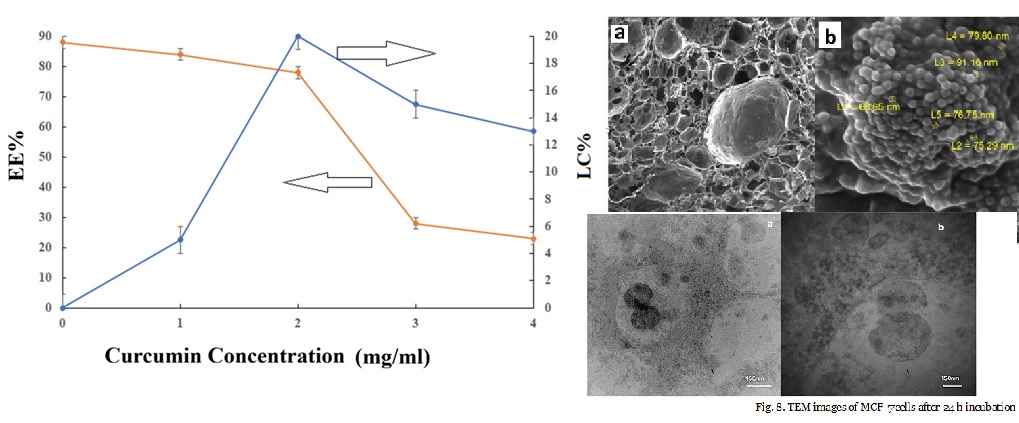
Results and Discussion: The loading capacity and entrapment efficiency of MSNs-curcumin were 20 wt% and 78 wt%, respectively. Characterization confirmed successful incorporation of curcumin into the MSNs and their uniform distribution within the hydrogel network. The chitosan/β-glycerophosphate/MSNs-curcumin hydrogel exhibited a prolonged curcumin release profile with minimal initial burst release under physiological conditions. MTT assay demonstrated that both MSNs-curcumin and chitosan/β-glycerophosphate/MSNs-curcumin maintained over 90% viability of HPHMF cells after 24 and 48 h, indicating good biocompatibility. Transmission electron microscopy analysis confirmed successful cellular internalization of MSNs-curcumin by Michigan Cancer Foundation-7 cells. These findings suggest that the developed injectable hydrogel is a promising platform for sustained localized delivery of curcumin and other hydrophobic therapeutic agents.
Downloads
References
1. Pateiro M, Gómez B, Munekata PES, Barba FJ, Putnik P, Kovačević DB, Lorenzo JM. (2021) Nanoencapsulation of Promising Bioactive Compounds to Improve Their Absorption, Stability, Functionality and the Appearance of the Final Food Products. Molecules. 26(6): 1547. https://doi.org/10.3390/molecules26061547
2. Fuloria S, Mehta J, Chandel A, Sekar M, Rani NNIM, Begum MY, Subramaniyan V, Chidambaram K, Thangavelu L, Nordin R, Wu YS, Sathasivam KV, Lum PT, Meenakshi DU, Kumarasamy V, Azad AK and Fuloria NK (2022) A comprehensive review on the therapeutic potential of curcuma longa linn. in relation to its major active constituent curcumin. front. Pharmacol. 13: 820806. https://doi.org/10.3389/fphar.2022.820806
3. Omidian H, Wilson RL, Chowdhury SD. (2023) Enhancing Therapeutic Efficacy of Curcumin: Advances in Delivery Systems and Clinical Applications. Gels. 25;9(8):596. https://doi.org/10.3390/gels9080596.
4. Bolouki A, Rashidi L, Vasheghani-Farahani E, Piravi-Vanak Z (2015) Study of Mesoporous Silica Nanoparticles as Nanocarriers for Sustained Release of Curcumin. Int J Nanosci Nanotech. 11: 139-146.
5. Almatroudi A. (2025) Advances in Mesoporous Silica and Hybrid Nanoparticles for Drug Delivery: Synthesis, Functionalization, and Biomedical Applications. Pharmaceutics. 17(12):1602. https://doi.org/10.3390/pharmaceutics17121602
6. Ahmadi F, Sodagar-Taleghani A, Ebrahim-nejad P, Pouya Hadipour Moghaddam S, Ebrahim-nejad F, Asare-Addo K, Nokhodchi A. (2022) A review on the latest developments of mesoporous silica nanoparticles as a promising platform for diagnosis and treatment of cancer. Int J Pharm. 25;625:122099. https://doi.org/10.1016/j.ijpharm.2022.122099.
7. Rashidi L, Vasheghani Farahani E, Ganji F, Rahmani A, Mazaheri M (2025) Amine-functionalized- mesoporous silica nanoparticles by various pore sizes containing gallic acid: characterization and cytotox-icity effect, Iran. J. Chem. Chem. Eng. 44(02): 336-349.https://doi.org/10.30492/ijcce.2025.2036880.6720
8. Iraji S, Ganji F, Rashidi L (2018) Surface modified mesoporous silica nanoparticles as sustained-release gallic acid nano-carriers. J Drug Del Sci Technol. 47: 468–476.
9. Rashidi L, Vasheghani-Farahani E, Soleimani M, Atashi A, Rostami K, Gangi F, Fallahpour M, Tahouri MT (2014) A cellular uptake and cytotoxicity properties study of gallic acid-loaded mesoporous silica nanoparticles on Caco-2 cells. J Nanopart Res. 16: 132-145. https://doi.org/10.1007/s11051-014-2285-6.
10. Ribeiro TdC, Sábio RM, Luiz MT, de Souza LC, Fonseca-Santos B, Cides da Silva LC, Fantini MCdA, Planeta CdS, Chorilli M. (2022) Curcumin-Loaded Mesoporous Silica Nanoparticles Dispersed in Thermo-Responsive Hydrogel as Potential Alzheimer Disease Therapy. Pharmaceutics. 14(9): 1976. https://doi.org/10.3390/pharmaceutics14091976.
11. Gonciarz W, Balcerczak E, Brzeziński M, Jeleń A, Pietrzyk-Brzezińska AJ, Narayanan VHB, Chmiela M. Chitosan-based formulations for therapeutic applications. A recent overview. J Biomed Sci. 2025 Jul 8;32(1):62. https://doi.org/10.1186/s12929-025-01161-7.
12. Ahmadi Nasab N, Hassani Kumleh H, Beygzadeh M, Teimourian S, Kazemzad M (2018) Delivery of curcumin by a pH-responsive chitosan mesoporous silica nanoparticles for cancer treatment. Artif. Cells Nanomed Biotechnol. 46: 75-81. https://doi.org/10.1080/21691401.2017.1290648.
13. Wang J, Huang L, Wu E, Li X, Rao Y, Zhu C. Recent Advances on Chitosan-Based Thermosensitive Hydrogels for Skin Wound Treatment. Biology. 2025; 14(6):619. https://doi.org/10.3390/biology14060619
14. Kazemi-Aghdam F., Jahed V., Dehghan-Niri M., Ganji F., Vasheghani-Farahani E., (2021), Injectable chitosan hydrogel embedding modified halloysite nanotubes for bone tissue engineering, Carbohydrate Polymer, 269, 118311. https://doi.org/10.1016/j.carbpol.2021.118311
14. Ghapanvari MA, Ganji F, Shaki H, Jafarzadeh-Holagh S, Vashegani-Farahani E, (2025) Bone-targeted and redox-responsive polymeric nanomicelles based on hyaluronic acid, Int J Pharmaceut, 679, 125734. https://doi.org/10.1016/j.ijpharm.2025.125734
15. Jangle RD, Thorat BN (2017) Reversed-phase High-performance Liquid Chromatography Method for Analysis of Curcuminoids and Curcuminoid-loaded Liposome Formulation. Indian J Pharm Sci. 1: 60-67.
16. Hu X, Wang Y, Peng B (2014) Chitosan-Capped Mesoporous Silica Nanoparticles as pH-Responsive Nanocarriers for Controlled Drug Release. Chem Asian J. 9: 319-327. https://doi.org/10.1002/asia.201301105.
17. Yaghoubzadeh, Z, Safari, R., Soheili, M. (2025) Cytotoxicity activity of peptides derived from enzymatic hydrolysis of Chlorella vulgaris proteins. Applied Food Biotechnology, 12(1), 1–9 (e1). https://doi.org/10.22037/afb.v12i1.46685
18. Tiwari N, Nawale L, Sarkar D, Badiger MV (2017) Carboxymethyl Cellulose-Grafted Mesoporous Silica Hybrid Nanogels for Enhanced Cellular Uptake and Release of Curcumin. Gels. 3: 1-15. https://doi.org/10.3390/gels3010008.
19. Daryasari MP, Akhgar MR, Mamashli F, Bigdeli B, Khoobi M (2016) Chitosan-folate coated mesoporous silica nanoparticles as a smart and pH-sensitive system for curcumin delivery. RSC Adv. 6: 105578-105588.

Downloads
Published
Submitted
Revised
Accepted
Issue
Section
License
Copyright (c) 2026 Mitra Asadian (Author); Ladan Rashidi, Fariba Ganji

This work is licensed under a Creative Commons Attribution-NonCommercial 4.0 International License.