
A Probiotic-Based Platform for Simultaneous Mycotoxin Neutralization, Heavy Metal Biosorption, and Biofilm Displacement
Probiotic decontamination
Keywords:
biofilm displacement , heavy metal biosorption , multi-target probiotics , mycotoxin neutralization , probiotic detoxification , sustainable bioremediationAbstract
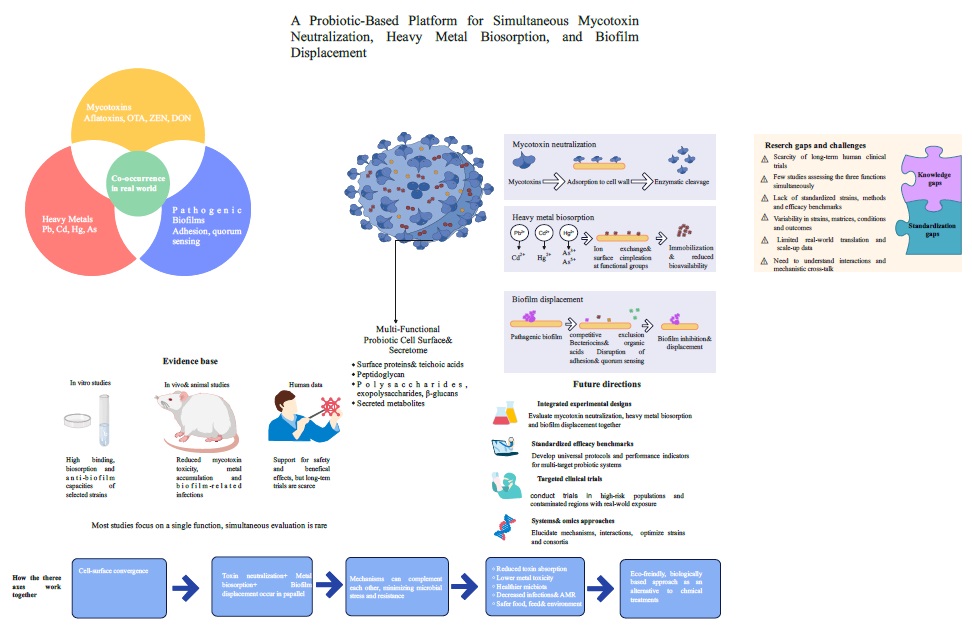
Background and aim: Mycotoxins, heavy metals, and pathogenic biofilms frequently co-occur in food, feed, and environmental matrices; however, they are almost always investigated and controlled in isolation. The present review examines whether probiotics can instead act as a single, integrated line of defense against all three classes of contaminant, with a focus on lactic acid bacteria of the genera Lactobacillus and Bifidobacterium and on the yeast Saccharomyces cerevisiae var. boulardii.
Method: A narrative review was conducted, in which structured searches across the major scholarly databases were combined with the targeted screening of specialized journals, and three mechanistically distinct but potentially complementary axes were examined: mycotoxin neutralization through electrostatic and hydrophobic adsorption to the cell envelope and, in certain strains, enzymatic cleavage; heavy metal capture at peptidoglycan-associated carboxyl, hydroxyl, amino, and phosphoryl groups by ion exchange and surface complexation; and biofilm displacement driven by competitive exclusion and the secretion of bacteriocins and organic acids.
Results and conclusion: Across these axes, the available evidence is substantial but uneven, and several constraints recur, including a scarcity of long-term human clinical trials, few designs that assess the three functions simultaneously, and persistent difficulties in standardization and real-world translation. Closing these gaps will require more than incremental single-contaminant studies; it will demand integrated experimental designs, standardized efficacy benchmarks, and trials conducted in the populations that carry the heaviest contamination burden. Framed in this way, probiotics emerge not merely as modulators of gut health but as a biologically sustainable, multi-target strategy for the management of complex, co-occurring contamination.
Downloads
References
REFERENCES
1. Schatzmayr G, Zehner F, Täubel M, Schatzmayr D, Klimitsch A, Loibner AP, et al. Microbiologicals for deactivating mycotoxins. Molecular nutrition & food research. 2006;50(6):543–51. https://doi.org/10.1002/mnfr.200500181
2. Średnicka P, Juszczuk-Kubiak E, Wójcicki M, Akimowicz M, Roszko M. Probiotics as a biological detoxification tool of food chemical contamination: A review. Food and Chemical Toxicology. 2021;153:112306. https://doi.org/10.1016/j.fct.2021.112306
3. Petrova P, Arsov A, Tsvetanova F, Parvanova-Mancheva T, Vasileva E, Tsigoriyna L, et al. The complex role of lactic acid bacteria in food detoxification. Nutrients. 2022;14(10):2038. https://doi.org/10.3390/nu14102038
4. Pereira KN, de Oliveira ACD, de Souza HF, Ullah S, Nasir U, Ali S, et al. Application of Saccharomyces cerevisiae var. boulardii for Biological Detoxification of Chemical Contaminants in Foods: A Comprehensive Review. Foods. 2025;14(24):4260. https://doi.org/10.3390/foods14244260
5. Zahir A, Ge Z, Khan IA. Public health risks associated with food process contaminants–A review. Journal of Food Protection. 2025;88(2):100426. https://doi.org/10.1016/j.jfp.2024.100426
6. Guerre P. Mycotoxin and gut microbiota interactions. Toxins. 2020;12(12):769. https://doi.org/10.3390/toxins12120769
7. Zhang J, Liu X, Su Y, Li T. An update on T2-toxins: Metabolism, immunotoxicity mechanism and human exposure assessment of intestinal microbiota. Heliyon. 2022;8(8). https://doi.org/10.1016/j.heliyon.2022.e10012
8. Shabani M, Ghoshehy A, Mottaghi AM, Chegini Z, Kerami A, Shariati A, et al. The relationship between gut microbiome and human diseases: mechanisms, predisposing factors, and potential intervention. Frontiers in Cellular and Infection Microbiology. 2025;15:1516010. https://doi.org/10.3389/fcimb.2025.1516010
9. Abou Izzeddine N, Ahmad K, Bacha C, Jabbour M, Najjar M, Salhab S, et al. The microbial guardians: Unveiling the role of gut microbiota in shaping neurodegenerative disease. IBRO Neuroscience Reports. 2025;19:17–37. https://doi.org/10.1016/j.ibneur.2025.05.014
10. Anchidin-Norocel L, Iatcu OC, Lobiuc A, Covasa M. Heavy metal–gut microbiota interactions: probiotics modulation and biosensors detection. Biosensors. 2025;15(3):188. https://doi.org/10.3390/bios15030188
11. Zoghi A, Khosravi-Darani K, Sohrabvandi S. Surface binding of toxins and heavy metals by probiotics. Mini reviews in medicinal chemistry. 2014;14(1):84–98. https://doi.org/10.2174/1389557513666131211105554
12. Massoud R, Zoghi A. Potential probiotic strains with heavy metals and mycotoxins bioremoval capacity for application in foodstuffs. Journal of Applied Microbiology. 2022;133(3):1288–307. https://doi.org/10.1111/jam.15685
13. Abdel-Megeed RM. Probiotics: a promising generation of heavy metal detoxification. Biological trace element research. 2021;199(6):2406. https://doi.org/10.1007/s12011-020-02350-1
14. Pop OL, Suharoschi R, Gabbianelli R. Biodetoxification and protective properties of probiotics. Microorganisms. 2022;10(7):1278. https://doi.org/10.3390/microorganisms10071278
15. Lázaro Á, Vila-Donat P, Manyes L. Emerging mycotoxins and preventive strategies related to gut microbiota changes: probiotics, prebiotics, and postbiotics–a systematic review. Food & Function. 2024;15(18):8998–9023. https://doi.org/10.1039/d4fo01705f
16. PENG J, SHANGGUAN W, ZHANG M, ZHONG Q. Probiotic properties of lactic acid bacteria quenching the quorum-sensing of Vibrio parahaemolyticus. Science and Technology of the Food Industry. 2023;44(8):180–6. https://doi.org/10.13386/j.issn1002-0306.2022070186
17. Cui Y, Wang D, Zhang L, Qu X. Research progress on the regulatory mechanism of biofilm formation in probiotic lactic acid bacteria. Critical Reviews in Food Science and Nutrition. 2025;65(25):4869–83. https://doi.org/10.1080/10408398.2024.2400593
18. Pane M, De Prisco A, Amoruso A, Deusebio G, Marzorati M, Corazzari M, et al. Probiotic detoxification of heavy metals: functional assessment in simulated intestinal and ex vivo models. Frontiers in Microbiology. 2026;17:1821114. https://doi.org/10.3389/fmicb.2026.1821114
19. García-Reyes RA, García-Cancino A, Arrevillaga-Boni G, Espinoza-Monje M, Gutiérrez-Zamorano C, Arrizon J, et al. Identification and characterization of probiotic Lactiplantibacillus plantarum BI-59.1 isolated from tejuino and its capacity to produce biofilms. Current Microbiology. 2023;80(7):220. https://doi.org/10.1007/s00284-023-03319-8
20. Haskard CA, El-Nezami HS, Kankaanpää PE, Salminen S, Ahokas JT. Surface binding of aflatoxin B1 by lactic acid bacteria. Applied and environmental microbiology. 2001;67(7):3086–91. https://doi.org/10.1128/aem.67.7.3086-3091.2001
21. c Ooi VE, Liu F. Immunomodulation and anti-cancer activity of polysaccharide-protein complexes. Current Medicinal Chemistry. 2000;7(7):715–29. https://doi.org/10.2174/0929867003374705
22. Liu L, Xie M, Wei D. Biological detoxification of mycotoxins: current status and future advances. International Journal of Molecular Sciences. 2022;23(3):1064. https://doi.org/10.3390/ijms23031064
23. Taheur FB, Kouidhi B, Al Qurashi YMA, Salah-Abbès JB, Chaieb K. Biotechnology of mycotoxins detoxification using microorganisms and enzymes. Toxicon. 2019;160:12–22. https://doi.org/10.1016/j.toxicon.2019.02.001
24. Marin S, Ramos A, Cano-Sancho G, Sanchis V. Mycotoxins: Occurrence, toxicology, and exposure assessment. Food and chemical toxicology. 2013;60:218–37. https://doi.org/10.1016/j.fct.2013.07.047
25. Khan GI, Akbar A, Anwar M, Shafee M, Sadia H, Razzaq A, et al. 01. Eco-friendly bacterial biodegradation of mycotoxins. Pure and Applied Biology (PAB). 2020;9(3):1708–17. http://dx.doi.org/10.19045/bspab.2020.90181
26. Loi M, Fanelli F, Liuzzi VC, Logrieco AF, Mulè G. Mycotoxin biotransformation by native and commercial enzymes: Present and future perspectives. Toxins. 2017;9(4):111. https://doi.org/10.3390/toxins9040111
27. Gil-Serna J, Vázquez C, Patiño B. Mycotoxins in functional beverages: A review. Beverages. 2020;6(3):52. https://www.mdpi.com/2306-5710/6/3/52
28. El-Nezami H, Kankaanpää P, Salminen S, Ahokas J. Physicochemical alterations enhance the ability of dairy strains of lactic acid bacteria to remove aflatoxin from contaminated media. Journal of Food Protection. 1998;61(4):466–8. https://doi.org/10.4315/0362-028x-61.4.466
29. Orrhage K, Sillerström E, Gustafsson J-Å, Nord C, Rafter J. Binding of mutagenic heterocyclic amines by intestinal and lactic acid bacteria. Mutation Research/Fundamental and Molecular Mechanisms of Mutagenesis. 1994;311(2):239–48. https://doi.org/10.1016/0027-5107(94)90182-1
30. Thyagaraja N, Hosono A. Binding properties of lactic acid bacteria from ‘Idly’towards food-borne mutagens. Food and chemical toxicology. 1994;32(9):805–9. https://doi.org/10.1016/0278-6915(94)90156-2
31. Zhang XB, Ohta Y, Hosono A. Antimutagenicity and binding of lactic acid bacteria from a Chinese cheese to mutagenic pyrolyzates. Journal of Dairy Science. 1990;73(10):2702–10. https://doi.org/10.3168/jds.s0022-0302(90)78955-2
32. Haskard C, Binnion C, Ahokas J. Factors affecting the sequestration of aflatoxin by Lactobacillusrhamnosus strain GG. Chemico-biological interactions. 2000;128(1):39–49. https://doi.org/10.1016/s0009-2797(00)00186-1
33. Mrvčić J, Stanzer D, Šolić E, Stehlik-Tomas V. Interaction of lactic acid bacteria with metal ions: opportunities for improving food safety and quality. World Journal of Microbiology and Biotechnology. 2012;28(9):2771–82. https://doi.org/10.1007/s11274-012-1094-2
34. Chen L, Garmaeva S, Zhernakova A, Fu J, Wijmenga C. A systems biology perspective on environment–host–microbe interactions. Human Molecular Genetics. 2018;27(R2):R187–R94. https://doi.org/10.1093/hmg/ddy137
35. Van Niel EW, Larsson CU, Lohmeier-Vogel EM, Rådström P. The potential of biodetoxification activity as a probiotic property of Lactobacillus reuteri. International journal of food microbiology. 2012;152(3):206–10. https://doi.org/10.1016/j.ijfoodmicro.2011.10.007
36. Langelier C. A proactive charcoal approach shields the gut microbiome from systemic antibiotics. Science Translational Medicine. 2018;10(430):eaas8966. https://doi.org/10.1126/scitranslmed.aas8966
37. Halttunen T, Collado M, El‐Nezami H, Meriluoto J, Salminen S. Combining strains of lactic acid bacteria may reduce their toxin and heavy metal removal efficiency from aqueous solution. Letters in applied microbiology. 2008;46(2):160–5. https://doi.org/10.1111/j.1472-765x.2007.02276.x
38. Woo J, Ahn J. Probiotic‐mediated competition, exclusion and displacement in biofilm formation by food‐borne pathogens. Letters in applied microbiology. 2013;56(4):307–13. https://doi.org/10.1111/lam.12051
39. Zommiti M, Feuilloley MG, Connil N. Update of probiotics in the human world: a nonstop source of benefactions till the end of time. Microorganisms. 2020;8(12):1907. https://doi.org/10.3390/microorganisms8121907
40. Joint FAO/WHO Meeting on Pesticide Residues. Pesticide residues in food. FAO Plant Production and Protection Paper. 2017;232.
41. Petrova P, Ivanov I, Tsigoriyna L, Valcheva N, Vasileva E, Parvanova-Mancheva T, et al. Traditional Bulgarian dairy products: ethnic foods with health benefits. Microorganisms. 2021;9(3):480. https://doi.org/10.3390/microorganisms9030480
42. Fuller R. Probiotics in man and animals. The Journal of Applied Bacteriology. 1989;66(5):365–78.
43. Hill C, Guarner F, Reid G, Gibson G, Merenstein D, Pot B, et al. Expert consensus document. The International Scientific Association for Probiotics and Prebiotics consensus statement on the scope and appropriate use of the term probiotic. Nature reviews Gastroenterology & hepatology. 2014;11(8):506–14. https://doi.org/10.1038/nrgastro.2014.66
44. Peltonen K, El-Nezami H, Haskard C, Ahokas J, Salminen S. Aflatoxin B1 binding by dairy strains of lactic acid bacteria and bifidobacteria. Journal of Dairy Science. 2001;84(10):2152–6. https://doi.org/10.3168/jds.s0022-0302(01)74660-7
45. Kratochvil D, Volesky B. Advances in the biosorption of heavy metals. Trends in biotechnology. 1998;16(7):291–300. https://doi.org/10.1016/S0167-7799(98)01218-9
46. Fooks L, Gibson GR. Probiotics as modulators of the gut flora. British journal of nutrition. 2002;88(S1):s39–s49. https://doi.org/10.1079/bjn2002628
47. Shetty PH, Jespersen L. Saccharomyces cerevisiae and lactic acid bacteria as potential mycotoxin decontaminating agents. Trends in food science & technology. 2006;17(2):48–55. https://doi.org/10.1016/j.tifs.2005.10.004
48. Woloszynek S, Pastor S, Mell J, Nandi N, Sokhansanj B, Rosen G. Engineering human microbiota: influencing cellular and community dynamics for therapeutic applications. International review of cell and molecular biology. 324: Elsevier; 2016. p. 67–124. https://doi.org/10.1016/bs.ircmb.2016.01.003
49. Xia D, Mo Q, Yang L, Wang W. Crosstalk between mycotoxins and intestinal microbiota and the alleviation approach via microorganisms. Toxins. 2022;14(12):859. https://doi.org/10.3390/toxins14120859
50. Fernández MF, Boris S, Barbes C. Probiotic properties of human lactobacilli strains to be used in the gastrointestinal tract. Journal of applied microbiology. 2003;94(3):449–55. https://doi.org/10.1046/j.1365-2672.2003.01850.x
51. Chapot-Chartier M-P, Kulakauskas S. Cell wall structure and function in lactic acid bacteria. Microbial cell factories. 2014;13(Suppl 1):S9. https://doi.org/10.1186/1475-2859-13-s1-s9
52. Jouany J, Yiannikouris A, Bertin G. The chemical bonds between mycotoxins and cell wall components of Saccharomyces cerevisiae have been identified. Arch Zootech. 2005;8(4).
53. Yiannikouris A, Poughon L, Cameleyre X, Dussap C-G, François J, Bertin G, et al. A novel technique to evaluate interactions between Saccharomyces cerevisiae cell wall and mycotoxins: application to zearalenone. Biotechnology letters. 2003;25(10):783–9. https://doi.org/10.1023/a:1023576520932
54. Lee E-S, Song E-J, Nam Y-D, Lee S-Y. Probiotics in human health and disease: from nutribiotics to pharmabiotics. Journal of Microbiology. 2018;56(11):773–82. https://doi.org/10.1007/s12275-018-8293-y
55. Azad MAK, Sarker M, Wan D. Immunomodulatory effects of probiotics on cytokine profiles. BioMed research international. 2018;2018(1):8063647. https://doi.org/10.1155/2018/8063647
56. Chang C-J, Lin T-L, Tsai Y-L, Wu T-R, Lai W-F, Lu C-C, et al. Next-generation probiotics in disease amelioration. Journal of food and drug analysis. 2019;27(3):615–22. https://doi.org/10.1016/j.jfda.2018.12.011
57. Asha MZ, Khalil SF. Efficacy and Safety of Probiotics, Prebiotics and Synbiotics in the Treatment of Irritable Bowel Syndrome: A systematic review and meta-analysis. Sultan Qaboos University Medical Journal. 2020;20(1):e13. https://doi.org/10.18295/squmj.2020.20.01.003
58. Islam SU. Clinical uses of probiotics. Medicine. 2016;95(5):e2658. https://doi.org/10.1097/md.0000000000002658
59. Bustamante M, Oomah BD, Oliveira WP, Burgos-Díaz C, Rubilar M, Shene C. Probiotics and prebiotics potential for the care of skin, female urogenital tract, and respiratory tract. Folia microbiologica. 2020;65(2):245–64. https://doi.org/10.1007/s12223-019-00759-3
60. Lemke A, Burkhardt B, Bunzel D, Pfeiffer E, Metzler M, Huch M, et al. Alternaria toxins of the alternariol type are not metabolised by human faecal microbiota. World Mycotoxin Journal. 2016;9(1):41–50. https://doi.org/10.3920/WMJ2014.1875
61. Crudo F, Aichinger G, Mihajlovic J, Varga E, Dellafiora L, Warth B, et al. In vitro interactions of Alternaria mycotoxins, an emerging class of food contaminants, with the gut microbiota: a bidirectional relationship. Archives of Toxicology. 2021;95(7):2533–49. https://doi.org/10.1007/s00204-021-03043-x
62. Vinderola CG, Ritieni A. Role of probiotics against mycotoxins and their deleterious effects. 2014. https://doi.org/10.5539/jfr.v4n1p10
63. Corbo MR, Campaniello D, Speranza B, Altieri C, Sinigaglia M, Bevilacqua A. Neutralisation of toxins by probiotics during the transit into the gut: challenges and perspectives. International Journal of Food Science and Technology. 2018;53(6):1339–51. https://doi.org/10.1111/ijfs.13745
64. Yao Y, Long M. The biological detoxification of deoxynivalenol: A review. Food and Chemical Toxicology. 2020;145:111649. https://doi.org/10.1016/j.fct.2020.111649
65. Abdel-Megeed RM. Probiotics: a promising generation of heavy metal detoxification. Biological trace element research. 2021;199(6):2406–13. https://doi.org/10.1007/s12011-020-02350-1
66. Sionek B, Szydłowska A, Jaworska D, Kołożyn-Krajewska D. Benefits of probiotics—biodetoxification. Applied Sciences. 2025;15(10):5297. https://doi.org/10.3390/app15105297
67. Ferrocino I, Cocolin L. Current perspectives in food-based studies exploiting multi-omics approaches. Current Opinion in Food Science. 2017;13:10–5. https://dx.doi.org/10.1016/j.cofs.2017.01.002
68. Teng TS, Chin YL, Chai KF, Chen WN. Fermentation for future food systems: Precision fermentation can complement the scope and applications of traditional fermentation. The EMBO Reports. 2021;22(5):EMBR202152680. https://doi.org/10.15252/embr.202152680
69. Jabbari V, Mokarram RR, Khiabani MS, Askari F, Ahmadi E, Hassanzadeh A, et al. Molecular Identification of Lactobacillus acidophilus as a probiotic from traditional doogh samples and evaluation of their antimicrobial activity against some pathogenic bacteria. Biomed Res. 2017;28(4):1458–63.
70. Hashemi SMB, Gholamhosseinpour A. Fermentation of table cream by Lactobacillus plantarum strains: effect on fungal growth, aflatoxin M1 and ochratoxin A. International Journal of Food Science and Technology. 2019;54(2):347–53. https://doi.org/10.1111/ijfs.13943
71. Hedman R, Pettersson H. Transformation of nivalenol by gastrointestinal microbes. Archives of animal nutrition. 1997;50(4):321–9. https://doi.org/10.1080/17450399709386142
72. Baralić K, Živančević K, Božic D, Đukić-Ćosić D. Probiotic cultures as a potential protective strategy against the toxicity of environmentally relevant chemicals: State-of-the-art knowledge. Food and Chemical Toxicology. 2023;172:113582. https://doi.org/10.1016/j.fct.2022.113582
73. Ahtesh FB, Stojanovska L, Apostolopoulos V. Antihypertensive peptides released from milk proteins by probiotics. Maturitas. 2018;115:103–9. https://doi.org/10.1016/j.maturitas.2018.06.016
74. Banerjee D, Jain T, Bose S, Bhosale V. Importance of probiotics in human health. Functional Food and Human Health: Springer; 2018. p. 539–54.
75. Amin N, Boccardi V, Taghizadeh M, Jafarnejad S. Probiotics and bone disorders: the role of RANKL/RANK/OPG pathway. Aging clinical and experimental research. 2020;32(3):363–71. https://doi.org/10.1007/s40520-019-01223-5
76. Hedin C, Whelan K, Lindsay JO. Evidence for the use of probiotics and prebiotics in inflammatory bowel disease: a review of clinical trials. Proceedings of the Nutrition Society. 2007;66(3):307–15. https://doi.org/10.1017/s0029665107005563
77. Tu P, Chi L, Bodnar W, Zhang Z, Gao B, Bian X, et al. Gut microbiome toxicity: connecting the environment and gut microbiome-associated diseases. Toxics. 2020;8(1):19. https://doi.org/10.3390/toxics8010019
78. Chi L, Tu P, Ru H, Lu K. Studies of xenobiotic-induced gut microbiota dysbiosis: from correlation to mechanisms. Gut Microbes. 2021;13(1):1921912. https://doi.org/10.1080/19490976.2021.1921912
79. Ibrahim F, Halttunen T, Tahvonen R, Salminen S. Probiotic bacteria as potential detoxification tools: assessing their heavy metal binding isotherms. Canadian journal of microbiology. 2006;52(9):877–85. https://doi.org/10.1139/w06-043
80. Xu R, Yiannikouris A, Shandilya UK, Karrow NA. Comparative assessment of different yeast cell wall-based mycotoxin adsorbents using a model-and bioassay-based in vitro approach. Toxins. 2023;15(2):104. https://doi.org/10.3390/toxins15020104
81. Halttunen T, Finell M, Salminen S. Arsenic removal by native and chemically modified lactic acid bacteria. International journal of food microbiology. 2007;120(1-2):173–8. https://doi.org/10.1016/j.ijfoodmicro.2007.06.002
82. Zhai Q, Tian F, Zhao J, Zhang H, Narbad A, Chen W. Oral administration of probiotics inhibits absorption of the heavy metal cadmium by protecting the intestinal barrier. Applied and environmental microbiology. 2016;82(14):4429–40. https://doi.org/10.1128/AEM.00695-16
83. Mack DR. Safety Issues of Probiotic Ingestion. Probiotics in Pediatric Medicine: Springer; 2009. p. 69–80.
84. Afshar P, Shokrzadeh M, Raeisi SN, Ghorbani-HasanSaraei A, Nasiraii LR. Aflatoxins biodetoxification strategies based on probiotic bacteria. Toxicon. 2020;178:50–8. https://doi.org/10.1016/j.toxicon.2020.02.007
85. Tajik H, Sayadi M. Effects of probiotic bacteria Lactobacillus acidophilus and Lactobacillus casei on aflatoxin B1 detoxification within a simulated gastrointestinal tract model. Toxin Reviews. 2022;41(1):92–9. https://doi.org/10.6084/m9.figshare.13213909
86. Arab M, Sohrabvandi S, Mortazavian A, Mohammadi R, Tavirani MR. Reduction of aflatoxin in fermented milks during production and storage. Toxin Reviews. 2012;31(3-4):44–53. https://doi.org/10.3109/15569543.2012.738350
87. Sarlak Z, Rouhi M, Mohammadi R, Khaksar R, Mortazavian AM, Sohrabvandi S, et al. Probiotic biological strategies to decontaminate aflatoxin M1 in a traditional Iranian fermented milk drink (Doogh). Food control. 2017;71:152–9. http://dx.doi.org/10.1016/j.foodcont.2016.06.037
88. Bansal M, Yang J, Karan C, Menden MP, Costello JC, Tang H, et al. A community computational challenge to predict the activity of pairs of compounds. Nature biotechnology. 2014;32(12):1213–22. https://doi.org/10.1038/nbt.3052
89. Styriak I, Conková E. Microbial binding and biodegradation of mycotoxins. Veterinary and human toxicology. 2002;44(6):358–61.
90. Smith T, Girish C. Prevention and control of animal feed contamination by mycotoxins and reduction of their adverse effects in livestock. Animal Feed Contamination: Elsevier; 2012. p. 326–51.
91. Pino A, Bartolo E, Caggia C, Cianci A, Randazzo CL. Detection of vaginal lactobacilli as probiotic candidates. Scientific reports. 2019;9(1):3355. https://doi.org/10.1038/s41598-019-40304-3
92. Karimi R, Hosseinzadeh D. Probiotics and Gastro-Intestinal disorders: Augmentation, Enhancement, and strengthening of epithelial lining. Probiotics: CRC Press; 2024. p. 188–215. https://doi.org/10.1201/9781003452249-9
93. Krasowska A, Murzyn A, Dyjankiewicz A, Łukaszewicz M, Dziadkowiec D. The antagonistic effect of Saccharomyces boulardii on Candida albicans filamentation, adhesion and biofilm formation. FEMS yeast research. 2009;9(8):1312–21. https://doi.org/10.1111/j.1567-1364.2009.00559.x
94. Czerucka D, Dahan S, Mograbi B, Rossi B, Rampal P. Saccharomyces boulardii preserves the barrier function and modulates the signal transduction pathway induced in enteropathogenic Escherichia coli-infected T84 cells. Infection and immunity. 2000;68(10):5998–6004. https://doi.org/10.1128/iai.68.10.5998-6004.2000
95. Martins FS, Dalmasso G, Arantes RM, Doye A, Lemichez E, Lagadec P, et al. Interaction of Saccharomyces boulardii with Salmonella enterica serovar Typhimurium protects mice and modifies T84 cell response to the infection. PLoS One. 2010;5(1):e8925. https://doi.org/10.1371/journal.pone.0008925
96. Pontier-Bres R, Munro P, Boyer L, Anty R, Imbert V, Terciolo C, et al. Saccharomyces boulardii modifies Salmonella typhimurium traffic and host immune responses along the intestinal tract. PLoS One. 2014;9(8):e103069. https://doi.org/10.1371/journal.pone.0103069
97. Collado MC, Isolauri E, Salminen S, Sanz Y. The impact of probiotic on gut health. Current drug metabolism. 2009;10(1):68–78. https://doi.org/10.2174/138920009787048437
98. Muth TR, Caplan AJ. Microbiomes for all. Frontiers in Microbiology. 2020;11:593472. https://doi.org/10.3389/fmicb.2020.593472
99. Xu X, He S, Zhang X. New food safety concerns associated with gut microbiota. Trends in food science & technology. 2013;34(1):62–6. https://doi.org/10.1080/19490976.2024.2410476
100. Chen L. Gut microbiota manipulation to mitigate the detrimental effects of environmental pollutants. MDPI; 2021. p. 127. https://doi.org/10.3390/toxics9060127
101. Joint F. Probiotics in food. Health and nutritional properties and guidelines for evaluation. 2006.
102. Leonard P. The role of biological research in supporting policy needs. Marine environmental research. 2002;54(3-5):209–13. https://doi.org/10.13140/RG.2.1.4320.6165
103. Sanders ME, Klaenhammer TR, Ouwehand AC, Pot B, Johansen E, Heimbach JT, et al. Effects of genetic, processing, or product formulation changes on efficacy and safety of probiotics. Annals of the New York Academy of Sciences. 2014;1309(1):1–18. https://doi.org/10.1111/nyas.12363
104. Tajabadi Ebrahimi M, Jafarvand E. Probiotics industry: review of current challenges and the future roadmap. Payesh (Health Monitor). 2021;20(3):263–73. http://dx.doi.org/10.52547/payesh.20.3.263
105. Jankovic I, Sybesma W, Phothirath P, Ananta E, Mercenier A. Application of probiotics in food products—challenges and new approaches. Current Opinion in Biotechnology. 2010;21(2):175–81. https://doi.org/10.1016/j.copbio.2010.03.009
106. Mafe AN, Büsselberg D. Microbiome–mycotoxin interactions and probiotic strategies: implications for gut health and cancer. Frontiers in Nutrition. 2026;13:1783295. https://doi.org/10.3389/fnut.2026.1783295
107. Razavi S, Janfaza S, Tasnim N, Gibson DL, Hoorfar M. Nanomaterial-based encapsulation for controlled gastrointestinal delivery of viable probiotic bacteria. Nanoscale advances. 2021;3(10):2699–709. https://doi.org/10.1039/d0na00952k
108. Silva PBVd, Rosales TKO, Fabi JP. Nanoencapsulation of biotics: Feasibility to enhance stability and delivery for improved gut health. Pharmaceutics. 2025;17(9):1180. https://doi.org/10.3390/pharmaceutics17091180
109. Ohtake H, Silver S, Rasul Chaudhry G. Biological degradation and bioremediation of toxic chemicals. Chapman & Hall, Portland; 1994
110. Nybom SM, Salminen SJ, Meriluoto JA. Specific strains of probiotic bacteria are efficient in the removal of several different cyanobacterial toxins from solution. Toxicon. 2008;52(2):214–20. https://doi.org/10.1016/j.toxicon.2008.04.169
111. Tejero-Sariñena S, Barlow J, Costabile A, Gibson GR, Rowland I. Antipathogenic activity of probiotics against Salmonella Typhimurium and Clostridium difficile in anaerobic batch culture systems: is it due to synergies in probiotic mixtures or the specificity of single strains? Anaerobe. 2013;24:60–5. https://doi.org/10.1016/j.anaerobe.2013.09.011
112. Relman DA, Lipsitch M. Microbiome as a tool and a target in the effort to address antimicrobial resistance. Proceedings of the National Academy of Sciences. 2018;115(51):12902–10. https://doi.org/10.1073/pnas.1717163115
113. Gallo A, Masoero F. In vitro models to evaluate the capacity of different sequestering agents to adsorb aflatoxins. Italian Journal of animal science. 2010;9(1):e21. https://doi.org/10.4081/ijas.2010.e21
114. Muhialdin BJ, Saari N, Meor Hussin AS. Review on the biological detoxification of mycotoxins using lactic acid bacteria to enhance the sustainability of foods supply. Molecules. 2020;25(11):2655. https://doi.org/10.3390/molecules25112655
115. Bisanz, J.E.; Enos, M.K.; Mwanga, J.R.; Changalucha, J.; Burton, J.P.; Gloor, G.B.; Reid, G. Randomized open-label pilot study of the influence of probiotics and the gut microbiome on toxic metal levels in Tanzanian pregnant women and school children. mBio 2014, 5, e01580-14 https://doi.org/10.1128/mbio.01580-14
116. Marco ML, Tachon S. Environmental factors influencing the efficacy of probiotic bacteria. Current opinion in biotechnology. 2013;24(2):207–13. https://doi.org/10.1016/j.copbio.2012.10.002
117. Palsson B, Zengler K. The challenges of integrating multi-omic data sets. Nature chemical biology. 2010;6(11):787–9. https://doi.org/10.1038/nchembio.462
118. Bisanz JE, Enos MK, Mwanga JR, Changalucha J, Burton JP, Gloor GB, Reid G. Randomized open-label pilot study of the influence of probiotics and the gut microbiome on toxic metal levels in Tanzanian pregnant women and school children. mBio. 2014 Oct 7;5(5):e01580-14.
https://doi.org/10.1128/mBio.01580-14.
119. Feng, P., Yang, J., Zhao, S., Ling, Z., Han, R., Wu, Y., Salama, E.S., Kakade, A., Khan, A., Jin, W. and Zhang, W., 2022. Human supplementation with Pediococcus acidilactici GR-1 decreases heavy metals levels through modifying the gut microbiota and metabolome. npj Biofilms and Microbiomes, 8(1), p.63. https://doi.org/10.1038/s41522-022-00326-8
120. LaTouche, L., 2023. Clinical Utility of Probiotics Therapy in Managing Mycotoxin Illness. Integrative Medicine: A Clinician's Journal, 22(4), p.12.
121. Darbandi, A., Navidifar, T., Koupaei, M., Afifirad, R., Nezhad, R.A., Emamie, A., Talebi, M. and Kakanj, M., 2025. The effect of the combination of probiotics and heavy metals from various aspects in humans: a systematic review of clinical trial studies. Health Science Reports, 8(3), p.e70521. https://doi.org/10.1002/hsr2.70521
122. Abbasi, A., Sheykhsaran, E., Hosseinzadeh, N., Bazdar, M., Hamehjani, M., Aghapour, B. and Shojaee-Aliabadi, S., 2026. Novel approaches in establishing chemical food safety based on the detoxification capacity of probiotics and postbiotics: a critical review. Probiotics and Antimicrobial Proteins, 18(1), pp.1641-1681.
123. D'Anna, R., Nutritional supplementation for recurrent urinary tract infections in women. www. clinicaltrials. gov/show/NCT03597152.
124. Sibanda T, Marole TA, Thomashoff UL, Thantsha MS, Buys EM. Bifidobacterium species viability in dairy-based probiotic foods: challenges and innovative approaches for accurate viability determination and monitoring of probiotic functionality. Frontiers in Microbiology. 2024;15:1327010. https://doi.org/10.3389/fmicb.2024.1327010
125. Janardana Reddy S. Probiotics in aquaculture: importance, influence and future perspectives. Int J Bioassays. 2015;4:3710–8.
126. Organization FaAOaWH. Guidelines for the Evaluation of Probiotics in Food. London, Ontario, Canada: Joint FAO/WHO Working Group; 2002.
127. Donohue DC. Safety of probiotics. Asia Pacific Journal of Clinical Nutrition. 2006;15(4):563–9. https://doi.org/10.1186/2045-7022-1-S1-S9
128. Bamunuarachchige T, Wickramasinghe H, Dissanayaka D, Wickramarathna N. Genetic engineering of probiotic microorganisms. Probiotics: Biology, Genetics and Health Aspects: Springer; 2011. p. 109–38. https://doi.org/10.1007/978-3-642-20838-6_5
129. Vanderhoof JA. Probiotics: future directions. The American journal of clinical nutrition. 2001;73(6):1152S–5S. https://doi.org/10.1093/ajcn/73.6.1152s
130. O’Toole PW, Marchesi JR, Hill C. Next-generation probiotics: the spectrum from probiotics to live biotherapeutics. Nature microbiology. 2017;2(5):17057. https://doi.org/10.1038/nmicrobiol.2017.57
131. Steger-Hartmann T, Raschke M. Translating in vitro to in vivo and animal to human. Current Opinion in Toxicology. 2020;23:6–10. https://doi.org/10.1016/j.cotox.2020.02.003
132. Luo Y, Liu X, Yuan L, Li J. Complicated interactions between bio-adsorbents and mycotoxins during mycotoxin adsorption: Current research and future prospects. Trends in Food Science & Technology. 2020;96:127–34. https://doi.org/10.1016/J.TIFS.2019.12.012
133. Green BN, Johnson CD, Adams A. Writing narrative literature reviews for peer-reviewed journals: secrets of the trade. Journal of chiropractic medicine. 2006;5(3):101–17. https://doi.org/10.1016/s0899-3467(07)60142-6
134. Ferrari R. Writing narrative style literature reviews. Medical writing. 2015;24(4):230–5. https://doi.org/10.1179/2047480615Z.000000000329
135. Snyder H. Literature review as a research methodology: An overview and guidelines. Journal of business research. 2019;104:333–9. https://doi.org/10.1016/j.jbusres.2019.07.039
136. Wang Y, Han J, Ren Q, Liu Z, Zhang X, Wu Z. The involvement of lactic acid bacteria and their exopolysaccharides in the biosorption and detoxication of heavy metals in the gut. Biological Trace Element Research. 2024;202(2):671–84. https://doi.org/10.1007/s12011-023-03693-1
137. Landersjö C, Yang Z, Huttunen E, Widmalm G. Structural Studies of the Exopolysaccharide Produced by Lactobacillus r hamnosus strain GG (ATCC 53103). Biomacromolecules. 2002;3(4):880–4. https://doi.org/10.1021/bm020040q
138. Chen, W.; Zhai, Q. Applications of Lactic Acid Bacteria in Heavy Metal Pollution Environment. In Lactic Acid Bacteria in Foodborne Hazards Reduction, 1st ed.; Chen, W., Narbad, A., Eds.; Springer: Singapore, 2018; pp. 213–248.
139. Kinoshita, H.; Sohma, Y.; Ohtake, F.; Ishida, M.; Kawai, Y.; Kitazawa, H.; Saito, T.; Kimura, K. Biosorption of heavy metals by lactic acid bacteria and identification of mercury binding protein. Res. Microbiol. 2013, 164, 701–709. https://doi.org/10.1016/j.resmic.2013.04.004
140. Hamad GM, Taha TH, Hafez EE, Ali SH, El Sohaimy SA. Supplementation of Cerelac baby food with yeast–probiotic cocktail strains induces high potential for aflatoxin detoxification both in vitro and in vivo in mother and baby albino rats. Journal of the Science of Food and Agriculture. 2018;98(2):707–18. https://doi.org/10.1002/jsfa.8518
141. Liu F, Malaphan W, Xing F, Yu B. Biodetoxification of fungal mycotoxins zearalenone by engineered probiotic bacterium Lactobacillus reuteri with surface-displayed lactonohydrolase. Applied Microbiology and Biotechnology. 2019;103(21):8813–24. https://doi.org/10.1007/s00253-019-10153-1
142. Li B, Jin D, Yu S, Etareri Evivie S, Muhammad Z, Huo G, et al. In vitro and in vivo evaluation of Lactobacillus delbrueckii subsp. bulgaricus KLDS1. 0207 for the alleviative effect on lead toxicity. Nutrients. 2017;9(8):845. https://doi.org/10.3390/nu9080845
143. Rezasoltani S, Ebrahimi NA, Boroujeni RK, Aghdaei HA, Norouzinia M. Detoxification of aflatoxin M1 by probiotics Saccharomyces boulardii, Lactobacillus casei, and Lactobacillus acidophilus in reconstituted milk. Gastroenterology and Hepatology from Bed to Bench. 2022;15(3):263. https://doi.org/10.22037/ghfbb.v15i3.2402
144. Poloni VL, Bainotti MB, Vergara LD, Escobar F, Montenegro M, Cavaglieri L. Influence of technological procedures on viability, probiotic and anti-mycotoxin properties of Saccharomyces boulardii RC009, and biological safety studies. Current research in food science. 2021;4:132–40. https://doi.org/10.1016/j.crfs.2021.02.006
145. Alassane-Kpembi I, Canlet C, Tremblay-Franco M, Jourdan F, Chalzaviel M, Pinton P, et al. 1H-NMR metabolomics response to a realistic diet contamination with the mycotoxin deoxynivalenol: Effect of probiotics supplementation. Food and Chemical Toxicology. 2020;138:111222. https://doi.org/10.1016/j.fct.2020.111222
146. Baralić K, Pavić A, Javorac D, Živančević K, Božić D, Radaković N, et al. Comprehensive investigation of hepatotoxicity of the mixture containing phthalates and bisphenol A. Journal of hazardous materials. 2023;445:130404. https://doi.org/10.1016/j.jhazmat.2022.130404
147. Gratz S, Mykkänen H, El-Nezami H. Aflatoxin B1 binding by a mixture of Lactobacillus and Propionibacterium: in vitro versus ex vivo. Journal of food protection. 2005;68(11):2470–4. https://doi.org/10.4315/0362-028x-68.11.2470
148. Pais P, Almeida V, Yılmaz M, Teixeira MC. Saccharomyces boulardii: what makes it tick as successful probiotic? Journal of Fungi. 2020;6(2):78. https://doi.org/10.3390/jof6020078
149. Yılmaz M. Predicting the Mechanisms of Probiotic Activity in Saccharomyces Boulardii: A Contribution to the Development of the ProBioYeastract Database: Universidade de Lisboa Lisbon, Portugal; 2019. https://doi.org/10.1007/s12602-025-10634-y
150. Tomičić ZM, Čolović RR, Čabarkapa IS, Vukmirović ĐM, Đuragić OM, Tomičić RM. Beneficial properties of probiotic yeast Saccharomyces boulardii. Food and Feed Research. 2016;43(2):103–10––10. https://doi.org/10.5937/FFR1602103T
151. Salminen S, Collado MC, Endo A, Hill C, Lebeer S, Quigley EM, et al. The International Scientific Association of Probiotics and Prebiotics (ISAPP) consensus statement on the definition and scope of postbiotics. Nature reviews Gastroenterology & hepatology. 2021;18(9):649–67. https://doi.org/10.1038/s41575-021-00440-6
152. Isaac-Bamgboye FJ, Mgbechidinma CL, Onyeaka H, Isaac-Bamgboye IT, Chukwugozie DC. Exploring the potential of postbiotics for food safety and human health improvement. Journal of nutrition and metabolism. 2024;2024(1):1868161. https://doi.org/10.1155/2024/1868161
153. Lin C-W, Chen Y-T, Ho H-H, Kuo Y-W, Lin W-Y, Chen J-F, et al. Impact of the food grade heat-killed probiotic and postbiotic oral lozenges in oral hygiene. Aging (Albany NY). 2022;14(5):2221. https://doi.org/10.18632/aging.203923
154. Zeise L, Bois FY, Chiu WA, Hattis D, Rusyn I, Guyton KZ. Addressing human variability in next-generation human health risk assessments of environmental chemicals. Environmental health perspectives. 2012;121(1):23. https://doi.org/10.1289/ehp.1205687
155. Ruas-Madiedo P, Gueimonde M, Margolles A, De Los Reyes-Gavilán CG, Salminen S. Exopolysaccharides produced by probiotic strains modify the adhesion of probiotics and enteropathogens to human intestinal mucus. Journal of food protection. 2006;69(8):2011–5. https://doi.org/10.4315/0362-028x-69.8.2011
156. Lücke F-K. Lactic acid bacteria involved in food fermentations and their present and future uses in food industry. Lactic Acid Bacteria: Current Advances in Metabolism, Genetics and Applications: Springer; 1996. p. 81–99. https://doi.org/10.1023/A:1002066306013
157. Ameen FA, Hamdan AM, El-Naggar MY. Assessment of the heavy metal bioremediation efficiency of the novel marine lactic acid bacterium, Lactobacillus plantarum MF042018. Scientific reports. 2020;10(1):314. https://doi.org/10.1038/s41598-019-57210-3
158. Clarke G, Sandhu KV, Griffin BT, Dinan TG, Cryan JF, Hyland NP. Gut reactions: breaking down xenobiotic–microbiome interactions. Pharmacological reviews. 2019;71(2):198–224. https://doi.org/10.1124/pr.118.015768
159. Tian, F.; Xiao, Y.; Li, X.; Zhai, Q.; Wang, G.; Zhang, Q.; Zhang, H.; Chen, W. Protective Effects of Lactobacillus plantarum CCFM8246 against Copper Toxicity in Mice. PLoS ONE 2015, 10, e0143318. https://doi.org/10.1371/journal.pone.0143318
160. Pakdel, M.; Soleimanian-Zad, S.; Akbari-Alavijeh, S. Screening of lactic acid bacteria to detect potent biosorbents of lead and cadmium. Food Control 2019, 100, 144–150 https://doi.org/10.1016/j.foodcont.2018.12.044
161. Kinoshita, H.; Ohtake, F.; Ariga, Y.; Kimura, K. Comparison and characterization of biosorption by Weissella viridescens MYU 205 of periodic group 12 metal ions. Anim. Sci. J. 2016, 87, 271–276. https://doi.org/10.1111/asj.12425
162. Mikó Z, Ujszegi J, Gál Z, Imrei Z, Hettyey A. Choice of experimental venue matters in ecotoxicology studies: comparison of a laboratory-based and an outdoor mesocosm experiment. Aquatic Toxicology. 2015;167:20–30. https://doi.org/10.1016/j.aquatox.2015.07.014
163. Zhu Y, Hassan YI, Lepp D, Shao S, Zhou T. Strategies and methodologies for developing microbial detoxification systems to mitigate mycotoxins. Toxins. 2017;9(4):130. https://doi.org/10.3390/toxins9040130
164. Kim N-N, Kim WJ, Kang S-S. Anti-biofilm effect of crude bacteriocin derived from Lactobacillus brevis DF01 on Escherichia coli and Salmonella Typhimurium. Food control. 2019;98:274–80. https://doi.org/10.1016/j.foodcont.2018.11.004
165. O. Kolawole, J. Meneely, B. O. Greer, O. Chevallier, D. S. Jones, L. Connolly and C. Elliott, Comparative in vitro assessment of a range of commercial feed addi tives with multiple mycotoxin binding claims, Toxins, 2019, 11(11), 659, https://doi.org/10.3390/toxins11110659.
166. P. Trinh, J. R. Zaneveld, S. Safranek and P. M. Rabinowitz,nOne health relationships between human, animal, and environmental microbiomes: A mini-review, Public Health Front., 2018, 6, 235, https://doi.org/10.3389/fpubh.2018.00235.
167. C. A. Thaiss, D. Zeevi, M. Levy, E. Segal and E. Elinav, A day in the life of the meta-organism: diurnal rhythms of the intestinal microbiome and its host, Gut Microbes, 2015, 6(2), 137–142, https://doi.org/10.1080/19490976.2015.1016690.
168. S. Subramanian, H. Thiruvengadamani and M. Sathiavelu, Comparison of Human gut Microbiota with other Animals, Res. J. Pharm. Technol., 2022, 5541–5547, https://doi.org/10.52711/0974-360x.2022.00935
169. J. S. Ahn, E. Lkhagva, S. Jung, H. J. Kim, H. J. Chung and S. T. Hong, Fecal microbiome does not represent whole gut microbiome, Cell. Microbiol., 2023, 1–14, https://doi.org/10.1155/2023/686841.
170. F. F. Campos, P. A. Sales Junior, A. J. Romanha, M.S.S.Araújo,E.P.Siqueira, J.M.Resende,T.M.A.Alves, O. A. Martins-Filho, V. L. Santos, C. A. dos Rosa, C. L. Zani and B. B. Cota, Bioactive endophytic fungi isolated from Caesalpinia echinata Lam. (Brazilwood) and identification of beauvericin as a trypanocidal metabolite from Fusarium sp., Mem. Inst. Oswaldo Cruz, 2015, 110(1), 65–74, https://doi.org/10.1590/0074-02760140243
171. J. Wiese, J. F. Imhoff, T. A. M. Gulder, A. Labes and R. Schmaljohann, Marine fungi as producers of benzocou marins, a new class of inhibitors of glycogen-synthase kinase 3β, Mar. Drugs, 2016, 14(11), 200, https://doi.org/10.3390/md14110200.
172. F. Crudo, G. Aichinger, J. Mihajlovic, E. Varga, L. Dellafiora, B. Warth, C. Dall’Asta, D. Berry and D. Marko, In vitro interactions of Alternaria, mycotoxins, an emerging class of food contaminants, with the gut microbiota: a bidirectional relationship, Arch. Toxicol., 2021, 95(7), 2533–2549, https://doi.org/10.1007/s00204-021-03043-x.

Downloads
Published
Submitted
Revised
Accepted
Issue
Section
License
Copyright (c) 2026 Shima Jahanfar; Tanaz Tarahi, Maryam Soheili (Author)

This work is licensed under a Creative Commons Attribution-NonCommercial 4.0 International License.